
Search engines have evolved far beyond simple keyword matching. Modern systems like Google’s ranking algorithms rely heavily on external validation signals to determine whether a page deserves visibility, authority, and trust. Understanding how this validation works is essential for anyone building long-term SEO strategies.
In this article, we’ll break down how search algorithms interpret external validation, why it matters, and how it influences rankings in competitive niches.
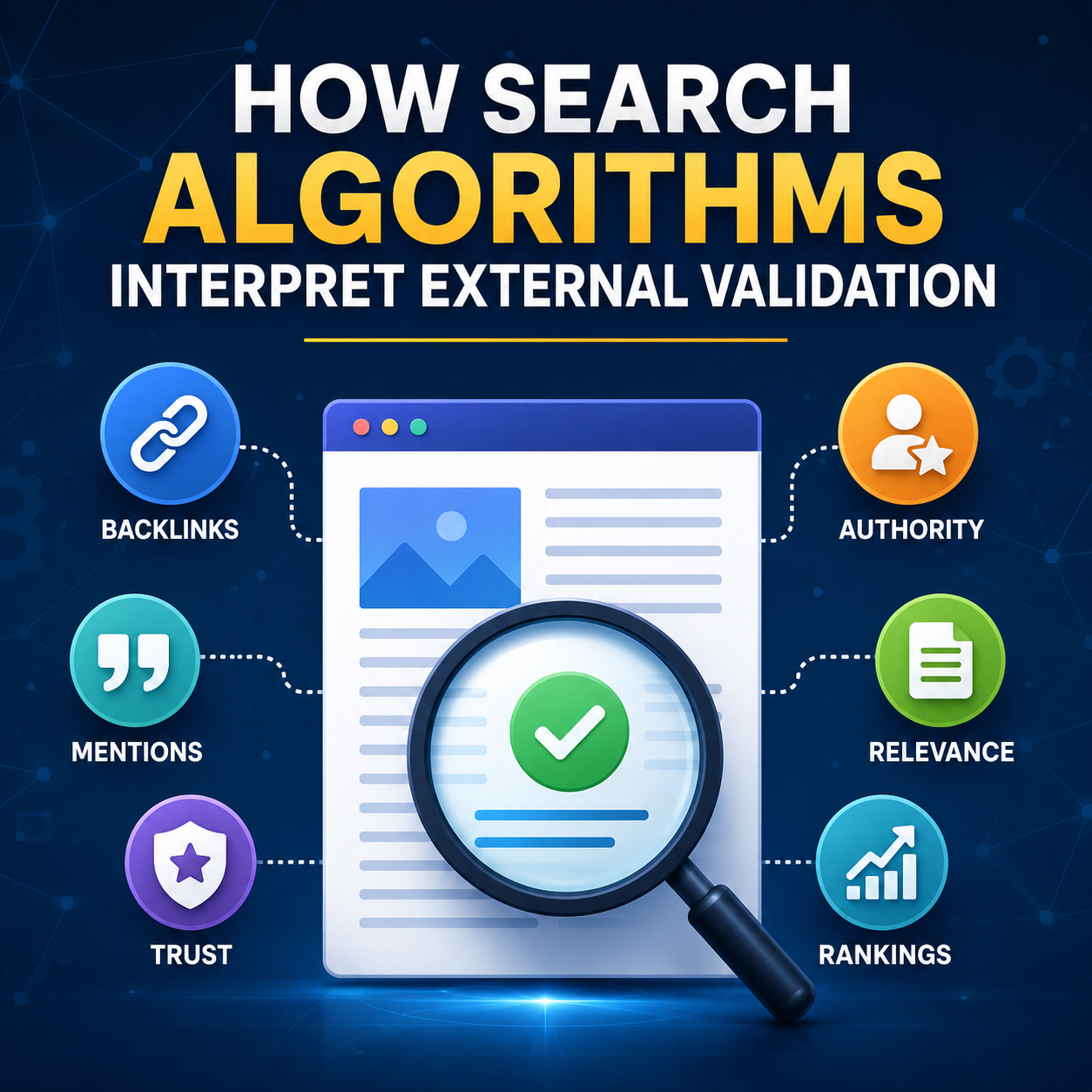
What Is External Validation in SEO?
External validation refers to signals from outside your website that indicate credibility, relevance, and authority. Instead of relying only on what you say about your content, search engines analyze what others say about you.
These signals include:
- Backlinks from other websites
- Mentions of your brand or content
- Citations in relevant industry sources
- Social references and engagement
- Co-occurrence with authoritative domains
In simple terms, external validation is the digital equivalent of reputation.
Why Search Engines Rely on External Signals
Search algorithms are designed to rank content that is not only relevant but also trustworthy. Since anyone can publish content online, search engines need independent verification that a page is valuable.
External validation helps solve three major problems:
1. Credibility Assessment
If multiple trusted websites reference your content, it signals that your information is likely accurate or useful.
2. Spam Reduction
External links and mentions act as filters against low-quality or manipulative content.
3. Authority Mapping
Search engines use external validation to map relationships between websites, industries, and topics.
How Algorithms Evaluate External Validation
Search engines don’t treat all external signals equally. Instead, they evaluate them using multiple layers of analysis.
1. Link Authority
Not all backlinks carry the same weight. A link from a high-authority domain (such as a trusted publication or niche leader) is far more valuable than one from an unknown or low-quality site.
Key factors include:
- Domain authority of the linking site
- Relevance to your niche
- Placement of the link (editorial vs. footer/spam)
- Context surrounding the link
2. Topical Relevance
Algorithms analyze whether the linking site is contextually related to your content. A backlink from a relevant industry site carries stronger validation than a random unrelated source.
For example:
- A marketing blog linking to an SEO article = strong relevance
- A cooking site linking to the same SEO article = weak relevance
3. Link Context and Semantics
Search engines now use natural language processing to understand why a link exists. They examine:
- Surrounding sentences
- Anchor text usage
- Overall topic of the page
This allows algorithms to distinguish between natural editorial links and manipulative placements.
4. Trust Signals of the Linking Domain
External validation is also influenced by the trustworthiness of the linking website itself. Factors include:
- Age of the domain
- Historical content quality
- Backlink profile of the linking site
- Spam history or penalties
Trusted domains pass stronger validation signals.
Mentions Without Links Still Matter
Modern search systems also recognize implied links, often called “linkless mentions.” Even if your brand or content is not hyperlinked, repeated mentions across authoritative sites can still contribute to ranking signals.
This shows how deeply algorithms now analyze web-wide consensus rather than just hyperlink structures.
External Validation and Ranking Power
External validation plays a major role in determining:
- Domain authority
- Page authority
- Keyword competitiveness
- Ranking stability over time
Pages with strong external validation tend to:
- Rank faster
- Recover quicker from algorithm updates
- Maintain long-term visibility
- Outperform newer competitors
In competitive SEO environments, external validation often becomes the deciding factor between pages that rank on page one and those that don’t.
How External Validation Fits Into SEO Strategy
While on-page SEO and technical optimization are important, external validation is often what pushes a page into top positions.
A balanced SEO strategy typically includes:
- High-quality content creation
- Technical optimization (speed, structure, indexing)
- Strategic external validation (links, mentions, citations)
Without external validation, even well-written content may struggle to compete in saturated niches.
Building External Validation Strategically
External validation should not be random. It should be intentional and aligned with your niche authority.
Common strategies include:
- Guest contributions on relevant sites
- Digital PR and outreach campaigns
- Content designed for citation and reference
- Relationship building within your industry
One of the most discussed approaches in SEO is understanding how link acquisition works at a strategic level. For a deeper breakdown of this process, you can explore guides like ours on how to buy backlinks, which examine how backlink strategies are evaluated and applied in competitive markets.
Final Thoughts
Search algorithms interpret external validation as a collective judgment of quality. The more consistent, relevant, and authoritative your external signals are, the stronger your chances of ranking well.
In today’s SEO landscape, content alone is not enough. Visibility is earned through both what you publish and what the web says about it.
Understanding external validation is ultimately about understanding how trust is built at scale—and how search engines decide who deserves to be seen.
Keep reading…
When Authority Becomes a Commodity
The Monthly Backlink Maintenance Checklist for Sustained Rankings