
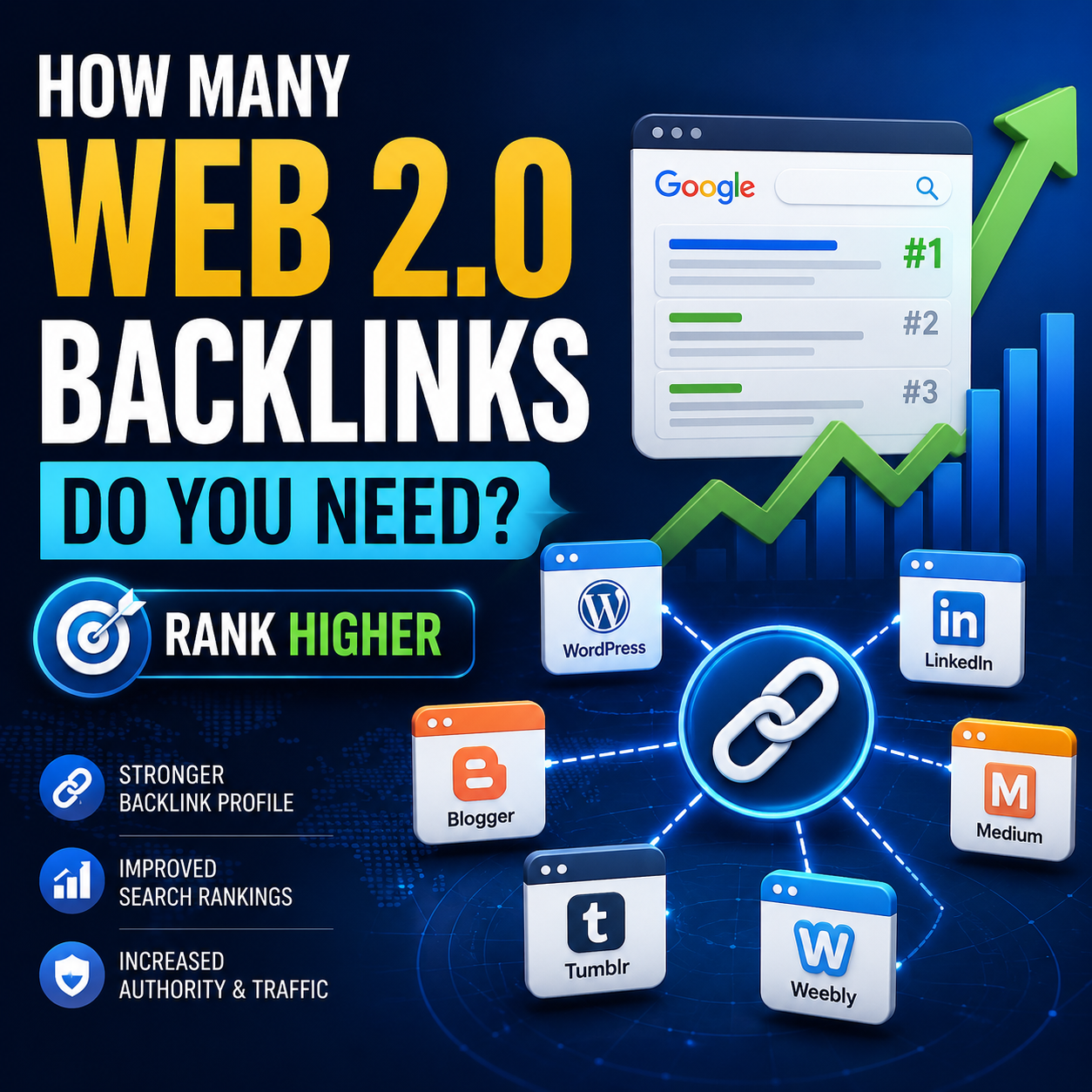
Web 2.0 backlinks have been used in SEO for years because they give website owners a simple way to create supporting content, build topical relevance, and send authority signals to important pages. But one question comes up again and again: how many Web 2.0 backlinks do you actually need to rank higher?
The honest answer is that there is no magic number. Some pages may improve with only a handful of well-built Web 2.0 links, while others may need a larger supporting structure depending on keyword competition, content quality, domain authority, and the strength of competing pages.
The real goal is not to build as many links as possible. The goal is to build enough relevant, natural, and useful Web 2.0 properties to support your main page without making your backlink profile look forced or spammy.
What Are Web 2.0 Backlinks?
Web 2.0 backlinks are links created from user-generated publishing platforms. These can include blogs, mini-sites, content hubs, and profile-based platforms where users can publish their own articles or pages.
When used correctly, Web 2.0 backlinks can help strengthen a page by adding contextual links from relevant supporting content. Instead of placing random links on thin pages, a better strategy is to create useful mini-articles around your target topic and link naturally to your main resource.
For example, if your target page is about Web 2.0 SEO, you could create supporting articles on related topics such as how Web 2.0 properties work, how to diversify anchor text, how to avoid over-optimization, and how to build tiered links safely.
For a deeper breakdown of the full process, you can read this web 2.0 link building guide.
The Best Number Depends on Keyword Competition
The number of Web 2.0 backlinks you need depends heavily on the keyword you are trying to rank for. A low-competition keyword may only need a small number of strong supporting links. A competitive keyword may require a much larger link-building campaign that includes Web 2.0 links, guest posts, niche edits, citations, and other authority signals.
For easy keywords, 5 to 10 quality Web 2.0 backlinks may be enough to create movement. These keywords usually have weaker competition, fewer referring domains, and lower-quality content ranking on page one.
For medium-competition keywords, you may need 10 to 30 Web 2.0 backlinks as part of a broader SEO strategy. In this case, Web 2.0 links should not be your only link source. They should support stronger backlinks and help build topical relevance.
For high-competition keywords, Web 2.0 backlinks alone are rarely enough. You may need 30 or more supporting properties, but they should be combined with higher-authority links, strong content optimization, technical SEO, and consistent site growth.
The key point is that Web 2.0 backlinks should support your SEO campaign, not replace every other ranking factor.
Quality Matters More Than Quantity
Building 100 weak Web 2.0 backlinks on thin, duplicate, or AI-spun content will usually be less effective than building 10 strong Web 2.0 properties with unique content, clean formatting, relevant images, and natural outbound links.
A quality Web 2.0 backlink should come from a page that looks like a real piece of content. It should have a clear topic, useful information, proper headings, and a reason for the link to exist.
The page should not be created just to drop a backlink. It should provide value on its own. This helps make the link look more natural and reduces the risk of creating a footprint that search engines can easily identify.
A strong Web 2.0 property may include:
- A unique article related to your niche
- Natural internal formatting
- One or two relevant authority outbound links
- One contextual link to your target page
- Branded or partial-match anchor text
- Images, videos, or other supporting media
- A complete profile or account setup
When each Web 2.0 page is treated like a real content asset, the backlink becomes much more valuable.
Start Small and Scale Gradually
One of the biggest mistakes people make with Web 2.0 backlinks is building too many too quickly. If a page has very few backlinks and suddenly receives dozens of similar links from newly created Web 2.0 properties, it can look unnatural.
A safer approach is to start small and build gradually. For a new or lower-authority website, you might begin with 5 to 10 Web 2.0 properties over several weeks. Then you can monitor ranking movement, indexing, traffic changes, and keyword improvements.
If the page begins moving upward, you can continue adding more links slowly. If there is no movement, you may need to improve the target page, adjust anchor text, build stronger links, or review the competition.
SEO is not only about link volume. Sometimes a page does not rank because the content does not satisfy search intent, the site lacks topical authority, or competitors have better on-page optimization. Web 2.0 backlinks can help, but they work best when the rest of your SEO foundation is already strong.
Anchor Text Should Look Natural
The number of backlinks is only one part of the equation. Anchor text is just as important.
If every Web 2.0 backlink uses the exact same keyword anchor, it can look over-optimized. A natural backlink profile usually includes a mixture of branded anchors, naked URLs, generic anchors, partial-match anchors, and occasional exact-match anchors.
For example, instead of using the same keyword every time, you can vary your anchors with phrases like:
- Your brand name
- Your website URL
- Learn more here
- This SEO resource
- A related guide on the topic
- Partial keyword variations
Exact-match anchors can still be useful, but they should be used carefully. The more aggressive the keyword, the more careful you need to be with anchor text ratios.
For many campaigns, branded and partial-match anchors are safer than repeatedly using the same exact keyword. This helps your backlink profile look more organic and reduces the chance of triggering over-optimization issues.
Web 2.0 Backlinks Should Be Relevant
Relevance is one of the most important parts of link building. A Web 2.0 backlink from a page about cooking, travel, or fashion will not make much sense if your target page is about SEO. The content around the link should match the topic of your target page.
If your pillar content is about Web 2.0 backlinks, your supporting articles should cover closely related SEO topics. These might include backlink building, content marketing, tiered link building, link diversity, authority building, or ranking strategies.
Relevant content helps search engines understand why the link exists. It also makes the page more useful for readers. A contextual link placed inside a relevant paragraph is far stronger than a random link placed at the end of unrelated content.
Indexing Also Matters
A Web 2.0 backlink cannot help much if the page is never indexed. Many people create Web 2.0 properties and assume the links will automatically count, but that is not always the case.
To improve indexing chances, make sure each Web 2.0 page has unique content and does not look abandoned. You can also add supporting content, share the page socially, build tiered links to the Web 2.0 property, or interlink related Web 2.0 assets where appropriate.
However, avoid blasting low-quality links at your Web 2.0 properties. The purpose is to strengthen them, not create another layer of spam. A few relevant tier-two links can help, but the overall structure should still look natural.
A Practical Web 2.0 Backlink Plan
If you are unsure where to start, a simple plan is best.
For a low-competition page, begin with 5 to 10 high-quality Web 2.0 properties. Each property should have a unique article of at least several hundred words, natural anchor text, and relevant supporting content.
For a medium-competition page, build 10 to 30 Web 2.0 backlinks over time. Spread them out gradually and vary your anchor text. Combine them with other link types to avoid relying on one backlink source.
For a competitive keyword, use Web 2.0 backlinks as part of a larger authority-building campaign. You may need more supporting properties, but they should be built carefully and mixed with stronger backlinks from relevant websites.
The safest approach is to build, wait, measure, and adjust. Rankings do not always move instantly, and adding more links is not always the answer. Sometimes improving your content, adding internal links, or updating on-page SEO can produce better results than building another batch of backlinks.
Signs You May Need More Web 2.0 Backlinks
You may need more Web 2.0 backlinks if your page is already well-optimized but stuck outside the top results. If your competitors have stronger backlink profiles and more topical support, additional Web 2.0 links may help close the gap.
You may also need more links if your website is new and lacks authority. In this case, Web 2.0 properties can help create a foundation, but they should be built alongside other trust signals.
Another sign is when your page ranks for long-tail keywords but struggles with the main target keyword. This often means Google understands the topic but does not yet see enough authority to rank the page higher for more competitive terms.
Signs You Should Stop Building and Improve the Page
More Web 2.0 backlinks will not fix every SEO problem. If your target page has thin content, poor structure, slow loading speed, weak search intent alignment, or no internal links, building more backlinks may not solve the issue.
Before increasing your link volume, review the page itself. Make sure the content answers the search query better than competing pages. Add useful headings, improve readability, include examples, and strengthen internal linking.
A strong page with fewer backlinks can often outrank a weak page with more backlinks. Link building works best when the destination page deserves to rank.
Final Answer: How Many Do You Need?
Most websites should start with 5 to 10 quality Web 2.0 backlinks for low-competition keywords, 10 to 30 for medium-competition keywords, and a larger supporting strategy for competitive keywords.
But the number is not the most important factor. The quality, relevance, indexing, anchor text diversity, and timing of your Web 2.0 backlinks matter far more than simply hitting a target number.
If you want better rankings, focus on building Web 2.0 properties that look real, read naturally, and support your pillar content with useful information. Build slowly, track results, and combine Web 2.0 backlinks with strong on-page SEO and a diverse link-building strategy.
The best Web 2.0 backlink strategy is not about creating the most links. It is about creating the right links in the right way.
Keep reading…
How to Build Powerful Web 2.0 Backlinks Without Getting Penalized