
Link building remains one of the most important parts of SEO, but not every backlink strategy delivers the same results. Two popular methods that often get compared are Web 2.0 backlinks and guest posts. Both can help improve visibility, build authority, and support keyword rankings, but they work in different ways.
Some website owners prefer Web 2.0 backlinks because they offer more control over content, anchor text, and publishing speed. Others prefer guest posts because they can provide stronger authority when placed on relevant, established websites. The real question is not simply which method is “better,” but which one works better for your goals, budget, and SEO strategy.
In this article, we will compare Web 2.0 backlinks and guest posts, explain their strengths and weaknesses, and help you decide how to use them effectively.
What Are Web 2.0 Backlinks?
Web 2.0 backlinks are links created on user-generated publishing platforms. These platforms often allow users to create free blogs, pages, or profiles where they can publish content and link back to their main website.
Examples of Web 2.0-style platforms may include blogging networks, content-sharing sites, and free publishing platforms. The main advantage is that you can create your own supporting content and place contextual backlinks inside it.
A smart web 2.0 backlink strategy focuses on quality, relevance, and natural content rather than simply creating as many links as possible.
What Are Guest Posts?
Guest posts are articles published on someone else’s website. Usually, you write a useful article for a blog or niche website, and in return, you receive a backlink to your site within the content or author bio.
Guest posting is often seen as a more authority-driven link building method because the backlink comes from an existing website that may already have traffic, rankings, trust signals, and topical relevance.
However, guest posts usually require more outreach, negotiation, writing, editing, and sometimes payment. This makes them more time-consuming than Web 2.0 backlinks.
Control: Web 2.0 Backlinks Offer More Flexibility
One major advantage of Web 2.0 backlinks is control. You can usually decide the topic, structure, anchor text, link placement, and publishing schedule. This makes Web 2.0 properties useful for supporting pillar pages, building topical relevance, and diversifying your backlink profile.
With guest posts, you have less control. The website owner or editor may change your content, limit your anchor text, restrict your link placement, or reject promotional links altogether. While this can result in a more natural and editorial link, it also means you cannot always shape the backlink exactly how you want.
For SEOs who want flexibility and fast implementation, Web 2.0 backlinks can be attractive.
Authority: Guest Posts Usually Have the Edge
When it comes to raw authority, guest posts often have an advantage. A backlink from an established, niche-relevant website can carry more weight than a link from a newly created Web 2.0 page.
This is because guest post links are placed on domains that may already have backlinks, indexed pages, organic traffic, and topical trust. A strong guest post can send both SEO value and referral traffic.
Web 2.0 backlinks, on the other hand, usually start with little page-level authority. Even if the platform itself is trusted, your newly created page may need time, content, and supporting links before it gains value.
So, if your goal is to get high-authority links from established sites, guest posting is usually stronger.
Cost: Web 2.0 Backlinks Can Be More Budget-Friendly
Web 2.0 backlinks are often more affordable because many platforms are free to use. The main investment is time: creating accounts, writing content, formatting posts, and maintaining the properties.
Guest posts can be more expensive. You may need to pay for content creation, outreach tools, placement fees, or agency services. In competitive niches, quality guest post placements can become costly.
For smaller websites, startups, affiliate projects, and local businesses, Web 2.0 backlinks can be a useful entry-level link building method. They allow you to build supporting links without needing a large outreach budget.
Speed: Web 2.0 Links Are Faster to Build
If you need links created quickly, Web 2.0 backlinks are usually faster. You can create a page, publish content, and add your backlink without waiting for editor approval or email responses.
Guest posting is slower. You need to find prospects, contact site owners, pitch topics, write the article, wait for review, and then wait for publication. This process can take days, weeks, or even months.
That said, faster does not always mean better. Speed is useful, but link quality, relevance, and indexing still matter.
Risk: Both Methods Need to Be Used Carefully
Both Web 2.0 backlinks and guest posts can be risky if used carelessly.
Low-quality Web 2.0 backlinks can look spammy if the content is thin, duplicated, over-optimized, or created only for links. Publishing hundreds of weak Web 2.0 pages with exact-match anchors can harm your backlink profile rather than help it.
Guest posts can also be risky if they are placed on poor-quality sites, link farms, private blog networks, or websites that publish unrelated sponsored content. A guest post is not automatically valuable just because it appears on another domain.
The safest approach is to focus on relevance, quality content, natural anchor text, and link diversity.
Content Quality Matters for Both
A common mistake is treating link building content as disposable. Whether you are creating a Web 2.0 post or a guest post, the content should still be useful, readable, and relevant.
For Web 2.0 backlinks, strong content helps the page look more natural and increases the chance of indexing. For guest posts, good content improves your chances of acceptance and makes the link more valuable.
Thin content, spun articles, keyword stuffing, and irrelevant topics can weaken both strategies.
Anchor Text Control: Web 2.0 Backlinks Are Easier to Manage
Anchor text is another key difference. With Web 2.0 backlinks, you usually have full control over the anchor text. This allows you to use branded anchors, partial-match anchors, naked URLs, and carefully selected keyword variations.
Guest posts may not offer the same freedom. Editors often prefer branded or natural anchors and may reject exact-match keyword anchors. While this can be frustrating, it can also make the backlink look more organic.
A balanced anchor text profile is important. Overusing exact-match anchors from either Web 2.0 backlinks or guest posts can create an unnatural pattern.
Indexing and Longevity
Guest posts are often easier to index because they are published on established websites that search engines already crawl frequently. If the website is active and well-structured, your guest post may be discovered quickly.
Web 2.0 backlinks may take longer to index, especially if the page is new and has no internal or external links pointing to it. Some Web 2.0 pages may also lose value over time if they are abandoned, deleted, or left without updates.
To improve longevity, Web 2.0 properties should be treated like mini-content assets rather than throwaway links.
Which Method Works Better for New Websites?
For new websites, Web 2.0 backlinks can be useful because they are accessible, affordable, and easy to control. They can help create early link diversity and support important pages while the site is still growing.
However, relying only on Web 2.0 links is not ideal. New websites also need stronger trust signals, and guest posts can help provide those signals when placed on relevant websites.
A good approach for new sites is to use Web 2.0 backlinks as supporting links while gradually building guest posts, citations, niche edits, digital PR links, and other authority-building backlinks.
Which Method Works Better for Competitive Niches?
In competitive niches, guest posts usually perform better because stronger authority links are often needed to compete. If your competitors have backlinks from real websites with traffic and topical relevance, basic Web 2.0 links may not be enough.
That does not mean Web 2.0 backlinks are useless. They can still support your link building structure, diversify your backlink profile, and strengthen secondary pages. But for highly competitive keywords, guest posts are often the stronger option.
The Best Strategy: Use Both Together
The strongest answer is not always Web 2.0 backlinks or guest posts. In many cases, the best strategy is to use both.
Guest posts can act as authority links, helping your website gain trust and relevance from established domains. Web 2.0 backlinks can act as supporting links, helping reinforce topical signals and provide additional contextual backlinks to important pages.
When used together, they can create a more natural and balanced backlink profile.
For example, you might use guest posts to link directly to your most important commercial or pillar pages. Then, you can use Web 2.0 properties to support informational content, branded pages, or secondary assets. This layered approach can help create a stronger overall SEO structure.
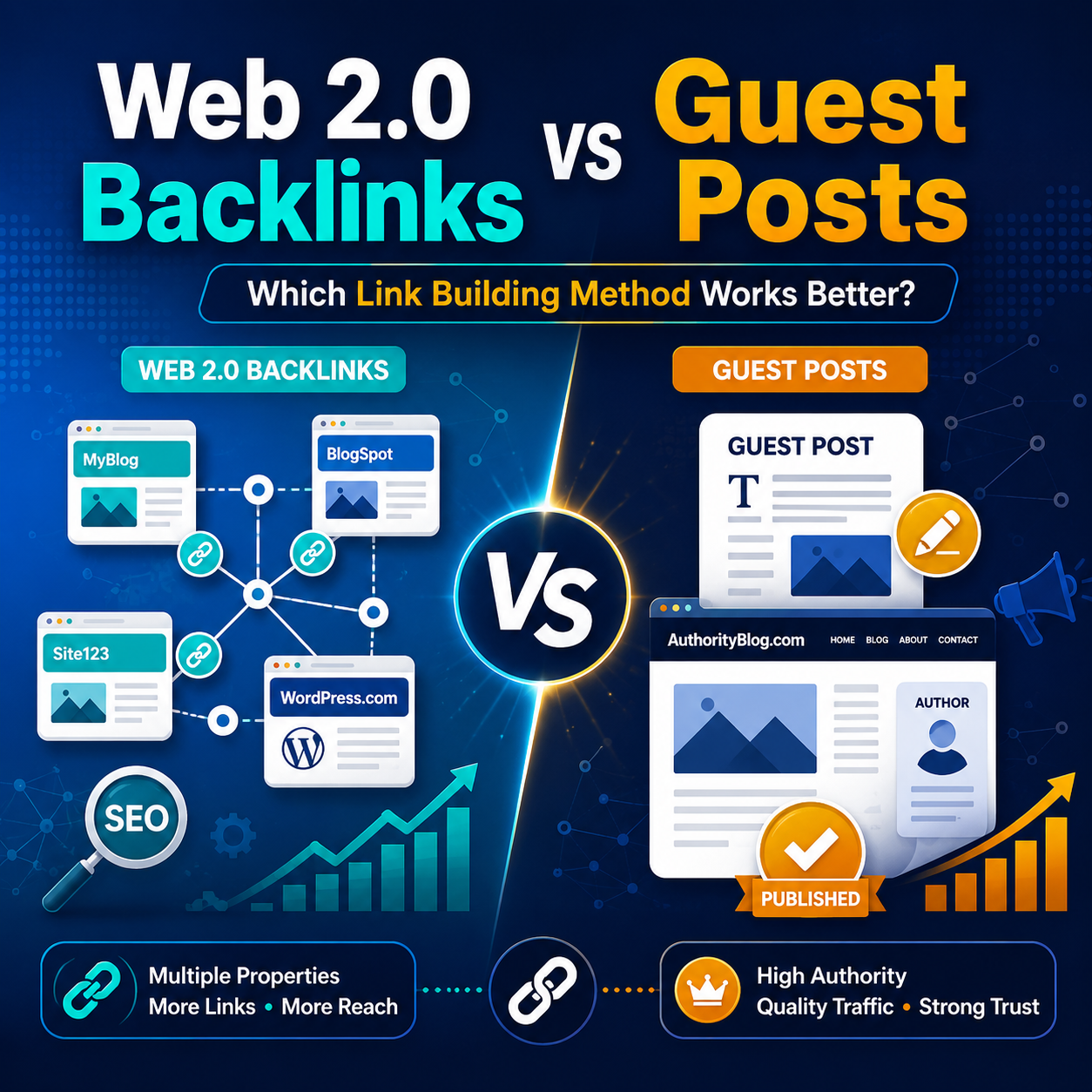
Web 2.0 Backlinks vs Guest Posts: Quick Comparison
Web 2.0 backlinks are best for control, affordability, speed, and supporting content structures. They are useful when you want to build contextual links with carefully chosen anchors and topics.
Guest posts are best for authority, trust, referral traffic, and niche relevance. They are better suited for websites that need stronger links from established domains.
Neither method should be abused. Both work best when the content is high quality, the links are relevant, and the overall backlink profile looks natural.
Final Verdict: Which One Works Better?
Guest posts usually work better when your goal is to build authority and compete for difficult keywords. A high-quality guest post from a relevant website can be more powerful than a basic Web 2.0 backlink.
However, Web 2.0 backlinks still have value when used properly. They are cost-effective, controllable, and useful for building supporting links around pillar content. They can be especially helpful for newer websites, content clusters, and SEO campaigns that need link diversity.
The best link building method depends on your strategy. If you want authority, invest in guest posts. If you want control and supporting relevance, use Web 2.0 backlinks. If you want the strongest long-term results, combine both methods carefully and focus on quality over quantity.
In SEO, the method matters, but execution matters more. A well-written, relevant Web 2.0 backlink can outperform a poor guest post. Likewise, a strong guest post on a trusted niche website can deliver results that most Web 2.0 links cannot match. The key is to build links that make sense, support your content, and help search engines understand your website’s relevance and authority.
Keep reading…
What Are Web 2.0 Backlinks and Why Do They Still Matter for SEO?
Are Web 2.0 Backlinks Still Effective for Ranking Websites?
How to Use Web 2.0 Backlinks to Strengthen Your SEO Strategy