
You’ve paid someone to build you a website. It looks great, it’s got pictures of your best work, your telephone number is plastered across the top, and you’ve even got a contact form.
There’s just one problem.
Nobody is visiting it.
You search Google for the services you offer in your local area and find three or four competing businesses sitting at the top. Some of them have websites that look like they haven’t been touched in ten years.
So why are they getting all the work?
Having a website and getting people to visit it are two completely different things.
The good news is that you don’t need to throw thousands of pounds at an advertising agency to start generating enquiries through Google.
Whether you’re a builder, plumber, electrician, roofer, plasterer, carpenter or landscape gardener, I’m going to show you where to start, what to spend your money on and, perhaps more importantly, what not to waste it on.
You can do a fair amount of this yourself.
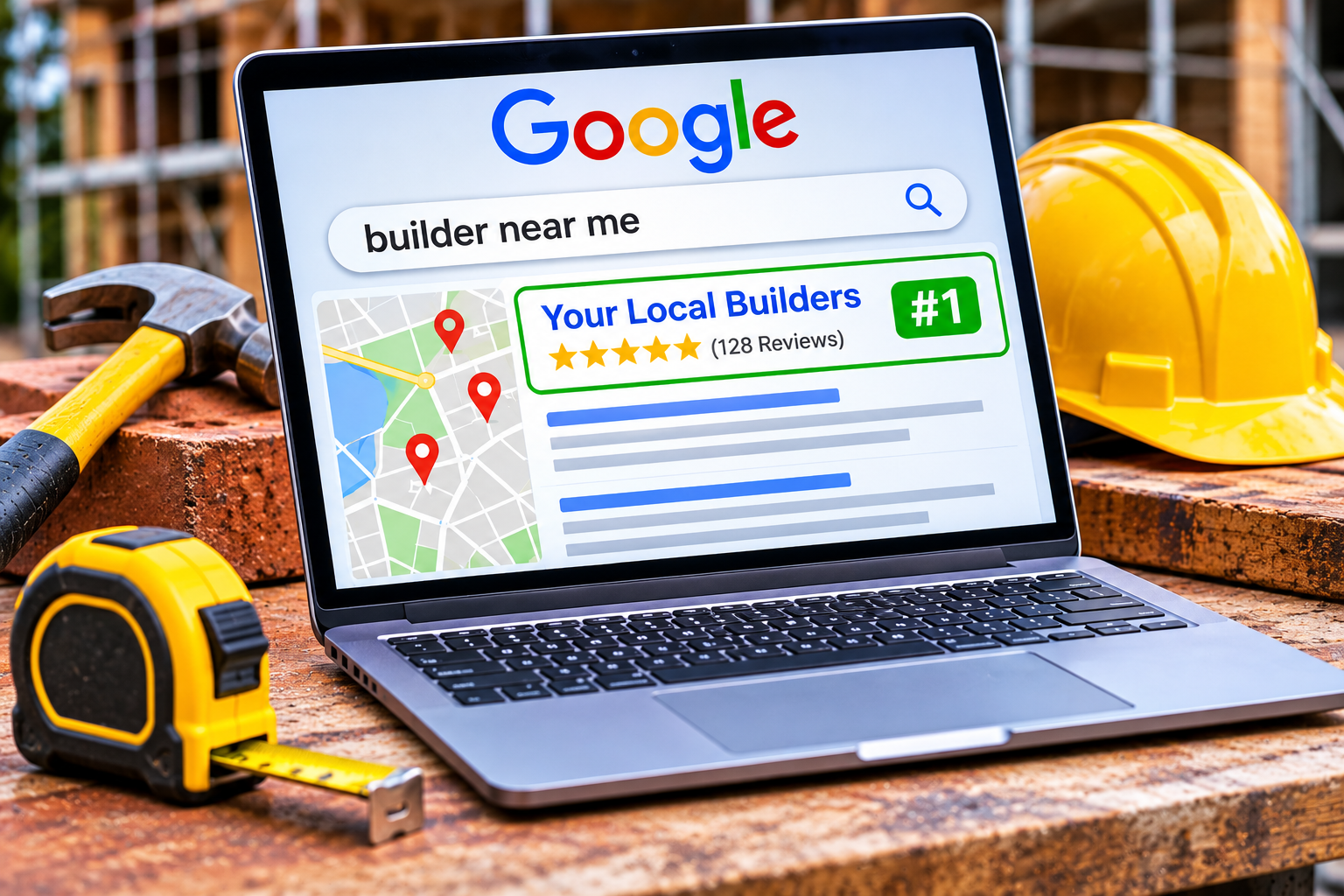
What Is SEO for Tradesmen?
Search engine optimisation (SEO) is the process of improving your website and its online presence so that potential customers can find your business through search engines such as Google.
For a tradesperson, the objective is straightforward.
You want your telephone to ring.
You don’t need 100,000 people visiting your website from all corners of the world. You need people who live within travelling distance of your business and are looking to pay somebody to carry out a job.
There is a huge difference between somebody searching for pictures of garden patios and somebody searching for a patio installer in Leeds.
One is looking for inspiration. The other could be your next paying customer.
This is where local search engine optimisation comes into play.
Get your business in front of the right people at the right time, and even a relatively small amount of website traffic can generate a decent return.
Why Your New Trade Website Isn’t Getting Any Traffic
A common mistake small business owners make is assuming that their web designer has taken care of everything.
They haven’t necessarily done anything wrong. You’ve paid them to build a website, and that’s what they’ve delivered.
Unless search engine optimisation was included in the agreement, getting that website to rank is another job entirely.
Think of it like buying a van.
You can have the nicest van in town, but if you leave it parked in your garage, nobody is going to see your business name on the side.
A website works much the same way.
Here are some of the reasons your competitors might be getting traffic while you aren’t:
-
Their websites have been established for longer.
-
Other websites mention and link to their businesses.
-
They have more detailed pages covering individual services.
-
Their Google Business Profiles are properly optimised.
-
They have accumulated genuine customer reviews.
-
Their website content matches what potential customers are searching for.
-
Google hasn’t discovered or indexed all your pages yet.
You can address many of these issues without having a massive marketing budget.
The trick is knowing which jobs to tackle first.
How Much Is a Number One Google Ranking Worth to a Tradesman?
Forget website traffic for a minute and think about money.
Let’s say you’re a builder offering house extensions, garage conversions and general building work.
Imagine your website generates the following results each month.
| Monthly performance | Example |
|---|---|
| Relevant website visitors | 300 |
| Visitors making an enquiry | 5% |
| Monthly enquiries | 15 |
| Enquiries converted into jobs | 20% |
| New jobs | 3 |
| Average job value | £2,500 |
| Additional monthly revenue | £7,500 |
These are hypothetical figures, not guaranteed results, but they demonstrate why you don’t necessarily need thousands of visitors.
Three decent jobs could make an enormous difference to a small building company.
Now compare that with spending money on advertising every month, where the traffic generally stops when you stop paying for clicks.
Organic search visibility can continue bringing people to your website after the initial work has been completed, although maintaining rankings usually requires ongoing attention.
That’s what makes SEO attractive to small businesses.
Step 1: Make Sure Your Website Is Actually on Google
Before spending a penny on marketing, establish whether Google knows your website exists.
Head over to Google and type the following into the search box, replacing the example domain with your own.
site:yourwebsite.co.uk
If your pages appear, Google has indexed at least some of your website.
If nothing comes back, don’t panic. A new website can take time to be discovered, and this search isn’t a comprehensive indexing report.
The next thing to do is register your website with Google Search Console.
It’s completely free.
Once you’ve verified ownership of your domain, you can submit your XML sitemap, inspect individual pages and request indexing.
Search Console will also show you which keywords are generating impressions and clicks.
I would get this set up before doing anything else.
There is little point building links to pages that are accidentally blocked from being indexed.
Step 2: Set Up Your Google Business Profile
If you’re a local tradesperson and haven’t claimed your Google Business Profile, you’re overlooking one of the most useful free marketing opportunities available to your business.
When somebody searches for a local plumber or electrician, Google frequently displays a map alongside a selection of nearby businesses.
These listings can generate telephone calls, website visits and enquiries without the customer having to scroll through the traditional search results.
Make sure your profile contains accurate information, including:
-
Your genuine business name.
-
Your primary business category.
-
Your telephone number.
-
Your website address.
-
Your operating hours.
-
The areas you serve.
-
Photographs of completed work.
-
A description of your services.
If you operate from home and travel to customers rather than receiving them at your address, you can generally configure your profile as a service-area business and hide your residential address.
Don’t create fake offices in towns where you want to rank.
Don’t stuff your business name with keywords either.
Google has specific guidelines for representing your business, and getting your listing suspended is the last thing you want.
Step 3: Target Keywords That Actually Generate Work
This is where a lot of small business websites get it wrong.
Let’s say you run a roofing company in York.
You might think ranking for the keyword “roofing” would be brilliant.
But what happens when somebody in London, Birmingham or Manchester finds your website?
Unless you’re prepared to travel hundreds of miles to replace a few roof tiles, that traffic isn’t particularly useful.
I’d much rather target somebody searching for an emergency roof repair ten minutes down the road.
Here are some examples of keywords worth investigating.
| Trade | Potential customer searches |
|---|---|
| Builder | Builders in Leeds, house extension builders |
| Plumber | Emergency plumber York, local boiler repairs |
| Electrician | Electrician near me, consumer unit replacement |
| Roofer | Roof repairs Scarborough, flat roof replacement |
| Landscaper | Garden landscaping Harrogate, patio installers |
| Carpenter | Local carpenter, fitted wardrobe installation |
| Plasterer | Plasterers in Hull, ceiling plastering |
| Painter | House painters near me, exterior decorating |
| Tiler | Bathroom tilers, kitchen tile installation |
| Driveway installer | Block paving installers, driveway resurfacing |
These are examples of commercially relevant searches, rather than verified search-volume figures.
You can investigate demand using Google Keyword Planner and look at the suggestions Google provides when you start typing a service into its search box.
Don’t dismiss a keyword simply because it has a relatively low monthly search volume.
A search that generates a £15,000 house extension is potentially worth considerably more than a thousand visitors reading an article about different types of bricks.
Step 4: Give Every Important Service Its Own Page
I’ve seen plenty of small business websites that consist of a homepage, an about page, a contact page and one services page containing everything the company does.
That’s not much for Google to work with.
If you’re a builder offering six different services, consider creating six dedicated pages.
Your website structure might look something like this:
| Page | Primary purpose |
|---|---|
| Homepage | Local building company |
| /house-extensions/ | House extension enquiries |
| /garage-conversions/ | Garage conversion enquiries |
| /loft-conversions/ | Loft conversion enquiries |
| /brickwork/ | Bricklaying and repairs |
| /property-renovations/ | Renovation projects |
| /garden-walls/ | Garden wall construction |
| /contact/ | Quotations and enquiries |
Each page gives you an opportunity to appear in Google for a different set of relevant searches.
Don’t just write 200 words saying you’re the best builder in town.
Show people what you can do.
Include photographs, explain the process, discuss likely costs where possible and answer questions customers regularly ask before requesting a quote.
You’ve probably answered those questions hundreds of times over the telephone.
Get those answers onto your website.
Your practical knowledge is something a generic directory listing cannot easily replicate.
Step 5: Optimise Your Website Without Making It Read Like Spam
You don’t need to mention your target keyword 50 times on a page.
Nobody wants to read a paragraph that says:
Looking for a builder in Leeds? Our builders in Leeds are the best builders in Leeds for anybody requiring a builder in Leeds.
It looks ridiculous.
If you’re creating a page targeting house extensions in Leeds, a sensible approach would be:
| SEO element | Example |
|---|---|
| Page title | House Extensions Leeds – Local Builders & Free Quotes |
| H1 heading | House Extension Builders in Leeds |
| URL | /house-extensions-leeds/ |
| Meta description | Extend your home with experienced local builders. View completed projects and request a free house extension quote in Leeds. |
From there, write naturally about the service.
Explain what types of extensions you build, the areas you cover, what affects the cost and how somebody can arrange a quotation.
Make sure your telephone number is easy to find, particularly on mobile devices.
Getting somebody onto your website is only half the battle. You need to make it easy for them to become a customer.
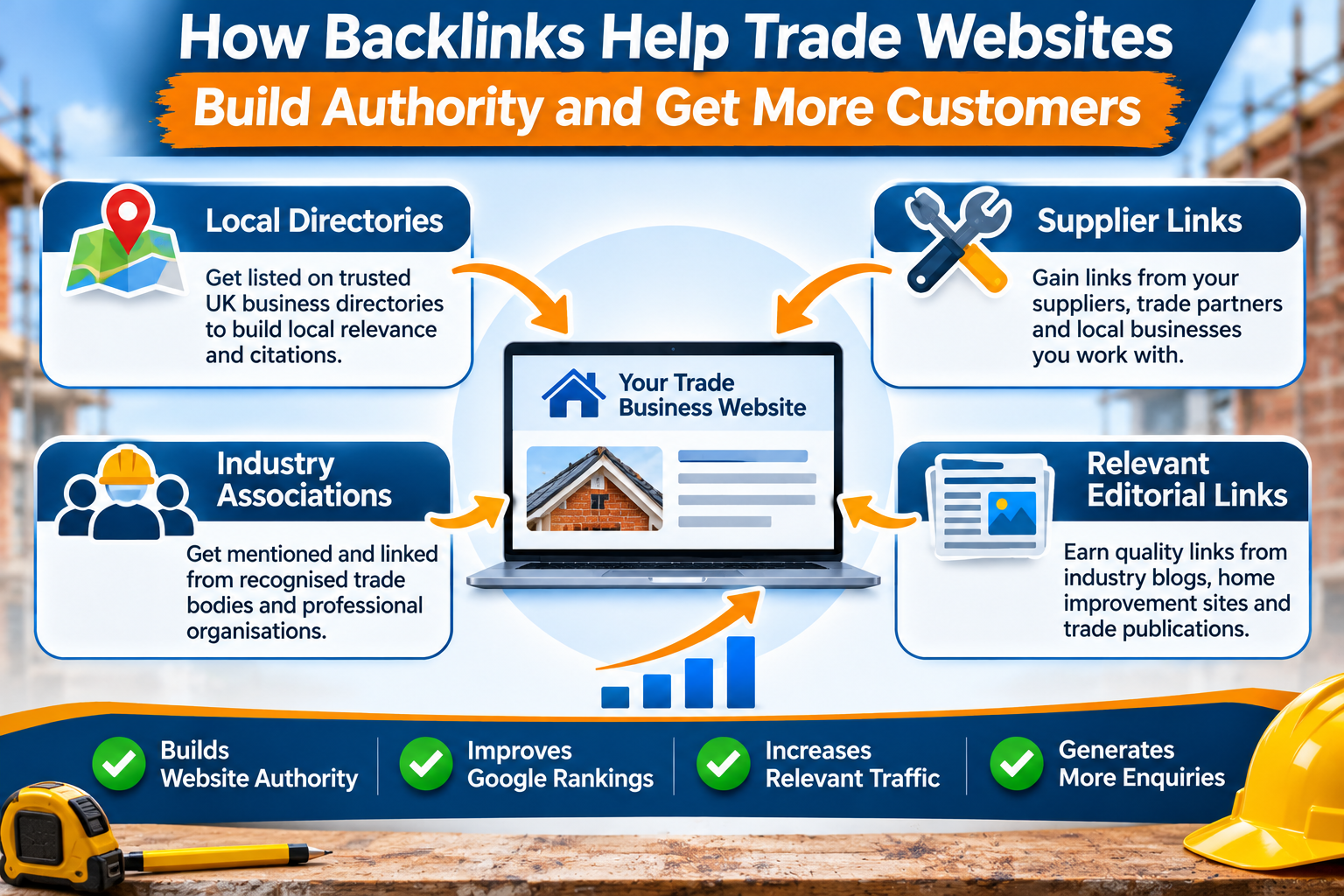
Step 6: Get Your First Backlinks Without Spending Any Money
Now we get to the part that can make a difference to your organic search visibility.
Backlinks.
A backlink is simply a clickable link from another website to your own. Relevant, editorially earned links can help Google discover your content and understand its authority.
Think of it as somebody recommending your business.
If you’ve just launched your website, chances are you’ve got very few other websites linking to it.
You don’t necessarily have to spend money to change that.
Start by looking at the business relationships you already have.
Do you purchase materials from a local builders’ merchant? Are you registered with a trade association? Do you work alongside other local businesses? Have you completed work for a local organisation?
All of these could present opportunities to get your business mentioned online.
Here are some websites and organisations worth investigating:
| Website or organisation | Opportunity |
|---|---|
| Yell | UK business listing |
| Bing Places | Business search visibility |
| FreeIndex | Business profile |
| Yelp | Local business listing |
| Federation of Master Builders | Accredited builder directory |
| TrustMark | Registered trade business listing |
| Local Chamber of Commerce | Regional business exposure |
| Local newspapers | Business features and project coverage |
| Suppliers | Customer showcases and case studies |
| Industry associations | Professional business listings |
Some listings require paid membership, registration or proof of qualifications.
Don’t sign up for hundreds of irrelevant directories simply to get a link. Start with places where your potential customers might actually look for your services.
Step 7: Build Free Websites That Promote Your Business
This is one of the methods I’ve covered extensively here on Rankers Paradise.
There are several platforms that allow you to create a website or publish articles without paying for hosting.
Examples include:
-
WordPress.com
-
Blogger.com
-
Wix.com
-
Tumblr.com
-
Weebly.com
-
Google Sites
-
Medium.com
-
Strikingly.com
You could use one of these platforms to publish useful information about your trade and include a reference to your main business website where appropriate.
Let’s say you’ve just completed a garage conversion.
Take some photographs of the finished project and write an article explaining what was involved, how long the work took and what the homeowner gained from having the conversion done.
Within that article, you could direct interested readers to the garage conversion page on your website.
That’s a simple example of an external content link.
I’ve published a detailed tutorial on how to create web 2.0 backlinks, which includes platform instructions and historical keyword ranking experiments.
You can work through the guide yourself if you have some spare time.
The important thing is to publish something worth reading. Creating dozens of empty websites purely to manipulate Google’s ranking systems can do more harm than good.
Do Web 2.0 links actually work?
I’ve documented several experiments involving these types of websites over the years.
In my original Web 2.0 link wheel tutorial, I recorded a first-page ranking on the opening day and a number-one ranking for my chosen search term around 30 days later.
Those were the results of that particular experiment. They are not a guarantee that repeating the process with a building company’s website will produce identical results today.
Search competition, content quality, website history and Google’s treatment of links all influence what happens.
You can take a look at my published tests and make your own assessment before deciding where to spend your time.
Step 8: Should Tradesmen Buy Backlinks?
Not everybody has the time to sit at a computer writing articles and contacting website owners.
If you’ve spent eight hours laying bricks, the chances are you don’t particularly fancy spending another three hours doing website promotion.
This is where outsourcing can make sense.
Before you buy backlinks, however, you need to understand what you’re purchasing.
There is a massive difference between getting your business featured on a genuine home improvement website and having your domain dropped into thousands of automated comments.
Look beyond the number of links advertised.
I would want to know the following before purchasing a service:
-
What types of websites will feature my business?
-
Are those websites relevant to my industry?
-
Do they publish useful content?
-
Are the placements accessible to real readers?
-
Which pages on my website will receive the links?
-
Will I receive a report showing the completed work?
-
How will paid placements be disclosed?
It’s also worth reading Google’s spam policies regarding links.
Google considers purchasing links for the purpose of manipulating search rankings to be link spam. Paid advertising placements should be appropriately qualified using the sponsored or nofollow link attribute.
There is no such thing as a completely risk-free paid ranking shortcut.
If you’re paying somebody to promote your website, make sure you understand the strategy rather than simply handing over your money and hoping for the best.
Step 9: Get Your Business Featured in Existing Articles
Imagine somebody has written an article about the cost of building a house extension.
The article has been online for several years, receives visitors through Google and discusses different construction options.
Now imagine your business being mentioned as a useful resource within that article.
That is the basic concept behind a niche edit.
Rather than publishing a completely new article, a website owner updates an existing piece of content to include a relevant reference.
For a tradesperson, suitable topics could include:
| Your business | Relevant article topic |
|---|---|
| Roofing company | How to spot a leaking roof |
| Building contractor | Planning a house extension |
| Landscaping company | Garden makeover ideas |
| Electrician | When to replace a consumer unit |
| Plumber | Common causes of low water pressure |
| Carpenter | Maximising storage in small bedrooms |
| Painter and decorator | Preparing exterior walls for painting |
The advantage of an existing article is that it may already have an established readership.
A brand-new article has to build its audience from scratch.
If you decide to buy niche edits, pay particular attention to the relevance and quality of the actual page where your business will appear, rather than relying entirely on domain authority scores.
A specialist home renovation website with a modest authority score could offer better business exposure than an enormous website covering subjects that have absolutely nothing to do with your trade.
Paid placements remain subject to Google’s link qualification guidelines.
Step 10: Use Guest Posts to Showcase Your Knowledge
You probably know more about your trade than most people writing articles about it online.
Use that to your advantage.
Guest posting involves contributing an article to another website. It gives you an opportunity to demonstrate your knowledge to a new audience and introduce readers to your business.
If you’re an electrician, you could contribute an article covering common warning signs of outdated electrical installations.
A roofing contractor could explain the differences between various flat roofing materials.
A builder might discuss the mistakes homeowners make when budgeting for an extension.
These are subjects that potential customers are interested in.
You don’t need to write an article that reads like a sales brochure. Give people something useful and allow the quality of your advice to establish your credibility.
If you haven’t got the time to organise outreach, you can buy guest posts through a managed service.
Look for publishers operating within relevant industries, such as construction, property, architecture, interior design and home improvement.
A well-placed article can introduce your business to customers who might never have discovered your website otherwise.
Which Type of Backlink Should a Tradesman Get First?
If I were putting together a website promotion plan for a newly established building business, I wouldn’t spend the entire budget on one type of placement.
Different websites offer different benefits.
| Link type | Main benefit | Typical cost |
|---|---|---|
| Local business citations | Business discovery and consistent contact information | Free or paid |
| Supplier links | Relevant business recommendations | Often free |
| Trade association listings | Professional credibility | Membership fees may apply |
| Web 2.0 content | Additional publishing opportunities | Often free |
| Editorial niche edits | Exposure within established content | Free or paid |
| Guest articles | Reaching relevant audiences | Free or paid |
| Local press coverage | Regional publicity | Free or paid |
I’d start with the opportunities that are free and directly connected to the business.
Once those are in place, I’d consider investing in broader promotion.
Remember, a backlink should ideally have a purpose beyond increasing a number inside an SEO reporting tool.
Don’t Get Hung Up on Domain Authority
You will probably come across the terms DA and DR when you start researching backlinks.
DA stands for Domain Authority, a metric developed by Moz.
DR stands for Domain Rating, a metric developed by Ahrefs.
Neither is an official Google ranking factor.
They can be useful when comparing websites, but they don’t tell you everything.
Let’s say you’ve got the opportunity to get your building company mentioned on a respected local property website with a DA of 25.
You also have the opportunity to purchase a placement on a DA 80 website that publishes articles about everything from cryptocurrency to dog food.
Which website is more likely to introduce your business to somebody looking for a builder?
That’s the question I’d be asking.
Check the subject matter, the quality of the content, the intended audience and the reputation of the publisher.
Don’t let a big number make the decision for you.
Step 11: Turn Every Completed Job Into Website Content
This is something tradespeople have a massive advantage with.
You’re constantly creating new material for your website without even realising it.
Every kitchen fitted, roof repaired, garden redesigned or extension completed can become a useful piece of content.
You don’t need to sit down and think up complicated blog post ideas.
Your everyday work is the content.
Example: A builder completing a house extension
Instead of uploading three photographs to Facebook and forgetting about them, create a dedicated project page on your website.
Give it a title such as:
Single-Storey Rear Extension in Leeds – From Unused Garden Space to a Family Kitchen
Then explain:
-
What the customer wanted to achieve.
-
What the property looked like beforehand.
-
The materials used.
-
Any challenges encountered.
-
How long the project took.
-
What the finished extension looked like.
-
What factors influenced the cost.
Add original photographs with the customer’s permission and include a link to your main house extension service page.
You’ve now created a piece of content that another builder cannot legitimately reproduce.
Do this across several completed projects and your website gradually becomes a portfolio of genuine experience.
It also gives potential customers a reason to trust you.
Step 12: Get More Google Reviews From Existing Customers
When did you last employ somebody to carry out work on your house without checking their reputation?
Most people want reassurance before handing over their money.
Genuine customer reviews can help provide it.
Google also confirms that review quantity and positive ratings can contribute to local search prominence, alongside other factors such as relevance and distance.
You can read Google’s explanation of how local rankings are determined.
The easiest time to ask for a review is shortly after completing a job.
The customer is happy with the result, everything is fresh in their mind and your business is still familiar to them.
You could send a simple message:
Hi, thanks again for choosing us to carry out the work. If you’re happy with everything, we’d really appreciate it if you could spare a minute to leave us a Google review. It makes a big difference to a small local business like ours.
Include your Google review link when you send it.
Don’t purchase fake reviews, offer discounts in exchange for positive ratings or ask friends to review work you’ve never carried out.
Build your reputation properly.
It takes longer, but you end up with something valuable.
Step 13: Create Internal Links Across Your Website
Before spending money getting links from other websites, make better use of the website you’ve already got.
Internal links connect one page on your website to another.
For example, if you’ve written an article explaining how much a garage conversion costs, link from that article to your garage conversion service page.
If you’ve published photographs of a completed patio installation, link back to your landscaping services.
This helps visitors navigate your website and gives Google additional context about the relationship between your pages.
Here’s how a simple structure might work.
The pages responsible for bringing in paying customers should receive plenty of relevant internal links.
Don’t leave an important service page buried somewhere on your website with nothing linking to it.
This is one of the easiest improvements you can make, and it won’t cost you anything.

SEO for Builders: A Practical Example
Let’s put everything together using a fictional building company based in Scarborough.
The company has just launched a website, employs three people and wants to generate more enquiries for house extensions and property renovations.
It has a limited marketing budget and cannot afford to spend thousands on advertising.
Here’s how I would approach it.
| Task | Action |
|---|---|
| Website indexing | Register with Google Search Console and submit sitemap |
| Local visibility | Complete Google Business Profile |
| Keyword research | Identify relevant construction searches in Scarborough |
| Service pages | Create individual pages for extensions and renovations |
| Project content | Publish three completed job case studies |
| Local listings | Register on suitable UK directories |
| Business reviews | Contact previous satisfied customers |
| Backlink acquisition | Approach suppliers, trade websites and local publishers |
| Internal linking | Connect project articles to commercial service pages |
| Performance monitoring | Track enquiries, clicks and search positions |
Notice that sending thousands of backlinks to the homepage isn’t the first thing on the list.
Get your foundations right.
There’s little point spending money directing people to a website that doesn’t properly explain what you do or make it easy to request a quotation.
How Much Does SEO for Tradesmen Cost in the UK?
You don’t necessarily need a huge monthly marketing budget.
The amount you should spend depends on your location, the services you offer, the strength of your competition and how quickly you’re looking to grow.
A self-employed plumber operating in a small town may face considerably less competition than a building contractor targeting central London.
Here are some illustrative budgeting options.
| Monthly budget | What you could prioritise |
|---|---|
| £0 | DIY optimisation, business listings, reviews and outreach |
| £50–£150 | Selected outsourced optimisation and promotional tasks |
| £150–£300 | Entry-level ongoing SEO support |
| £300–£750 | Broader content production, outreach and website improvements |
| £750–£1,500+ | More comprehensive campaigns in competitive markets |
These are suggested planning budgets rather than surveyed UK market averages or fixed package quotations.
If you’re just getting started, I would establish what a new customer is worth to your business before deciding how much to invest.
A roofer making £1,500 gross profit from a job only needs one additional customer to cover several months of a modest SEO budget.
A small decorating company might need several extra enquiries to achieve the same return.
Work out your own numbers.
Calculate how many jobs you need to cover your SEO costs
Trade Business SEO Return Calculator
Find out how many extra jobs you need to cover your monthly SEO investment.
Gross Profit Per Job
Jobs Needed to Cover SEO
Estimated Enquiries Needed
Revenue From Those Jobs
Ready to Get More Customers?
Put your website to work and start building your organic Google visibility.
Illustrative estimates based on your inputs. Excludes additional overheads and tax. Results are not guaranteed.
Illustrative estimates based on your inputs. Excludes additional overheads and tax. Not a prediction of ranking or enquiry results.
With a £300 monthly marketing budget, an average job value of £2,500 and a gross profit margin of 30%, just one additional job would generate £750 in gross profit.
Deduct the £300 marketing expenditure and you’re left with £450 before other overheads and tax.
That’s a much more useful way of evaluating an SEO service than simply asking how many backlinks you’re getting for your money.
How Long Does SEO Take to Work for a New Trade Website?
This is usually one of the first questions people ask.
There isn’t a fixed answer.
I’ve published ranking experiments here on Rankers Paradise where individual keywords moved considerably within a few weeks. Other campaigns can take several months before producing meaningful results.
A new website competing against established local businesses needs time to develop its content, reputation and search visibility.
Here’s a sensible example of what the first six months of work could involve.
| Period | Primary focus |
|---|---|
| Month 1 | Indexing, keyword research and website optimisation |
| Month 2 | Service page expansion, local listings and reviews |
| Month 3 | Project content, outreach and performance analysis |
| Month 4 | Improving pages receiving impressions but few clicks |
| Month 5 | Expanding relevant content and business mentions |
| Month 6 | Evaluating enquiries, revenue and campaign profitability |
Don’t interpret this as a promise that you’ll reach page one within six months.
It is a work plan, not a ranking forecast.
Some keywords will move faster than others. You may also discover that a particular service generates more profitable enquiries than the one you initially planned to promote.
Use the data to decide where your next investment should go.
SEO vs Google Ads for Tradesmen
Should you pay Google for advertising or invest in organic rankings?
There are advantages to both.
| Feature | Organic SEO | Google Ads |
|---|---|---|
| Traffic generation | Builds over time | Can begin shortly after campaign approval |
| Payment for clicks | No direct organic click charge | Usually charged per click |
| Long-term visibility | Can continue after work is completed | Generally stops when advertising stops |
| Budget control | Based on work undertaken | Daily campaign budget |
| Ranking certainty | No guaranteed positions | Depends on auction and campaign settings |
| Best use | Building sustainable visibility | Generating immediate exposure |
If you’ve just started a business and urgently need work, advertising might help you generate visibility while your organic search presence develops.
If you’re looking to reduce your dependence on paid advertising over time, investing in your website makes sense.
You don’t have to choose one exclusively.
A combination can work well, provided you measure what each channel is actually delivering.
How to Check Whether Your SEO Is Working
Don’t rely entirely on somebody sending you a monthly spreadsheet containing hundreds of keywords and backlink URLs.
What you want to know is whether your business is moving in the right direction.
There are several free tools you can use to check.
Google Search Console
Use this to monitor organic Google search impressions, clicks, keyword positions and indexing issues.
Keep an eye on pages that are receiving an increasing number of impressions but haven’t started generating many clicks.
They may be worth improving.
Google Analytics
Google Analytics can help you understand what visitors do after arriving on your website.
Set up appropriate tracking for contact form submissions and telephone link clicks, alongside any required privacy and consent measures.
A telephone link click does not necessarily mean a completed call, so compare the figures with your actual business records.
Google Business Profile performance
Your business listing provides performance information that can help you understand how people discover and interact with it.
Monitor calls and website interactions where these metrics are available.
Your own enquiry records
This is arguably the most important part.
When somebody contacts you, ask where they found your business.
Keep a simple record of the enquiry, quotation value and whether the customer went ahead with the job.
You can then calculate what your marketing is contributing to your business rather than getting distracted by visitor numbers alone.

Seven SEO Mistakes Tradesmen Should Avoid
1. Targeting an entire country when you only serve one town
You don’t need website traffic from places where you’re unable to carry out work.
Concentrate on the geographical areas that are commercially viable.
2. Buying the cheapest backlinks you can find
Thousands of links from irrelevant, low-quality websites aren’t necessarily going to help your business.
Understand what you’re buying and why before paying for any service.
3. Copying another builder’s website content
Another company has different projects, customers and experience.
Use your own knowledge, original photographs and genuine business information to create something more useful.
4. Expecting immediate rankings
You cannot force Google to rank a new website at number one overnight.
Give your strategy time and assess progress using meaningful data.
5. Creating dozens of identical location pages
Changing the town name on duplicated pages doesn’t make each page genuinely useful.
Create dedicated regional pages only where you can offer meaningful information about serving that location.
6. Ignoring mobile users
Somebody searching for an emergency plumber is unlikely to sit down at a desktop computer.
Make sure your website loads properly on a mobile phone and that contacting your business is straightforward.
You can check your website performance using Google PageSpeed Insights.
7. Paying for traffic without measuring enquiries
More visitors don’t automatically mean more jobs.
Track your leads and completed sales before deciding whether a marketing campaign is delivering value.
A 30-Day DIY SEO Plan for Tradesmen
If you haven’t got a marketing budget yet, don’t use that as an excuse to leave your website sitting there doing nothing.
Here’s what you can start doing yourself.
30-day website promotion checklist
0 of 16 complete
Week 1 – Get the foundations right
Week 2 – Improve your content
Week 3 – Promote your business
Week 4 – Outreach and monitoring
Copy checklist
Most of these tasks can be completed without paying an SEO company.
If you’re prepared to spend a few evenings working on your website, you can get a surprising amount done.
Once work starts coming in and your time becomes more valuable elsewhere, you can decide which parts of the process to outsource.
Should You Hire an SEO Company or Do It Yourself?
That depends on how much spare time you’ve got and what you want to achieve.
There’s absolutely nothing stopping a self-employed builder from learning search engine optimisation.
I’ve published numerous tutorials on Rankers Paradise for people who want to work on their own websites without paying somebody else to do it.
Take a look at my guide to free backlinks if you want to explore additional website promotion opportunities.
However, there comes a point where you need to consider what your time is worth.
If you earn £250 a day carrying out building work, spending two working days every month on website marketing effectively costs you £500 in potentially lost revenue.
Outsourcing selected tasks could make financial sense.
At Rankers Paradise, you can choose individual website promotion services or ongoing SEO support depending on your budget and requirements.
You don’t necessarily need the biggest package available.
Start with what your website actually needs and expand your investment when the results justify doing so.
What to Look for When Choosing an SEO Company for Your Trade Business
Before employing an SEO provider, have a look at its own website.
Can you find it through Google?
Does it publish useful information?
Can it demonstrate previous results?
Does it explain what work will be carried out?
Would you employ a builder who couldn’t show you any examples of their workmanship?
Apply the same common sense when choosing somebody to promote your website.
Ask about reporting, content quality, link acquisition methods and realistic expectations.
Be particularly cautious of companies promising guaranteed number-one rankings for every keyword imaginable.
Nobody outside Google controls the organic search results.
You should know exactly what you’re paying for and be able to evaluate the work that has been completed.
Frequently Asked Questions About SEO for Tradesmen
Is SEO worth it for a small building company?
It can be extremely valuable when the campaign targets relevant services and profitable geographical areas. Building projects often carry substantial contract values, meaning that a relatively small number of additional customers could justify the marketing expenditure.
Can I get my trade website to rank on Google for free?
Yes. Creating helpful website content, optimising service pages, completing your business listing, acquiring legitimate mentions and improving internal links can all be done without paying an agency.
You will still need to invest your time.
Do plumbers and electricians need SEO?
Any trade business relying on local customers can benefit from improved search visibility. Emergency services can be particularly dependent on appearing when nearby customers urgently require assistance.
How many backlinks does a new trade website need?
There is no universal number. It depends on the search terms you’re targeting, your competition, the quality of your website and the relevance of your existing links.
Some low-competition searches can rank without much external promotion.
Can I rank on Google without paying for advertising?
Yes. Organic search results are separate from Google Ads. Paying for advertising does not directly improve your organic rankings.
Is Facebook enough to promote a trade business?
Facebook can be useful for generating recommendations and showcasing completed work. However, relying entirely on one social platform limits your ability to reach customers who search directly through Google.
Your own website gives you greater control over your business’s online presence.
Do I need to write blog posts for my building company?
You don’t need to publish articles every day. A collection of detailed service pages, completed project case studies and useful answers to common customer questions can be a much better starting point than producing endless generic blog content.
Can I do SEO myself without technical knowledge?
You can complete many important tasks without knowing how to code. Writing service descriptions, gathering reviews, publishing project photographs, registering with relevant directories and contacting local organisations are all accessible starting points.
Should I pay for monthly SEO?
Ongoing support can be worthwhile if you lack the time to maintain your website and promote your business. Evaluate the service against measurable business objectives rather than assuming a monthly payment guarantees improved rankings.
What is the cheapest way to get more traffic to a new website?
Start with free tools and methods. Make sure your pages are indexed, complete your Google Business Profile, publish useful service content and pursue relevant business mentions.
Spend money once you’ve established which areas require professional assistance.
Can a small local builder outrank a large national company?
Yes, particularly for geographically specific searches. A local business may offer more relevant information, genuine regional experience and stronger proximity to the person carrying out the search.
However, results vary depending on the query and competition.
Get Your Trade Website Working as Hard as You Do
You didn’t pay for a website so that it could sit on the internet collecting dust.
You paid for it because you wanted more customers.
The difference between a website that generates enquiries and one that nobody visits often comes down to the work carried out after it has been launched.
Start with your service pages.
Get your business listed in the right places. Show people the work you’ve completed. Collect genuine customer reviews. Build relationships with relevant publishers and businesses.
Keep an eye on what’s happening in Google Search Console and put more effort into the pages that show potential.
You can do much of this yourself, and you don’t need to spend a fortune getting started.
If you haven’t got the spare time, take a look at the website promotion services available in the Rankers Paradise SEO shop.
We have options for newly established websites as well as businesses looking to expand their existing search visibility.
SEO for tradesmen isn’t about getting the biggest traffic figures or collecting the most backlinks. It’s about getting your business in front of the people who are ready to employ you.
Your next customer could already be searching Google for the exact service you provide.
Give them a chance to find you.