
Let’s be honest: everybody wants to rank #1 on Google, but nobody wants to burn thousands of dollars a month on premium outreach services if they don’t have to. I get it. I’ve been in the SEO game for years, and the temptation to buy cheap backlinks is always sitting right there.
The real secret? The price isn’t actually the problem. You can absolutely find low-cost links that pack a serious punch. The real killer is the footprint.
If you head over to cheap marketplaces or forums and buy a package promising “10,000 wiki and forum links for $10,” you aren’t building a ranking strategy. You are building a one-way ticket to a manual action penalty. If you point that automated garbage directly at your money site, Google’s spider will flag it before the week is out.
But can you actually buy cheap backlinks without footprints? Yes, you can. But you have to know exactly how to vet the links, how to get them indexed fast, and more importantly, where to point them.
Here is exactly how I handle budget link building to safely drive rankings without getting caught in a footprint trap.
What is an SEO Footprint Anyway?
Think of a footprint as a digital fingerprint left behind by sloppy automation. It’s a dead giveaway that tells the Google search spider: “Hey, this site is buying fake, low-quality links to manipulate our algorithm.”
When budget sellers blast out links, they leave massive, obvious clues. According to the official Google Spam Policies, manipulating rankings through link schemes can lead to a site being completely removed from search results. The most common cheap link footprints look like this:
-
Identical Anchor Text Distribution: If you have 500 new links and every single one uses the exact phrase “best weight loss supplement,” it looks incredibly unnatural. Real people don’t link to websites like that.
-
The C-Class IP Overlap: Cheap PBNs (Private Blog Networks) or automated link farms usually host hundreds of blogs on the exact same server or under the same C-Class IP range. You can easily track these footprints using tools like Ahrefs or Majestic.
-
Thin, Spun Content: If your link is surrounded by unreadable, AI-spun garbage on a page with zero traffic and zero indexation, Google simply ignores it—or penalizes the site it’s pointing to.
-
The Sudden Velocity Spike: Going from zero links to 5,000 links in 24 hours is a massive red flag. Real traffic climbs organically; spam happens in a single burst.
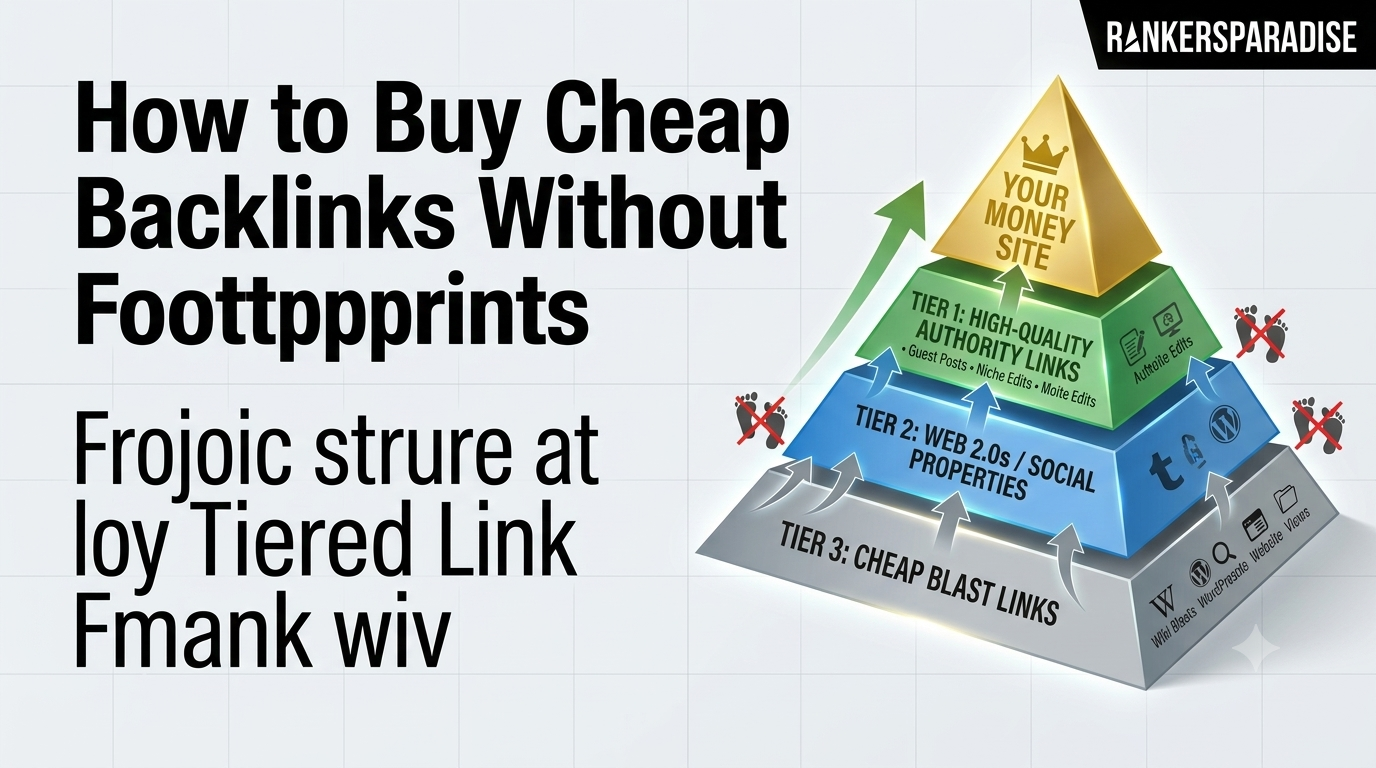
The Framework: The Tiered Link Structure
If you take nothing else away from this guide, remember this cardinal rule: You never point cheap, automated links directly at your money site.
Instead, we use a Tiered Link Framework to isolate the risk while keeping 100% of the ranking power. This creates a powerful buffer between the spam and your actual business. When you are ready to invest in your main profile, you can safely buy backlinks directly for your Tier 1 layer, but the cheap stuff stays at the bottom.
[Tier 3: Cheap Blast Links]
          │
          ▼
[Tier 2: Web 2.0s / Social Properties]
          │
          ▼
[Tier 1: High-Quality Authority Links]
          │
          ▼
   [YOUR MONEY SITE]
Tier 1 (The Inner Circle)
These are the links that touch your money site directly. They must be clean, contextual, and highly relevant. We’re talking hand-written guest posts, high-quality niche edits, and foundational brand profiles.
Tier 2 (The Buffer Layer)
This is where we build out a powerful layer of Web 2.0 sites and social properties. These are real, high-authority domains that Google already trusts. To get the best results, you should structure these assets into a web 2.0 link wheel to pass maximum power down the line. You write decent content here and link them to your Tier 1 pages or directly to your money site.
Tier 3 (The Power House)
This is where you fire your cheap backlinks. You buy those massive budget link packages and point them directly at your Tier 2 Web 2.0 sites.
Why? Because the high authority of domains like Tumblr or WordPress absorbs the spam footprint. If Google decides those Tier 3 links are junk, it just ignores them. Your Web 2.0 might lose a little steam, but your money site stays completely safe and untouched. Meanwhile, the raw juice from those thousands of cheap links filters through the buffer and pushes your rankings up.
Setting Up Your Tier 2 Buffer to Index Fast
A cheap link is completely worthless if Google doesn’t know it exists. Because Google has gotten much stricter about indexation, your Tier 2 properties need to look like real, standalone websites, or the spider will ignore them entirely.
-
Vary Your Platforms: Don’t just stick to WordPress. Spread your Tier 2 layer across multiple platforms. Mix in Tumblr, Blogger, and high-authority profiles to build a diverse footprint. You can even utilize a solid list of free backlinks to seed these properties with initial authority.
-
Establish Semantic Entity Alignment: Google reads pages based on entities (topics and concepts) rather than just raw keywords. Make sure the articles on your Tier 2 sites use relevant LSI (Latent Semantic Indexing) terms that closely tie into your money site’s niche.
-
Interlink the Buffer: Don’t let your Web 2.0s sit on isolated islands. Lightly link them to one another before they pass power to your Tier 1 links. This mimics how a real community of bloggers interacts on the web.
How to Vet a Cheap Seller Before You Buy
If you’re going to browse forums or marketplaces for low-cost links, you can’t just buy blindly. You need to grill the seller to make sure their setup won’t ruin your buffer sites. Here is my exact vetting checklist:
1. Demand Anchor Text Control
If a seller doesn’t let you choose your anchor text, walk away immediately. To keep things looking entirely human-written, you need to use a heavy “Pillow Layer.” This means when you buy a batch of links, you structure them like this:
-
70% Naked URLs & Brand Anchors: (e.g.,
https://yoursite.comorBrand Name) -
20% Generic Phrases: (e.g.,
click here,visit website,source) -
10% Exact/Partial Match Keywords: (e.g.,
cheap dog food tips)
This distribution looks completely organic to the Google spider, hiding the fact that the links were bought.
2. Avoid “Spinner” Content Packages
Ask the seller: “Are these articles generated by old-school paragraph spinners?” If the text looks like a robot had a stroke while reading a dictionary, the page won’t even get indexed. You want the content to at least be readable and semantically aligned with your niche so that Google associates the link with your actual entity. For a breakdown on how to keep your contextual layers safe, check out our guide on how to use web 2.0 sites for backlinks.
3. Insist on a Drip-Feed Delivery
If you buy a package of 500 links, ask the seller to drip-feed them over 14 to 30 days. You do not want them hitting the web all at once. Gradual delivery mimics real-world sharing and bypasses automated spam filters.
The Secret Tool: Getting Tier 3 Links Indexed
When you are buying links on a budget, sellers rarely do the hard work of getting them indexed. If those 1,000 Tier 3 links stay invisible, your Tier 2 buffer won’t get any power.
To force the Google search spider to crawl your Tier 3 links without spending a fortune, I use specific indexing APIs. If you run your buffer sites on WordPress, you can hook up the Rank Math Instant Indexing API to force instant crawls on your Tier 2 layer. For the massive bulk Tier 3 links, running them through a dedicated premium indexing service or drip-feeding them through a network of high-crawl-rate indexing sites is the fastest way to get them recognized in Google Search Console.
The Bottom Line on Ranking Easy
At the end of the day, outsmarting the organic SERPs for low-competition long-tails isn’t about avoiding budget tools—it’s about execution.
By using cheap links to power up your Tier 2 buffers, and keeping your Tier 1 anchor profiles completely natural, you get the absolute best of both worlds. You get massive link volume and authority on a shoestring budget, while leaving absolutely zero footprints for the Google spider to trace back to your brand. Keep your money site clean, protect your tiers, and watch your rankings climb.