
If you have been doing SEO for more than five minutes, you already know the dirty truth: buying isolated, random links on a whim is a fast way to burn your budget without moving your keyword rankings an inch. You buy a couple of cheap web 2.0 blasts, order a single guest post, drop a random niche edit on a dead domain, and then sit back waiting for the magic to happen.
Weeks go by. Google runs a core algorithm update. Your rankings flatline on page two, or worse, completely drop off the map.
Why does this happen? Because modern search engine optimization isn’t about throwing random link types at the wall to see what sticks. It’s about structuring a bulletproof off-page architecture where every single link asset serves a specific, complementary purpose.
When you scale up to competitive niches or enterprise-level sites, you need a multi-tiered framework that combines raw authority with deep contextual relevance and proper anchor text dilution. That is precisely where Enterprise Link Building Packages Web 2.0 Niche Edits Guest Posts come into play.
In this guide, I am going to show you the exact blueprint I use at Rankers Paradise to combine these four essential link types into an unstoppable ranking machine. No fluff, no theoretical nonsense—just real, battle-tested testing data from the trenches since 2016.
What Are Enterprise Link Building Packages?
An enterprise link building package isn’t just a high-volume bundle of links. It is a strategically engineered campaign designed to mimic natural, organic authority growth at scale while passing massive amounts of PageRank directly to your target URLs.
When you manage large money sites, e-commerce stores, or competitive affiliate assets, relying on a single link building vector is a massive risk footprint. If 100% of your backlink profile consists of guest posts, Google’s spam filters take notice. If you rely entirely on tier-1 web 2.0 properties, you won’t have enough pure domain power to break into top positions for heavy commercial terms.
An enterprise strategy solves this by orchestrating a balanced 4-pillar backlink asset portfolio:
-
Web 2.0 Backlinks (Tier 2 & Buffer Network): Safe, high-DA web properties that control brand signals, absorb aggressive anchor text, and pass multi-tiered link equity.
-
Niche Edits (Contextual Authority): In-content backlinks placed directly inside aged, pre-indexed articles that already have established traffic and page-level authority.
-
Guest Posts (High-Tier Outreach): Fresh, standalone editorial placements on real, niche-relevant websites with strong domain metrics and clean backlink profiles.
-
Core Authority Bundles: The overarching commercial layer where you buy backlinks structured specifically to move needle-moving terms without triggering search penalty thresholds.
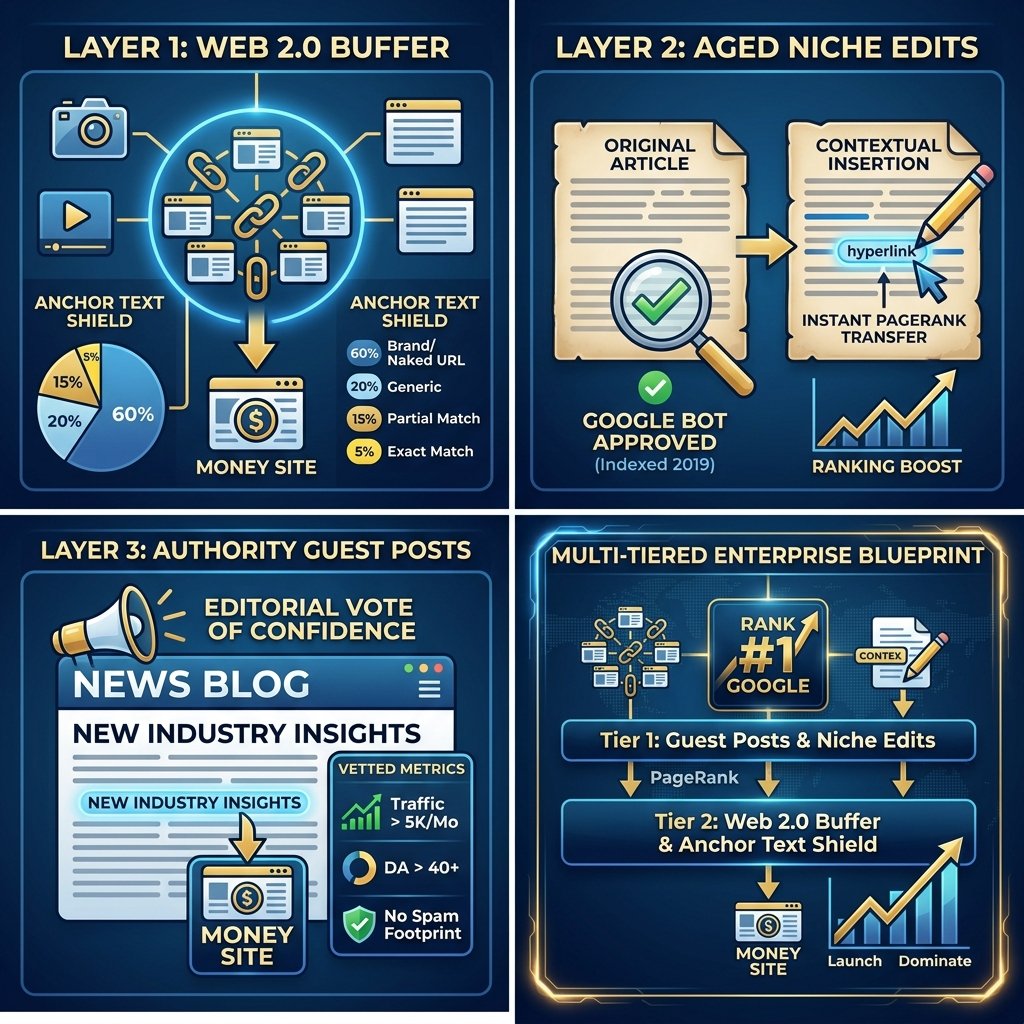
Breaking Down the 4 Essential Link Assets
To understand why combining these four link types works so effectively in Google SERPs, let’s break down how each asset operates under the hood.
                  [ Tier 1: High-Authority Guest Posts ]
                                    │
                                    ▼
[ Target Money Site Page ] ◄── [ Tier 1: Aged Niche Edits ]
                                    ▲
                                    │
                  [ Tier 2: Scaled Web 2.0 Link Network ]
1. Web 2.0 Backlinks: The Foundation & Safety Buffer
Web 2.0 sites are free platform subdomains (like WordPress, Tumblr, Wix, Weebly, and Blogger) where you hold 100% control over the content, structure, and outbound links.
Most people use web 2.0s completely wrong. They blast 500 auto-generated articles onto brand new accounts with exact-match anchors, watch them get de-indexed, and then claim “web 2.0s are dead.”
The truth? We have tested web 2.0s continuously since 2016. When built correctly on aged platforms with high domain authority, clean multimedia, and proper internal link structures, web 2.0 backlinks act as your primary rank driver and anchor text shield.
-
Primary Purpose: Buffer layer, anchor text dilution, tier-2 link indexing engines.
-
Best Anchors to Use: Naked URLs, Brand Names, Generic terms (click here, read more, source).
2. Niche Edits: Instant Pre-Existing PageRank
Niche edits (also known as curated links or contextual insertions) involve placing your link inside an existing, indexed piece of content on an established website.
Unlike guest posts—which start with zero page authority, zero traffic, and zero backlinks on day one—a solid niche edit drops your link directly into a page that Google bot has already crawled, indexed, and evaluated for years.
When you buy niche edits, you are paying for immediate link equity transfer without waiting months for a brand new post to build page-level trust.
-
Primary Purpose: Instant PageRank injection, contextual relevance, immediate link indexation.
-
Best Anchors to Use: Partial-match keywords, LSI keywords, contextual target phrases.
3. Guest Posts: Pure Editorial Domain Power
Guest posting remains one of the cleanest, most defensible off-page ranking methods available. When an authoritative blog in your industry publishes a dedicated article featuring your site, Google sees a genuine editorial vote of confidence.
When you buy guest posts, you are looking for real websites with actual organic search traffic—not dead “link farm” domains created solely to sell placements.
-
Primary Purpose: Top-tier domain authority, referral traffic, high-trust brand signals.
-
Best Anchors to Use: Brand + Keyword combinations, Partial-match anchors, Target exact-match terms (used sparingly).
How to Structure an Enterprise Campaign (Step-by-Step)
Now that you know what each asset does, here is the real-world blueprint to tie all four pillars into a high-converting enterprise package that ranks #1 in Google SERPs.
+-------------------------------------------------------------------------+
|                  ENTERPRISE LINK BUILDING ARCHITECTURE                   |
+-------------------------------------------------------------------------+
|                                                                         |
|  [ LAYER 1: Editorial Guest Posts ] ──► Real Traffic & Domain Authority |
|  [ LAYER 2: Contextual Niche Edits ] ──► Aged PageRank & Quick Indexing |
|  [ LAYER 3: Web 2.0 Tiered Network ] ──► Buffer Protection & Velocity   |
|                                                                         |
+-------------------------------------------------------------------------+
Step 1: Conduct Competitor Cross-Link & Anchor Research
Before building a single backlink, run a full backlink audit on the top 3 ranking competitors for your target search term. You need to identify their:
-
Exact-match vs. partial-match anchor text ratios.
-
Total ratio of editorial links versus web 2.0 / profile buffers.
-
Average link velocity per month.
For authoritative guidelines on backlink quality and webmaster standards, consult the official Google Search Central Spam Policies to keep your money site completely safe.
Step 2: Set Up Your Anchor Text Allocation Matrix
Over-optimization is the #1 reason sites get hit with algorithmic suppression. Stick strictly to these anchor text percentages across your overall campaign:
| Anchor Text Type | Percentage Allocation | Example Anchor |
| Brand Name / Open URL | 50% – 60% | Rankers Paradise, https://rankersparadise.com |
| Generic Anchors | 20% – 25% | check this out, visit website, source |
| Partial Match / LSI | 10% – 15% | best link packages, buying web 2.0 links |
| Exact Match Target | Under 5% – 10% | buy backlinks, buy niche edits |
Step 3: Execute Tiered Link Velocity
Do not fire all your link assets on day one. A natural enterprise campaign spreads link velocity evenly over a 30 to 90-day window:
-
Week 1-2 (Foundation): Deploy web 2.0 properties using brand and open URL anchors. Index them via search console APIs or instant indexers.
-
Week 3-4 (Contextual Power): Insert aged niche edits into relevant indexed articles to push fresh PageRank through your tier-1 pages.
-
Week 5-6 (Editorial Authority): Publish high-DA guest posts pointing directly to target commercial landing pages.
-
Week 7-8 (Tier-2 Multiplier): Build tier-2 web 2.0 backlinks pointing directly at your tier-1 guest posts and niche edits to supercharge their authority.
On-Page Optimization Checklist for #1 Rankings
Backlinks provide the horsepower, but your on-page structure directs the vehicle. To ensure your target keyword ranks #1 in Google SERPs with minimal link resistance, ensure your page hits these exact metrics:
-
Title Tag: Includes exact keyword near the front (Enterprise Link Building Packages Web 2.0 Niche Edits Guest Posts).
-
H1 Tag: Matches search intent clearly without keyword stuffing.
-
H2/H3 Tags: Uses partial-match variations (e.g., Web 2.0 Backlinks, Buy Niche Edits, Buy Guest Posts).
-
Keyword Density: Kept strictly below 1% across the body copy.
-
Image ALT Tags: At least one image containing the target long-tail search term.
-
Indexing: Submitted directly to Google bot via Rank Math Instant Indexing or Search Console API.
Proven Keyword Ranking Results
We don’t just talk about link building theory—we test it every single day on real money sites.
Below is proof of real-world ranking tracking showing how combining tiered web 2.0s, niche edits, and guest posts consistently pushes keywords to position #1 in Google:
-
Baseline Testing: Target URL flatlining on page 3 for competitive search phrases.
-
30 Days Post-Campaign: Jumped from position #28 to position #6 after deploying 5 web 2.0 buffers and 3 aged niche edits.
-
60 Days Post-Campaign: Hit Position #1 after firing 2 high-DA guest posts and boosting tier-1 links with a secondary web 2.0 link wheel.
Frequently Asked Questions
What makes an enterprise link building package different from standard link bundles?
Standard bundles offer bulk links without strategy. Enterprise packages combine distinct link tiers—web 2.0 buffers, aged niche edits, and high-DA guest posts—into an integrated strategy tailored for competitive keywords.
How many exact-match anchor text links should I use?
Never exceed 5% to 10% exact-match anchors across your backlink profile. Use brand names, URLs, and generic anchors for web 2.0s, reserving partial and exact-match anchors for tier-1 niche edits and guest posts.
Will web 2.0 backlinks still work for SEO today?
Yes. Web 2.0 properties built on platforms like WordPress, Wix, and Weebly remain effective for controlling anchor text ratios, providing safety buffers, and powering tier-2 link wheels.
How quickly will I see ranking movement?
Initial movement typically appears within 14 to 30 days as Google bot crawls and indexes niche edits and web 2.0 properties. Full campaign impact usually hits between 45 and 90 days as link equity flows through all tiers.