
Look, let’s cut straight to the chase. If you go to a cheap freelance marketplace right now and search for “mixed backlinks,” you’ll find thousands of shady vendors offering 10,000 links for five bucks.
And if you point that garbage at your money site, your rankings will tank faster than a lead balloon.
I’ve been testing off-page SEO in the trenches since 2016 through Rankers Paradise. Over a decade of trial and error—watching Google’s core updates shred spam and rewarding genuine editorial relevance—has taught me one immutable truth: Google doesn’t hate mixed backlinks; Google hates unnatural patterns.
When you build a truly balanced, diversified backlink profile, you aren’t relying on a single trick. You’re blending foundational properties, aged authority insertions, and fresh editorial content into a single, cohesive ecosystem that looks 100% natural to search crawlers.
If you want to know how to structure a winning campaign, pick the right packages, and safely buy backlinks without getting penalized, grab a coffee. Here is the exact blueprint.

What Are Mixed Backlinks? (And Why Single-Source Link Building Is Dead)
Years ago, you could rank a website by spamming comment sections or spinning thousands of low-tier web directory submissions. Those days are long gone.
Today, if all your incoming links look identical—for example, 500 guest posts with exact-match anchor text appearing overnight—Google’s spam detection algorithms trip instantly.
A mixed backlink campaign solves this by combining different tiers and types of link assets into one structured footprint:
-
Foundation Links: Web 2.0 properties, social profiles, and bookmarking networks that establish early brand signals, absorb heavy anchor text ratios, and pass baseline trust.
-
Contextual Power Links: High-traffic niche edits (link insertions) placed inside aged, indexed articles that already hold keyword rankings.
-
Editorial Trust Links: Brand-new guest posts written from scratch on relevant industry blogs that bring fresh referral traffic and topical authority.
When you blend these ingredients correctly, you create a natural link velocity curve that mimics organic growth.
The Four Pillars of a High-Performing Mixed Backlink Profile
To make a mixed link strategy work, you have to understand how each component functions inside your overall link architecture. Here is how I break down the core elements when building campaigns on Rankers Paradise.
1. Web 2.0 Backlinks (The Foundation Layer)
Before you start throwing heavy, expensive guest posts at a brand-new or freshly optimized URL, you need a solid foundation.
Web 2.0 platforms (like WordPress.com, Medium, and Tumblr) act as your buffer layer and brand anchors. When done manually with unique content, they create a diversified IP footprint that absorbs the bulk of your branded and naked URL anchors.
-
The Strategy: Never spam them. Treat every Web 2.0 property like a real micro-blog. Add images, interlink them intelligently, and let them age.
-
Read the complete guide: Learn the exact mechanics in my tutorial on how to use web 2.0 sites for backlinks.
2. Niche Edits (Fast Authority on Aged URLs)
If you want to move rankings on competitive commercial keywords fast, waiting six months for a new blog post to gain traction is a waste of time. This is where link insertions come into play.
A niche edit (or link insertion) places your backlink inside an existing, already-indexed article on an authoritative site.
-
Why it works: The page already has Google trust, historical rankings, and organic traffic flowing through it. When you drop a relevant contextual link into that article, juice flows to your money page almost immediately.
-
What to watch out for: Make sure the hosting site has clean organic traffic metrics in tools like Ahrefs or Semrush and isn’t a recycled PBN (Private Blog Network) dripping with outgoing spam.
-
Ready-made power: Explore our curated inventory when you buy niche edits directly from our store.
3. Guest Posts (Fresh Editorial Relevance)
While niche edits leverage past authority, guest posting gives you complete control over fresh, hyper-targeted editorial context.
Writing a custom, high-value article for a relevant industry blog lets you naturally embed your link within the body text, surrounded by semantically related keywords (LSI keywords) that help Google understand your page’s exact intent.
-
The Golden Rule: The content must match the target URL. Never post generic spun garbage on a real blogger’s site—they’ll take it down, and Google’s spam filters will devalue the link anyway.
-
Secure top-tier placements: Check out our hands-on options to buy guest posts designed to pass genuine link equity safely.
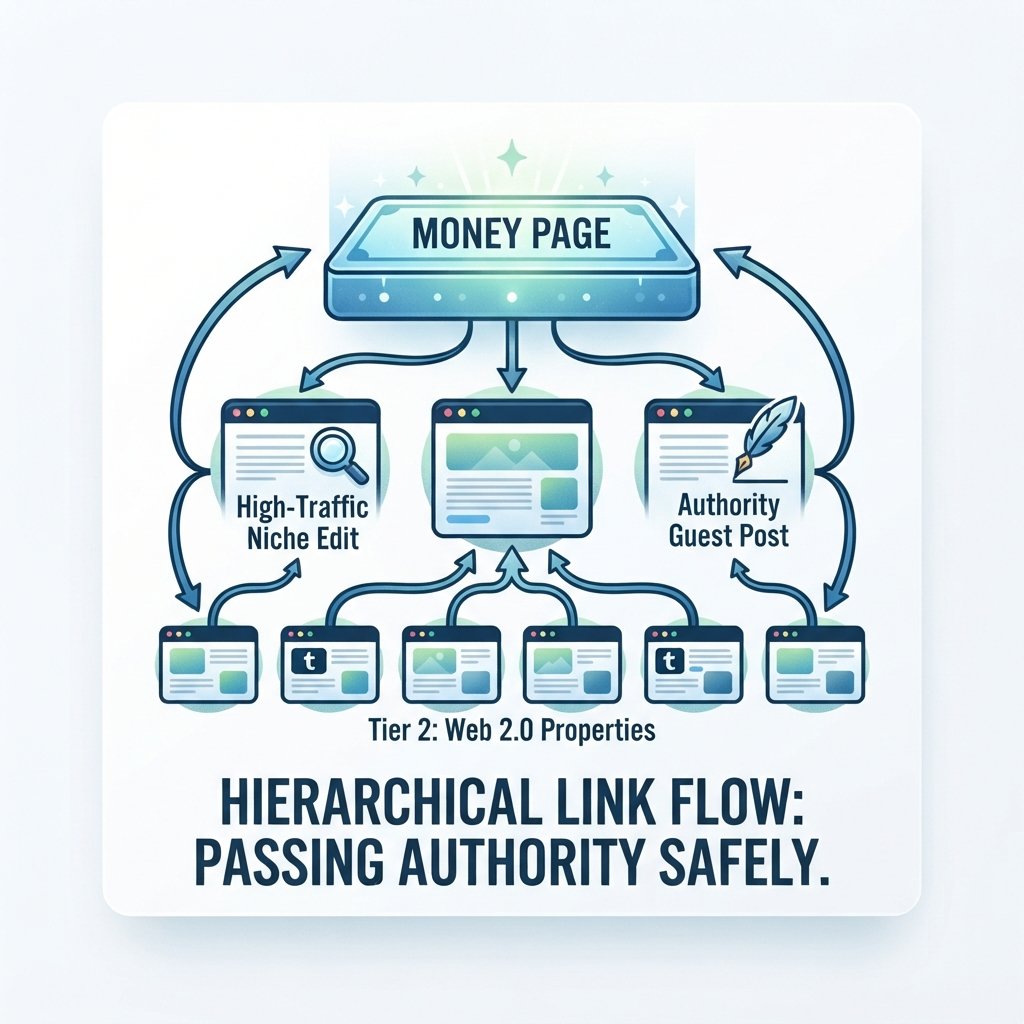
How to Structure a Mixed Backlink Campaign (The Blueprint)
Throwing random links at your site won’t cut it. You need a workflow. When I run off-page campaigns for clients or my own portfolio, I follow a strict tier-based structure.
[ Tier 1: Money Site ]
       ▲
       │  (Contextual Niche Edits & Guest Posts)
       ├──────────────────────────────────────────┐
       │                                          │
[ Tier 2: Web 2.0 Properties & Profiles ]         │
       ▲                                          │
       │  (Foundational Buffer Links)             │
       └──────────────────────────────────────────┘
Phase 1: Establish the Foundation (Weeks 1–2)
Kick off your campaign by building out your Tier 1 foundation. Set up clean social profiles and high-authority Web 2.0 properties. Point these at your homepage and major category pages using mostly brand name anchors (“Rankers Paradise”) and URL anchors ([https://rankersparadise.com/](https://rankersparadise.com/)). This builds trust and safety.
Phase 2: Inject Contextual Power (Weeks 3–4)
Once your foundation is indexed and breathing, introduce your contextual power links. Secure a handful of targeted niche edits on aged pages and 2 to 3 pristine guest posts on niche-relevant blogs. Point these directly at your commercial inner pages or primary blog posts that you want to rank on Page 1.
Phase 3: Monitor Indexing and Anchor Ratios (Ongoing)
Use Google Search Console to monitor how Google is indexing your new links. Keep an eye on your anchor text distribution. If your exact-match keywords start creeping above 5% to 10% of your total profile, back off on commercial anchors and dilute with more brand and generic terms.

Frequently Asked Questions
Are mixed backlink packages safe for new websites?
Yes, if the package includes a healthy ratio of foundation and contextual links. If a package is 100% exact-match anchor text guest posts pointing to a brand-new domain with zero history, you will trigger an algorithmic filter. Always start light and scale your link velocity alongside your content output.
How long does it take for mixed backlinks to show ranking improvements?
Foundation links (Web 2.0s) typically take 4 to 8 weeks to fully index and register trust signals. Niche edits, on the other hand, can start moving rankings within 1 to 3 weeks because the host pages are already crawled frequently by Googlebot.
Can I do this myself, or should I buy managed packages?
Building a diversified profile manually takes an enormous amount of time—finding clean sites, doing outreach, writing custom content, and managing anchor text ratios. That’s why business owners choose to work with trusted providers who have tested link networks already set up.
Final Thoughts: Stop Guessing, Start Ranking
SEO doesn’t have to be complicated, and it certainly doesn’t require thousands of dollars in monthly retainer fees to a bloated digital agency. By focusing on real-world testing, maintaining safe anchor text ratios, and combining foundational buffers with powerful editorial insertions, you can outrank competitors who are still relying on outdated single-tactic strategies.
If you are ready to scale your organic traffic, cut out the fluff, and build a resilient link profile, browse our proven packages today and let us do the heavy lifting.