
Over the last ten years running Rankers Paradise, I’ve tested just about every off-page SEO strategy under the sun. I’ve seen algorithm updates wipe out massive sites overnight, and I’ve watched simple, well-architected link campaigns climb straight to the top of Google.
If there is one absolute truth I’ve learned from a decade in the trenches, it’s this: buying single, isolated link types rarely cuts it anymore.
If you throw 50 guest posts at a brand-new money site with zero foundational trust, Google smells a footprint. If you spam Web 2.0s without any real editorial backing, your rankings will stall out. To rank #1 in competitive Google organic SERPs, you need a balanced ecosystem. You need the best off page seo packages that combine multiple link tiers into one cohesive machine.
In this guide, I’m going to break down how to structure a bulletproof off-page campaign using a mix of web 2.0 backlinks, niche edits, and guest posts—without triggering algorithmic filters or wasting your budget on low-quality spam.
Why Single-Link Strategies Fail (And Why You Need a Stack)
Most site owners make the mistake of looking for a silver bullet. They hear that guest posts are the holy grail, so they buy ten guest posts with exact-match anchor text and wonder why their site drops.
Google’s core algorithms are sophisticated. They look at your link profile holistically:
-
Anchor Text Ratios: If 80% of your links say “buy running shoes,” you’re asking for a penalty. Natural anchors require a healthy mix of brand names, naked URLs, and generic phrases, keeping exact-match keywords under 10% to 20%.
-
Link Velocity: Getting ten powerful links on Monday and zero for the next six months looks unnatural.
-
Domain Diversity: Relying on just one platform type leaves a massive footprint.
When you look at the best off page seo packages, they don’t rely on guesswork. They mimic a natural, organic link acquisition campaign by layering different types of authority together. Let’s look at how the pieces fit.
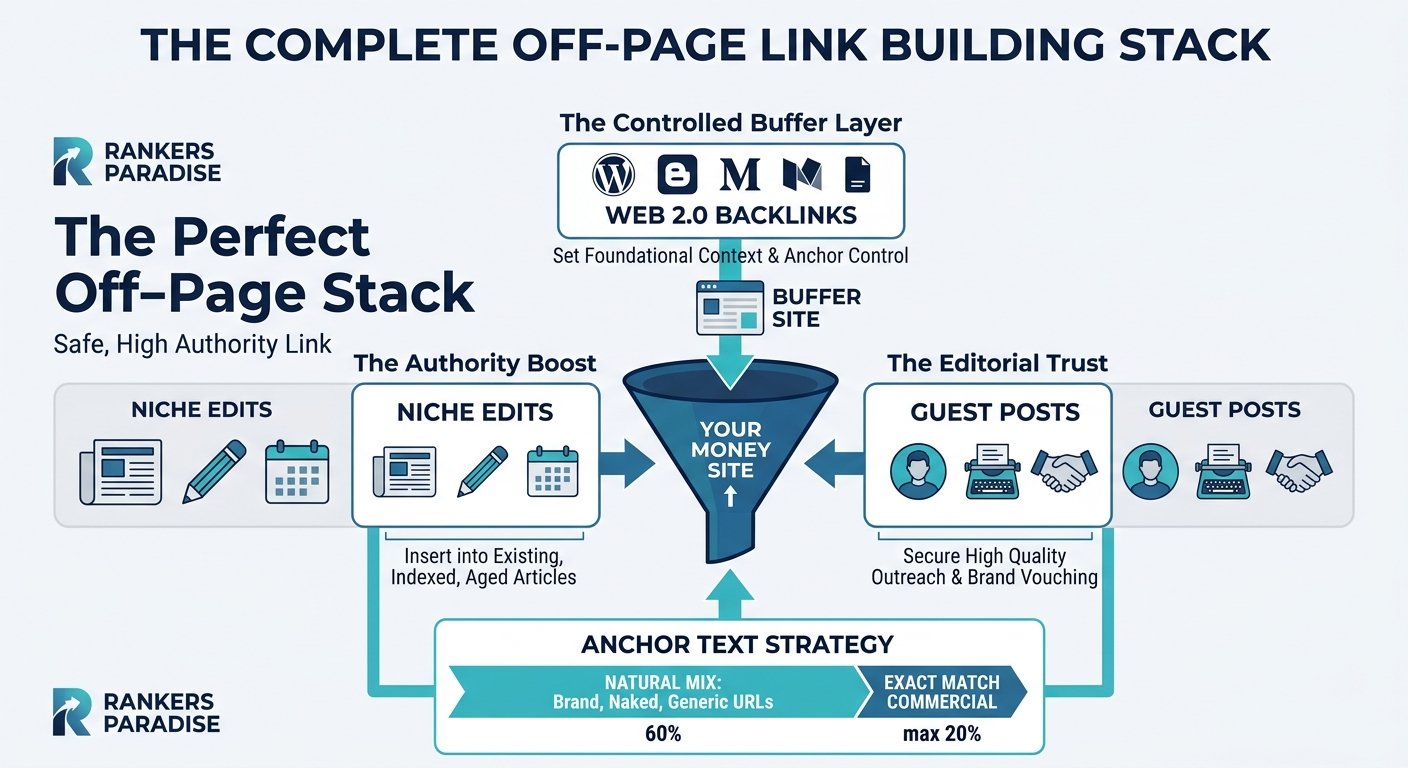
The 4-Pillar Off-Page Stack
To build a campaign that actually moves the needle, you need to combine four distinct layers of off-page SEO. Here is how we break it down in our own testing and client work.
Pillar 1: Foundational Control (Web 2.0 Backlinks)
Before you start pumping high-cost editorial links straight to your money site, you need a controlled buffer layer. This is where Web 2.0 properties shine.
Web 2.0s allow you to create properties on high-authority domains (like WordPress, Medium, or Tumblr) where you control the content, the outbound links, and the indexing speed.
-
The Role: They act as a buffer zone. They establish initial topical relevance, absorb anchor text variation safely, and pass controlled link juice down to your target pages.
-
How to build them right: Never point low-quality spun junk straight to your main site. Build out clean, readable content on these platforms, and if you want a complete masterclass on executing this properly, check out my guide on web 2.0 backlinks.
Pillar 2: Instant Aged Authority (Buy Niche Edits)
If you want to fast-track your rankings, waiting months for new pages to index and gain trust is painful. That’s why niche edits (also known as contextual link insertions) are so powerful.
-
The Role: Niche edits involve placing your link inside an existing article that is already indexed by Google, has active organic traffic, and already possesses historical authority.
-
Why they work: You are skipping the sandbox phase. Google already crawls and trusts the host page; dropping a relevant contextual link into that article passes instantaneous juice to your URL.
-
What to look out for: Always ensure the host domain meets strict metrics. I recommend checking that the site has real organic traffic (at least 1,000+ monthly visits via tools like Ahrefs or Semrush) and verified Google indexation before you buy niche edits. Avoid PBN networks that look artificial or leave obvious footprints.
Pillar 3: High-DA Editorial Trust (Buy Guest Posts)
Guest posting remains a cornerstone of ethical, high-impact off-page SEO. But there is a massive difference between mass-produced blog network posts and real editorial outreach.
-
The Role: Real guest posts secure contextual placements on genuine, niche-relevant websites with real audiences. They signal to Google that other real publishers in your industry vouch for your content.
-
Execution: When you buy guest posts, make sure the content surrounding your link is high quality, completely unique, and adds genuine value to the host reader. Do not just drop a link into a 300-word spun article. Make it an asset.
Pillar 4: Safe, Multi-Tiered Campaign Architecture (Buy Backlinks)
The final piece of the puzzle is how you tie everything together. When you buy backlinks, you shouldn’t just spray links randomly at your homepage and hope for the best.
-
Tiered Link Building: For aggressive or competitive keywords, running secondary tiers (such as pointing web 2.0s or social signals at your buffer links) helps push raw indexation and equity safely through the pipe.
-
Transparency and Reporting: Always demand transparency. Whether you are running a campaign yourself or outsourcing it, you should expect clear reporting—ideally through detailed Excel spreadsheets or Google Docs—so you can inspect every single URL, anchor text, and metric.
Summary Checklist for Choosing an Off-Page Package
When evaluating any off-page SEO service or putting together your own campaign blueprint, run through this quick checklist:
-
Are the host sites indexed? Never accept a link on a page that Google hasn’t indexed.
-
Is there organic traffic? Look for domains pulling in real traffic, not just vanity metrics like Domain Authority (DA) or Domain Rating (DR), which can easily be manipulated.
-
Is the anchor text natural? Keep exact-match commercial keywords under control (10–20% max) and pad the rest with brand names and generic terms.
-
Is the reporting transparent? You deserve to see exactly where your links are living.
Final Thoughts
Ranking #1 in Google isn’t about finding a secret loophole or buying cheap automated software blasts from Fiverr. It’s about building a robust, natural link profile that scales safely over time. By combining the foundational buffer of Web 2.0s, the instant punch of niche edits, and the editorial authority of guest posts, you create an off-page SEO package that can weather any algorithm update Google throws your way.
Take a look at your current link profile, identify your weak spots, and start building links that actually move the needle.