
If you’ve been following my work at Rankers Paradise for a while, you know I’ve spent years refining the art of the Web 2.0. From the early days of simple link wheels to the more complex structures I use today, I’ve seen what works and what gets slapped by Google.
Here is the truth that most “SEO gurus” won’t tell you: the era of “link dumping” is dead. You can no longer just drop a URL onto a WordPress.com or Blogger subdomain and expect it to move the needle for your money site.
Google in 2026 isn’t just counting backlinks; it’s building a massive knowledge map. It is looking for entities—people, brands, concepts, and locations. If your Web 2.0 content doesn’t align with the entities on your money site, you’re just wasting your time.
Today, we’re going to get under the hood of Semantic SEO and I’m going to show you how to align your Web 2.0 content with your money site’s core entities to build real, unshakeable authority.
What is Entity Alignment?
Google’s Knowledge Graph organizes the internet into nodes of information. These nodes are entities. When you create content, your goal shouldn’t just be to rank for a keyword; it should be to convince Google that your site is the primary authority for a specific set of entities.
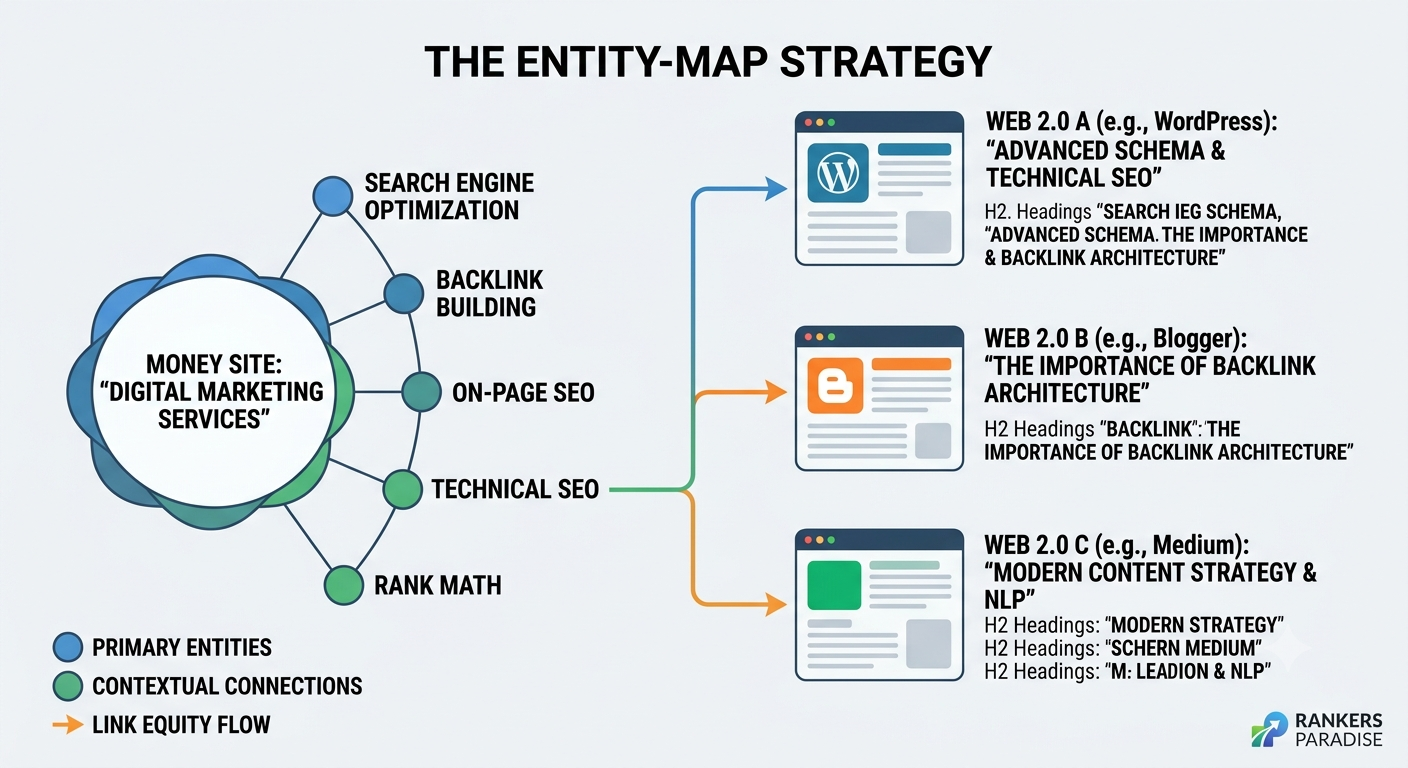
When I talk about “Entity Alignment,” I’m talking about creating a semantic bridge. You want Google to look at your Web 2.0 property and see clear, relevant connections to your money site. If your money site is about “Digital Marketing Services,” and your Web 2.0 is just posting random articles about “How to bake a cake,” the link between them is worthless.
In fact, it can sometimes even be a negative signal because it confuses Google’s understanding of your site’s topical focus.
Why Semantic Relevance is the New Link Authority
In the past, we obsessed over PageRank and Domain Authority (DA). Don’t get me wrong—authority metrics still matter. But authority without topical relevance is like a fancy car with no engine. It looks good, but it’s not going anywhere.
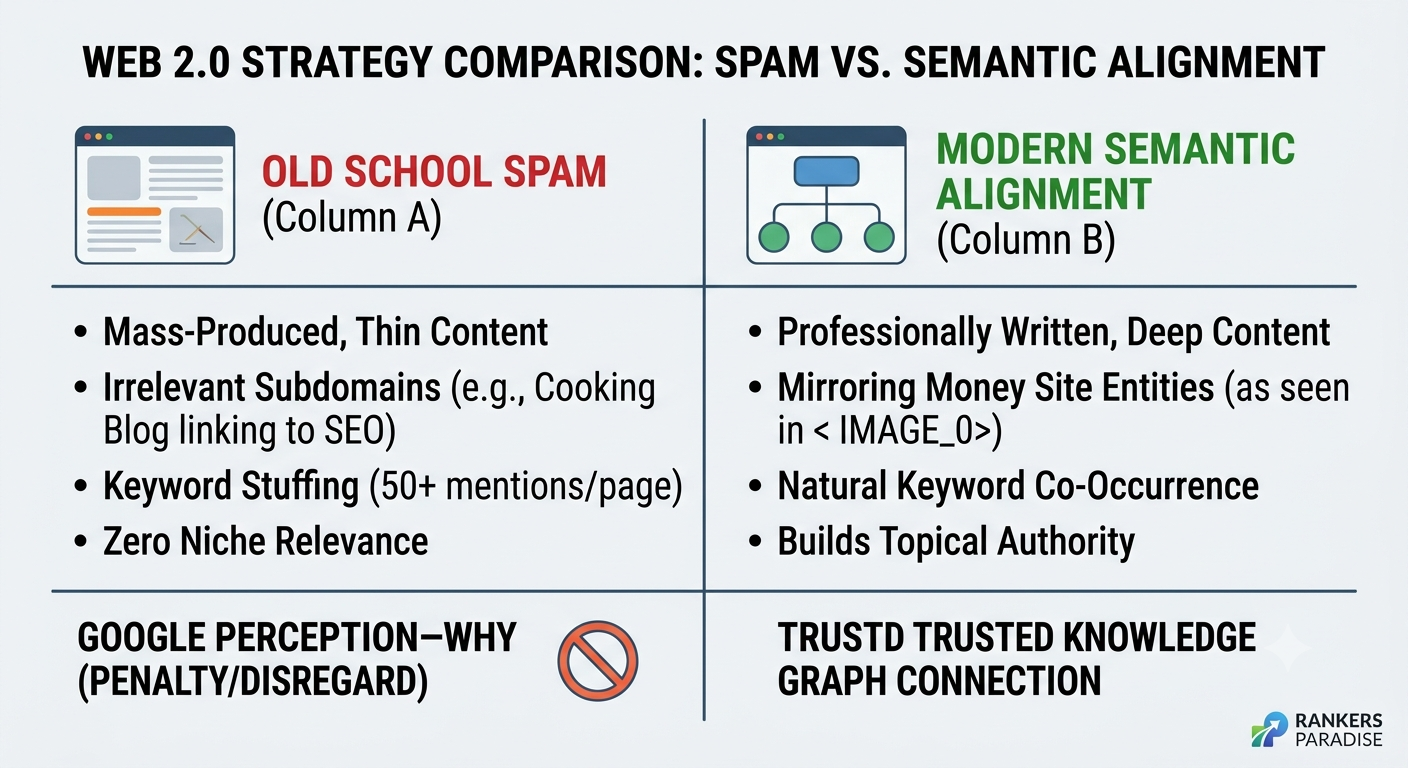
When you align your Web 2.0 content with your money site’s entities, you are doing three things:
-
Defining the Context: You are telling Google exactly which industry/niche your site belongs to.
-
Building a Topical Cluster: You are creating a web of related concepts that strengthen your “pillar” pages.
-
Reducing “Link Noise”: You are removing irrelevant signals, making it easier for Google to pass “link juice” without dilution.
If you are still stuck on the basics of creating these properties, I highly recommend you brush up on my guide on how to use web 2.0 backlinks to ensure your foundation is solid before you start this advanced work.
The “Entity-Bridge” Execution Strategy
You don’t need a PhD in data science to do this. You just need to be more methodical than the competition.
1. Identify Your Core Entity Map
Before you open up that Web 2.0 editor, go to your money site and identify your primary entities. If you’re an SEO consultant, your entities might be: Search Engine Optimization, Backlink Building, On-Page SEO, Rank Math, and Technical SEO.
2. Mirror the Schema Architecture
Google loves Schema.org markup because it explicitly defines entities. You don’t need to code it perfectly on your Web 2.0, but you should mirror the structure. If your money site has a service page for “Link Building,” use that exact phrasing in your Web 2.0 article as a main heading.
3. Leverage Natural Co-Occurrence
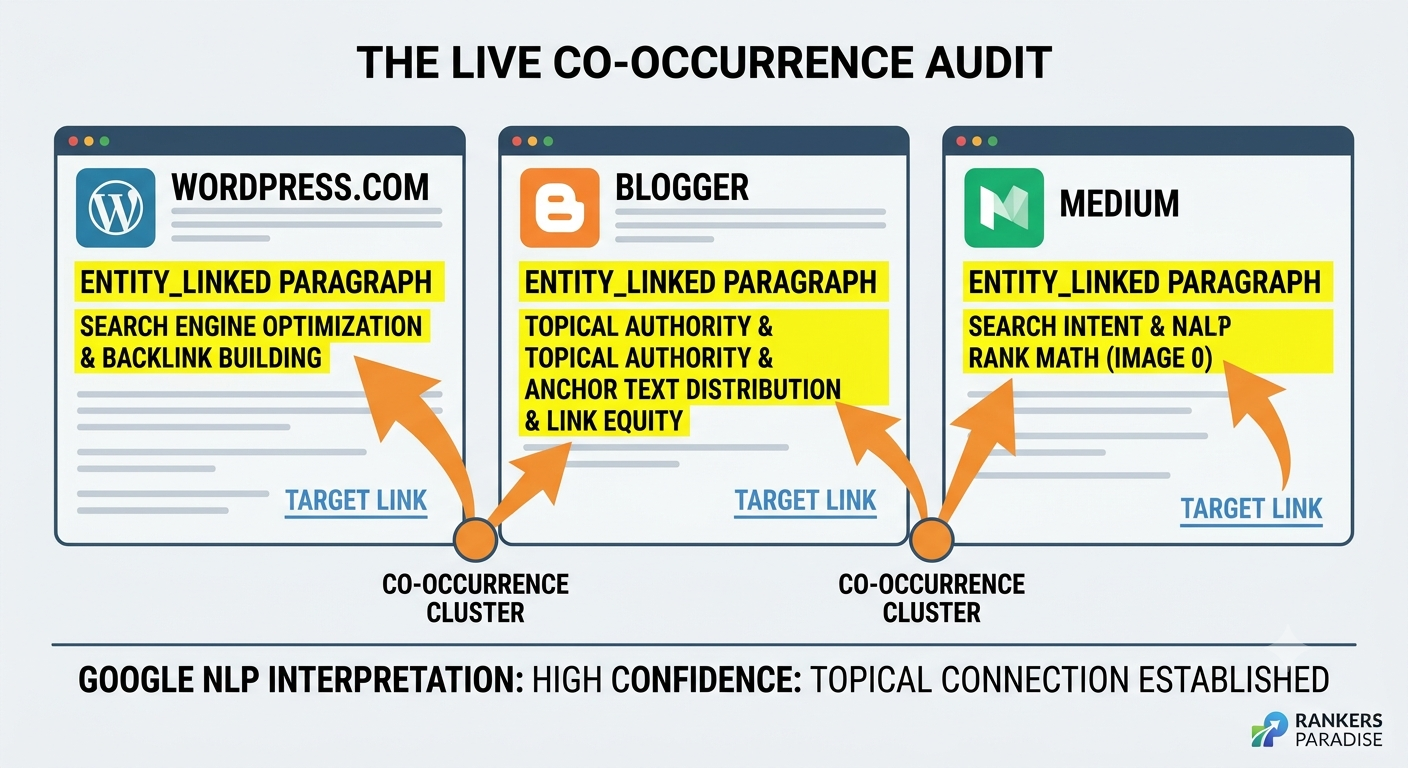
This is the “secret sauce.” If your target keyword is “Web 2.0 backlinks,” don’t just surround it with filler text. Surround it with related entity terms like “topical authority,” “anchor text distribution,” “link equity,” and “search intent.”
When these terms appear together, Google’s NLP (Natural Language Processing) models build a stronger “vector” between the two sites.
Does This Really Work?
I’ll give you a real-world example. I recently worked on a site that was stuck on page two for a specific competitive keyword. They had plenty of links, but they were generic. We didn’t add more links. We simply went back to the existing Web 2.0s and updated the content to align with the semantic entities of the money site—using the same H2s, the same terminology, and the same entity-linked concepts.
The result? Within three weeks, the site moved to the first page. It wasn’t about the quantity of the links; it was about the clarity of the signal.
Why “Human-First” Content Wins
I know a lot of people are using AI to crank out Web 2.0 posts. If you do that, you’re likely writing generic, repetitive content that says nothing new.
To win in 2026, you need to inject “Experience” signals. Add a personal anecdote. Explain a mistake you made. Provide a tip that isn’t in every other blog post on the internet. Google’s algorithms are getting better at identifying “Information Gain”—content that adds something new to the conversation.
If you want to master this, take a look at my do it yourself SEO guide to see how I balance technical optimization with content that people actually want to read.
Ready to Elevate Your Strategy?
Entity alignment is how you separate yourself from the amateurs who are still buying mass-produced, irrelevant links. It takes a bit more effort, but the rewards are clear: better rankings, more traffic, and a site that Google actually respects.
If you don’t have the time to map out these entities and build these high-authority Web 2.0s yourself, I’ve got you covered. Check out our web 2.0 backlinks service at Rankers Paradise. We build them to be semantically relevant, professionally written, and strategically aligned with your money site.
Stop guessing. Start building authority.
Are you ready to take your link building to the next level? Let me know in the comments if you need any help.