
Anchor text is one of the most powerful signals in link building, but it is also one of the easiest to overuse. Years ago, many websites could rank by building dozens of links with the same exact-match keyword. Today, that approach looks unnatural, risky, and easy for search engines to spot.
A strong backlink profile is not just about getting links. It is about creating a pattern that looks natural, supports topical relevance, and gives search engines enough context to understand what your pages deserve to rank for. That is where advanced anchor text ratios come in.
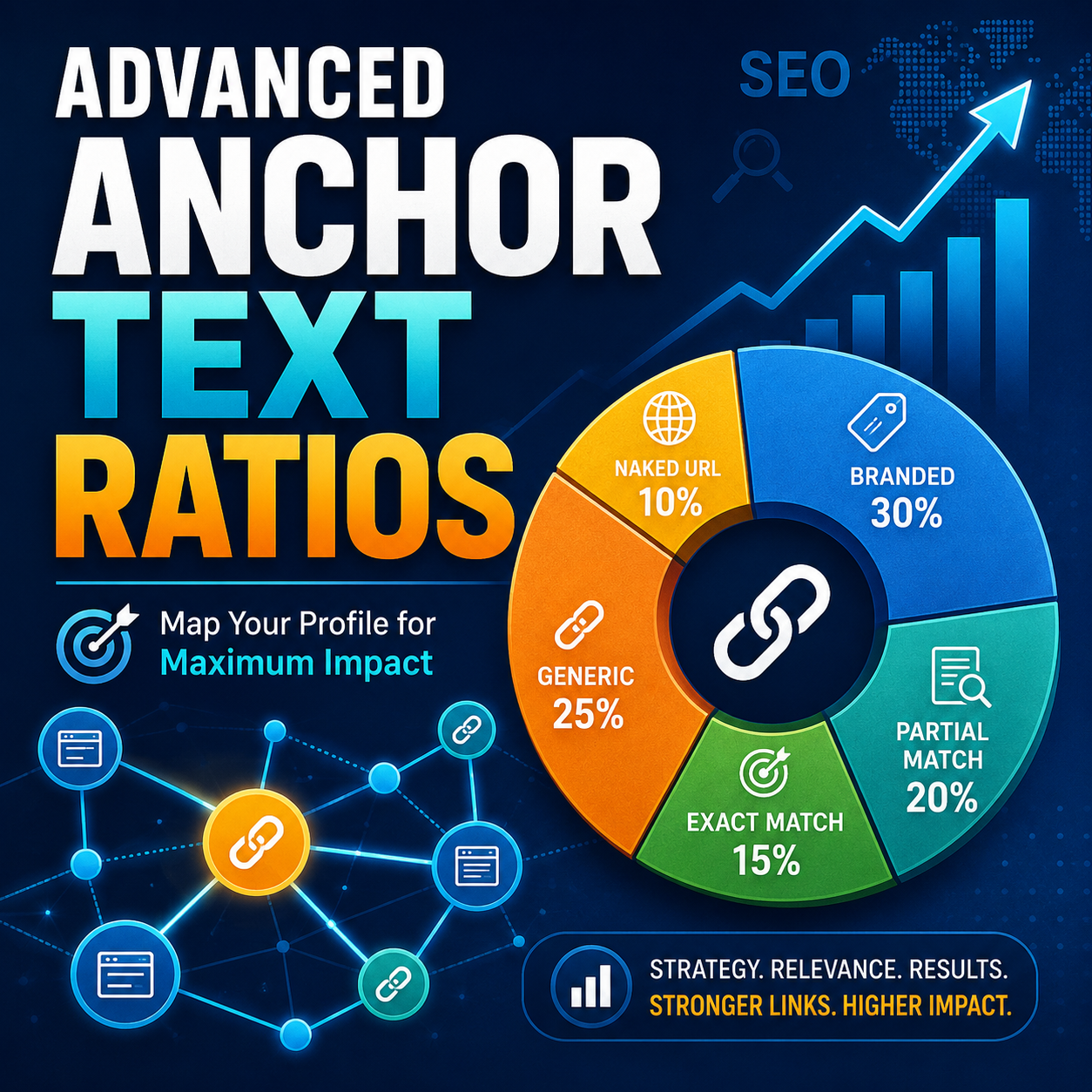
Instead of randomly choosing anchors for every new backlink, smart SEOs map their anchor profile before building links. This helps them balance branded anchors, naked URLs, generic anchors, topical phrases, partial-match keywords, and exact-match keywords in a way that strengthens rankings without creating an obvious footprint.
What Are Anchor Text Ratios?
Anchor text ratios refer to the percentage breakdown of the different types of anchor text pointing to a specific page or domain.
For example, if a page has 100 backlinks, and 40 of them use your brand name as the anchor, your branded anchor ratio is 40%. If 10 links use an exact keyword, your exact-match anchor ratio is 10%.
The goal is not to follow one universal formula. Different niches, websites, and ranking pages have different backlink patterns. A local plumber, an eCommerce store, a SaaS company, and an affiliate website may all have very different natural-looking anchor profiles.
The real goal is to create a profile that looks believable for your industry while still pushing enough keyword relevance to help the target page rank.
Why Anchor Text Still Matters
Search engines use anchor text as a contextual clue. When multiple websites link to a page using related language, it helps search engines understand what that page is about.
For example, if a page receives links using phrases like “link building guide,” “buying backlinks safely,” “SEO backlink strategy,” and “how to choose quality links,” those anchors all build topical relevance around backlinks and SEO.
However, if too many links use the same keyword repeatedly, the pattern can become suspicious. That is why advanced anchor text planning is about balance. You want enough keyword relevance to influence rankings, but enough variation to make the profile look organic.
The Main Types of Anchor Text
Before mapping ratios, it is important to understand the main categories of anchor text.
1. Branded Anchors
Branded anchors use your business, website, or brand name. These are usually the safest and most natural anchors.
Examples include:
Rankers Paradise
RankersParadise.com
Rankers Paradise SEO
Branded anchors are especially useful when building authority to your homepage, pillar content, or commercial pages. Most natural websites attract a large number of branded links over time.
2. Naked URL Anchors
A naked URL anchor uses the raw URL as the clickable text.
Example:
https://example.com/page-url/
These anchors are common across forums, directories, citations, resource pages, and editorial references. They help diversify a backlink profile and reduce over-optimization.
3. Generic Anchors
Generic anchors use broad phrases that do not include a keyword or brand.
Examples include:
click here
visit website
read more
learn more
this guide
this article
Generic anchors are natural because real people often link this way. While they do not provide strong keyword relevance on their own, they help dilute aggressive keyword anchors and make the profile look more balanced.
4. Partial-Match Anchors
Partial-match anchors include part of the target keyword or a related phrase without using the full exact keyword.
Examples include:
safe backlink buying tips
building links for SEO
quality backlink strategy
SEO link acquisition guide
Partial-match anchors are very valuable because they provide topical relevance without appearing as forced as exact-match anchors.
5. Exact-Match Anchors
Exact-match anchors use the precise keyword you want to rank for.
Example:
buy backlinks
Exact-match anchors can be powerful, but they carry the highest risk when overused. They should usually make up a small portion of a backlink profile, especially for competitive or commercial keywords.
6. Topical or Semantic Anchors
Semantic anchors use phrases that are closely related to the main topic but not direct keyword variations.
Examples include:
improving domain authority
earning stronger SEO signals
link placement strategy
authority-building campaigns
These anchors help build topical depth. They are especially useful for pillar content because they reinforce the broader subject rather than repeating the same keyword.
Why Advanced Anchor Mapping Beats Guesswork
Many website owners build links one at a time and choose anchors based on what feels right in the moment. This can create problems later.
Without a map, you may accidentally use too many keyword-rich anchors. You may also forget to build enough branded or neutral anchors to support a natural-looking profile.
Advanced anchor mapping gives you a clear plan before links are built. It helps you answer questions like:
How many branded anchors does this page need?
How many partial-match anchors can we safely use?
Are we overusing commercial keywords?
Do we need more topical variation?
Is the page’s link profile too aggressive compared to competitors?
This type of planning is especially important when building links to commercial pages, affiliate pages, or SEO-focused pillar content.
How to Build an Anchor Text Map
Creating an anchor text map does not need to be complicated. The key is to understand your current backlink profile, compare it with competitors, and plan future anchors based on what looks natural in your niche.
Step 1: Audit Your Existing Anchors
Start by reviewing the backlinks already pointing to your page. Use an SEO tool to export the anchor text data for the target URL.
Group each anchor into categories:
Branded
Naked URL
Generic
Partial-match
Exact-match
Topical or semantic
Image anchors
Miscellaneous
Once you categorise them, calculate the percentage of each type. This gives you a clear picture of your current anchor profile.
For example, your current page might look like this:
Branded anchors: 35%
Naked URLs: 20%
Generic anchors: 15%
Partial-match anchors: 18%
Exact-match anchors: 7%
Topical anchors: 5%
This may be perfectly acceptable in one niche and too aggressive in another. That is why the next step is competitor comparison.
Step 2: Analyse Ranking Competitors
Look at the top-ranking pages for your target keyword. Review their anchor text profiles and identify common patterns.
Do the top-ranking pages have a high percentage of branded anchors?
Are exact-match anchors common in the niche?
Do competitors use many naked URL anchors?
Are their anchors mostly editorial and natural?
Do they rely heavily on partial-match phrases?
You are not trying to copy competitors exactly. You are trying to understand the range of what Google already appears to tolerate and reward in your niche.
If every ranking competitor has a very conservative anchor profile, using a highly aggressive exact-match strategy could be risky. If the niche is more competitive and keyword-rich anchors are common, you may need more partial-match and exact-match relevance to compete.
Step 3: Set a Target Ratio
Once you know your current profile and competitor averages, create a target ratio for future links.
A balanced anchor text plan for a pillar page might look something like this:
Branded anchors: 35–45%
Naked URL anchors: 15–25%
Generic anchors: 10–20%
Partial-match anchors: 15–25%
Exact-match anchors: 1–5%
Topical or semantic anchors: 5–15%
This is not a fixed rule. It is a starting point. The right ratio depends on your domain authority, niche, competition level, link velocity, and the type of page being promoted.
For newer websites, safer anchors are usually better. For established websites with strong brand signals, there may be more room for partial-match anchors. For highly competitive commercial keywords, exact-match anchors may still play a role, but they should be used carefully.
Step 4: Match Anchor Type to Link Type
Not every backlink should use the same style of anchor.
Editorial links from high-quality guest posts or niche placements can usually support partial-match or topical anchors. Citations, profiles, directories, and social links are better suited for branded or naked URL anchors.
For example:
Guest post link: partial-match or topical anchor
Business directory link: branded anchor
Resource page link: topical anchor
Forum mention: naked URL or generic anchor
Press release: branded or naked URL anchor
Homepage mention: brand anchor
This makes your profile look more realistic because different types of websites naturally link in different ways.
Step 5: Use Exact Match Sparingly
Exact-match anchors are not dead, but they should be treated like a strong spice. A little can improve the dish. Too much can ruin it.
If your exact-match anchor ratio becomes too high, your page may look artificially manipulated. This is especially true for money keywords such as “buy backlinks,” “best casino bonus,” “personal injury lawyer,” or “cheap web hosting.”
A safer approach is to use more partial-match and semantic anchors. These still send relevance while reducing the risk of over-optimization.
For example, instead of repeatedly using “buy backlinks,” you could use variations such as:
guide to buying backlinks
backlink buying strategy
safe link acquisition
choosing quality backlinks
SEO backlink planning
These phrases support the topic without repeating the same commercial keyword too often.
Step 6: Map Anchors Before Building Links
Before launching a campaign, create a simple spreadsheet with the following columns:
Target URL
Current anchor type
Planned anchor
Anchor category
Link source
Placement type
Date built
Status
This allows you to monitor your backlink campaign as it grows. Every time you build or earn a link, update the sheet. Over time, you will see whether your ratios are staying balanced or drifting too heavily toward one category.
Anchor mapping is especially useful when multiple people are involved in a campaign. Writers, outreach specialists, and SEO managers can all follow the same plan instead of choosing anchors randomly.
Common Anchor Text Mistakes
Even experienced website owners can make anchor text mistakes. The most common issue is focusing too much on the keyword and not enough on the overall pattern.
Using Too Many Exact-Match Anchors
This is the classic mistake. A page that receives too many links with the same commercial keyword can look unnatural. It may rank temporarily, but it can also become vulnerable to algorithm updates or manual review.
Ignoring Brand Anchors
Brand anchors build trust. If a website has lots of keyword-rich backlinks but very few branded mentions, the profile may look artificial. Strong brands naturally attract branded links.
Forgetting Naked URLs
Naked URLs are simple, but they are useful. They create natural variation and help dilute more aggressive anchors.
Repeating the Same Partial-Match Phrase
Some website owners avoid exact-match anchors but then repeat the same partial-match phrase too often. This can still create a pattern. Variation matters.
Not Considering Page Type
A homepage usually needs more branded anchors. A blog post can often support more topical anchors. A product or service page may need a careful mix of branded, generic, and partial-match anchors. The page type should influence the anchor strategy.
Anchor Text for Pillar Content
Pillar content usually covers a broad topic in depth. Because of that, the anchor profile should not be too narrow.
Instead of relying on one main keyword, pillar content benefits from a wide range of supporting anchors. These can include definitions, questions, long-tail phrases, related topics, and branded references.
For example, a pillar page about backlinks could receive anchors related to:
backlink strategy
link building methods
SEO authority building
safe backlink acquisition
how backlinks influence rankings
quality link building
link profile planning
This approach helps the pillar page become associated with the entire topic, not just one keyword.
When you are planning internal links, you can also use descriptive anchors to connect supporting articles to your main pillar page. For example, if you want a deeper guide on choosing link providers, you can explore trusted outsourced link building services as part of your broader SEO planning.
How Internal Links Fit Into Anchor Text Strategy
Internal anchor text is different from external anchor text, but it still matters.
With internal links, you have more control. You can use clearer, more descriptive anchors because you are helping both users and search engines understand the relationship between your pages.
However, you should still avoid making every internal link identical. If every blog post links to the same pillar page with the same anchor, the internal linking structure can look repetitive.
A better approach is to vary internal anchors naturally.
Examples include:
backlink buying guide
link building strategy
how to evaluate backlinks
safe backlink planning
SEO link acquisition tips
buying backlinks the right way
Internal anchors should be useful to readers first. If the anchor feels forced, it probably needs to be rewritten.
How to Adjust Ratios Over Time
Anchor text ratios are not something you set once and forget. Your backlink profile changes as new links are built, earned, removed, or discovered by search engines.
Review your anchor profile regularly, especially after a major link building campaign. If you notice too many keyword-rich anchors, shift future links toward branded, naked URL, generic, and topical anchors.
If your profile is too safe and lacks relevance, add more partial-match or semantic anchors through quality editorial placements.
The goal is controlled movement. You do not need to fix everything at once. You simply need each new link to move the profile closer to the target balance.
Example Anchor Text Mapping Scenario
Imagine you have a pillar page about buying backlinks. The page currently has 40 referring domains.
The anchor profile looks like this:
Branded: 20%
Naked URL: 10%
Generic: 10%
Partial-match: 25%
Exact-match: 25%
Topical: 10%
This profile may be too aggressive because exact-match anchors are taking up a large share. Instead of building more keyword-heavy links, the next phase should focus on safer anchors.
The next 20 links might use:
8 branded anchors
5 naked URL anchors
3 generic anchors
3 topical anchors
1 partial-match anchor
0 exact-match anchors
After those links are added, the overall profile becomes more balanced. The page still has keyword relevance, but it no longer looks as heavily dependent on exact-match anchors.
Advanced Tips for Anchor Text Planning
Advanced anchor text strategy is about more than percentages. It is also about context, placement, and link quality.
A keyword-rich anchor from a weak, irrelevant website is not as valuable as a natural topical anchor from a trusted industry source. Search engines look at the surrounding content, the linking page, the domain, and the relationship between the two sites.
For maximum impact, consider these factors:
Use anchors that fit naturally inside the sentence.
Surround the link with relevant supporting content.
Avoid forcing commercial anchors into unrelated articles.
Balance homepage links with deep links.
Use branded anchors to strengthen trust.
Use topical anchors to support semantic relevance.
Track each link so the profile stays controlled.
The best anchor text strategy feels natural from the reader’s perspective while still being intentional from an SEO perspective.
The Relationship Between Anchor Text and Link Velocity
Anchor ratios should also be considered alongside link velocity.
If a page suddenly gains many links with keyword-rich anchors in a short period, it may look unnatural. On the other hand, a steady mix of branded, generic, naked URL, and topical anchors can appear more organic.
For newer websites, slower and safer is usually better. Build authority first with branded and natural anchors. Once the domain becomes stronger, you can introduce more targeted partial-match anchors.
For established websites, you may be able to build links at a faster pace, but the anchor profile still needs to remain balanced.
Final Thoughts
Advanced anchor text ratios are not about finding a magic percentage. They are about creating a natural, strategic, and competitive link profile that supports long-term rankings.
The strongest approach is to audit your current anchors, study your competitors, set a realistic target ratio, and map every future link before it is built. This gives you control over your SEO campaign while reducing the risk of over-optimization.
A well-planned anchor profile helps search engines understand your content, strengthens topical relevance, and protects your site from patterns that look manipulative. When done correctly, anchor text mapping turns link building from guesswork into a structured ranking strategy.
Keep reading…
Don’t Buy Backlinks Until You Know This
Why You Should Drip-Feed Your Backlink Purchases Instead of Buying in Bulk