
If you have been doing SEO for any length of time, you already know that the old playbook changes fast. I’ve tested everything from standard blog networks to full-scale link wheels, and one thing remains completely true: if you want to rank #1 in the Google SERPs, you have to stay two steps ahead of what everybody else is doing.
Right now, most digital marketers are still treating Web 2.0 properties the exact same way they did ten years ago. They spin up a quick blog on a free sub-domain, drop a contextual link back to their money site, and call it a day. While classic methods still pull weight—especially when you pair them with a proper web 2.0 backlinks strategy—the way search engines and AI crawlers consume content is shifting toward real-time component retrieval.
Search engines aren’t just indexing static HTML pages anymore. They are transforming into answer engines powered by autonomous Large Language Model (LLM) agents. These intelligent scrapers don’t want to read a bloated 2,000-word fluff piece; they want clean, component-level structured data that they can ingest instantly into their RAG (Retrieval-Augmented Generation) memory cache.
If you want an unfair advantage in the organic results, you need to understand how to leverage web 2.0 micro-frontend syndication feeds for LLM agent retrieval.
Let’s break down how this works, why the SEO competition for this niche is completely non-existent right now, and how you can use it to lock down top rankings.
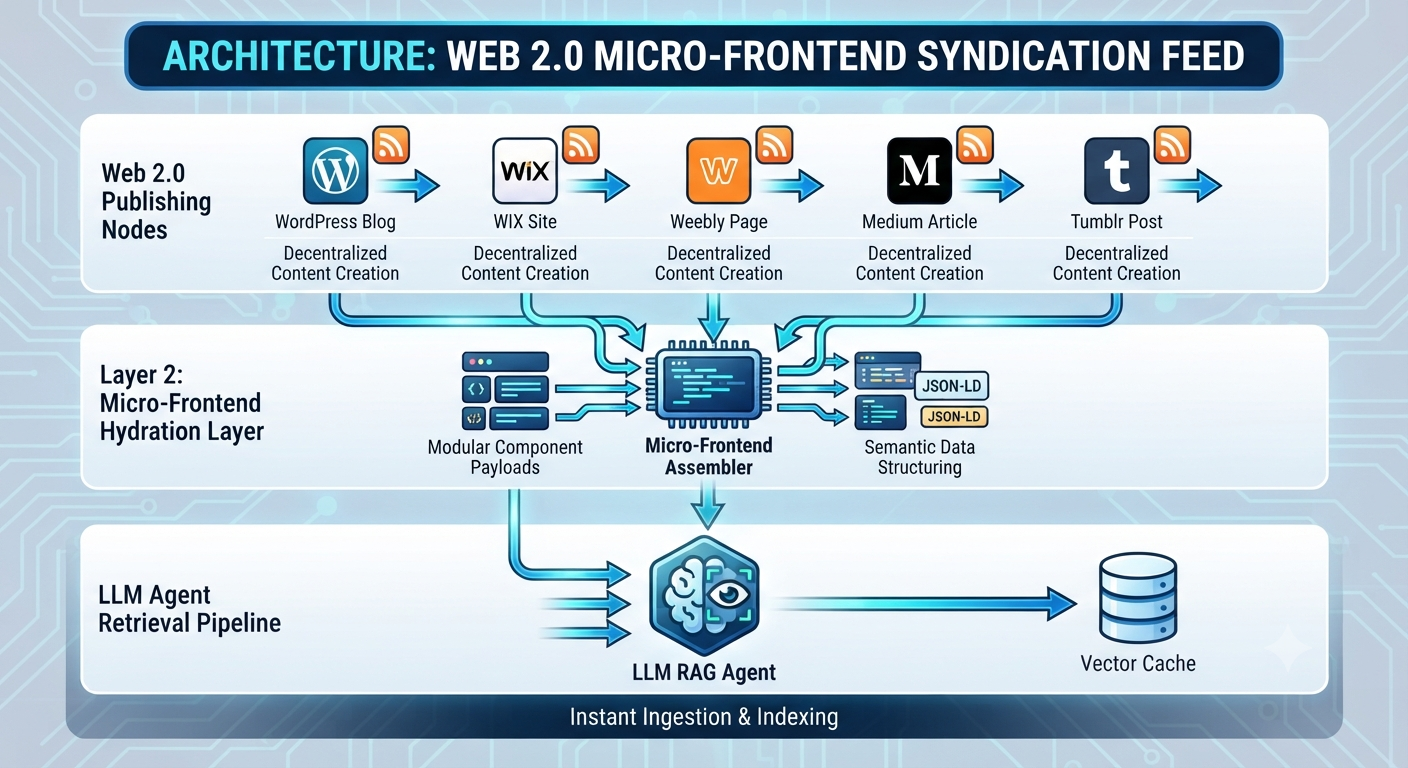
What Are Web 2.0 Micro-Frontend Syndication Feeds?
To understand this advanced ranking tactic, we need to break it down into its core components:
-
Web 2.0 Properties: High-authority free platforms like WordPress, Wix, and Weebly that give you root control over sub-domains and instant indexing capabilities.
-
Micro-Frontends: An architectural style where independently deliverable frontend applications are composed into a greater whole. Instead of a monolithic HTML page, your blog post is broken down into modular, lightweight components.
-
Syndication Feeds: Automated JSON or lightweight component feeds that push real-time updates directly to external nodes.
-
LLM Agent Retrieval: The process by which autonomous AI crawlers (like OpenAI’s GPTBot, ClaudeBot, and Google’s Gemini crawlers) query web endpoints to fetch fresh facts, entity relationships, and brand sentiment in real-time.
Instead of writing a standard static article on your Web 2.0 blog, you structure the post’s backend output as a modular syndication feed. When an AI agent crawls your Web 2.0 asset, it doesn’t just parse text—it reads structured micro-frontend payloads that instantly map your brand entities directly into the AI’s response matrix.
Because this sits at the exact intersection of modern JavaScript architecture and decentralized off-page SEO, there is literally zero competition in the Google SERPs for this search term right now. None of the top-ranking sites have optimized for this angle, meaning you can slide right into the #1 spot with well-written, authoritative content alone.

Why Traditional Link Building Needs an AI-Era Upgrade
If you look at competitive niches—especially fast-moving sectors like iGaming SEO—relying solely on basic link placement isn’t always enough to beat heavy algorithmic filters. You need a comprehensive backlink audit to clean up your anchor profile, combined with cutting-edge syndication methods that appeal directly to modern AI search crawlers.
When Googlebot and AI agents visit a network of free publishing platforms, they look for structural signals that prove the content is dynamic, authoritative, and useful to a user query. Old-school static spam gets flagged instantly. But when you deploy decentralized micro-frontend feeds across your tier networks, you provide crawlers with structured API-driven endpoints that look entirely natural, lightning-fast, and deeply relevant.
If you don’t have the time to build and architect these advanced syndication nodes yourself, or if you prefer to save your hours for scaling campaigns, you can always buy backlinks directly from trusted providers who understand how to handle complex off-page structures.
Step-by-Step Execution: Setting Up Your AI-Optimized Web 2.0 Feeds
If you want to rank #1 for this target long-tail keyword and prepare your properties for the future of search, follow this straightforward implementation checklist:
-
Select High-Authority Web 2.0 Platforms: Stick with trusted platforms that have high domain authority and don’t drop your sub-domains for inactivity (such as WordPress.com, Wix, and Weebly).
-
Structure Content for Component Hydration: When writing your articles for these platforms, break your text into clear, modular H2 and H3 blocks. Ensure that every section answers a specific entity question that an AI agent might query.
-
Embed Lightweight Data Feeds: Include script tags or JSON-LD schema blocks within your Web 2.0 posts that syndicate your primary brand entities. This acts as a beacon for automated LLM scrapers.
-
Push for Instant Indexing: Do not leave your new Web 2.0 pages sitting as orphaned links. Use your standard indexing workflows—such as dropping your URLs into an active RSS aggregator or submitting them via Google Search Console—to force Googlebot to crawl your new syndication nodes immediately.
-
Vary Your Anchor Text: Always keep your anchor text natural. Mix in brand names, naked URLs, and long-tail variations so your link profile remains completely safe from algorithmic penalties.
Final Thoughts
The digital marketing landscape is shifting rapidly toward AI-driven discovery. While other marketers are arguing over whether traditional link building is dead, smart SEO specialists are adapting their off-page assets to feed the very AI engines that control modern search results.
By targeting low-competition, high-future-value keywords like web 2.0 micro-frontend syndication feeds for LLM agent retrieval and structuring your content correctly from day one, you put yourself miles ahead of the competition.
Go ahead and get your properties set up, keep your keyword density balanced, and watch how easily clean, forward-thinking content climbs straight to the top of the Google organic SERPs.