
If you have been following my work here at Rankers Paradise for a while, you know I have spent years refining the art of the Web 2.0 asset. From the early days of basic link wheels and simple tiered architectures to the advanced frameworks I use today, I have watched search engines evolve through countless algorithm updates.
Right now, we are sitting in the middle of the biggest shift in search history. Google’s transition toward AI Overviews and Search Generative Engines (SGE) has fundamentally changed how off-page authority works. If you are still building Web 2.0 properties the exact same way we did back in 2018—dropping a spun 500-word article, throwing in an exact-match anchor link, and hoping for raw PageRank to flow—you are wasting your time.
Today, I am going to show you how to master Web 2.0 Entity Staging for AI Overviews and Search Generative Engines. If you want to stay ahead of the curve, secure top positions, and learn how to structure your off-page assets for the future of machine-learned search, follow this guide step-by-step.
What is Web 2.0 Entity Staging?
To understand why this matters, we first need to look at how modern search engines process information. In the past, Google’s web crawler looked at a backlink as a simple vote of confidence. A link from a high-authority platform passed “link juice” directly to your money site, lifting your keyword rankings in the organic SERPs.
Today, Google is an answer engine driven by entity extraction and machine learning models. When Google bot crawls the web, it doesn’t just read words—it looks for entities (people, places, concepts, brands, and things) and maps the relationships between them.
Web 2.0 Entity Staging is the process of setting up and optimizing secondary properties (like WordPress.com, Medium, Tumblr, and Blogger) not merely as link farms, but as semantic validation nodes that feed structured entity data directly into Google’s Knowledge Graph and generative retrieval systems.
When you configure your staging properties correctly, they act as trust anchors that corroborate your brand identity, making it vastly easier for your primary site to get cited inside AI Overviews. If you want to understand how these foundational strategies tie into broader off-page campaigns, take a look at my guide on web 2.0 backlinks.
Why Old-School Web 2.0 Tactics Fail in the Era of SGE
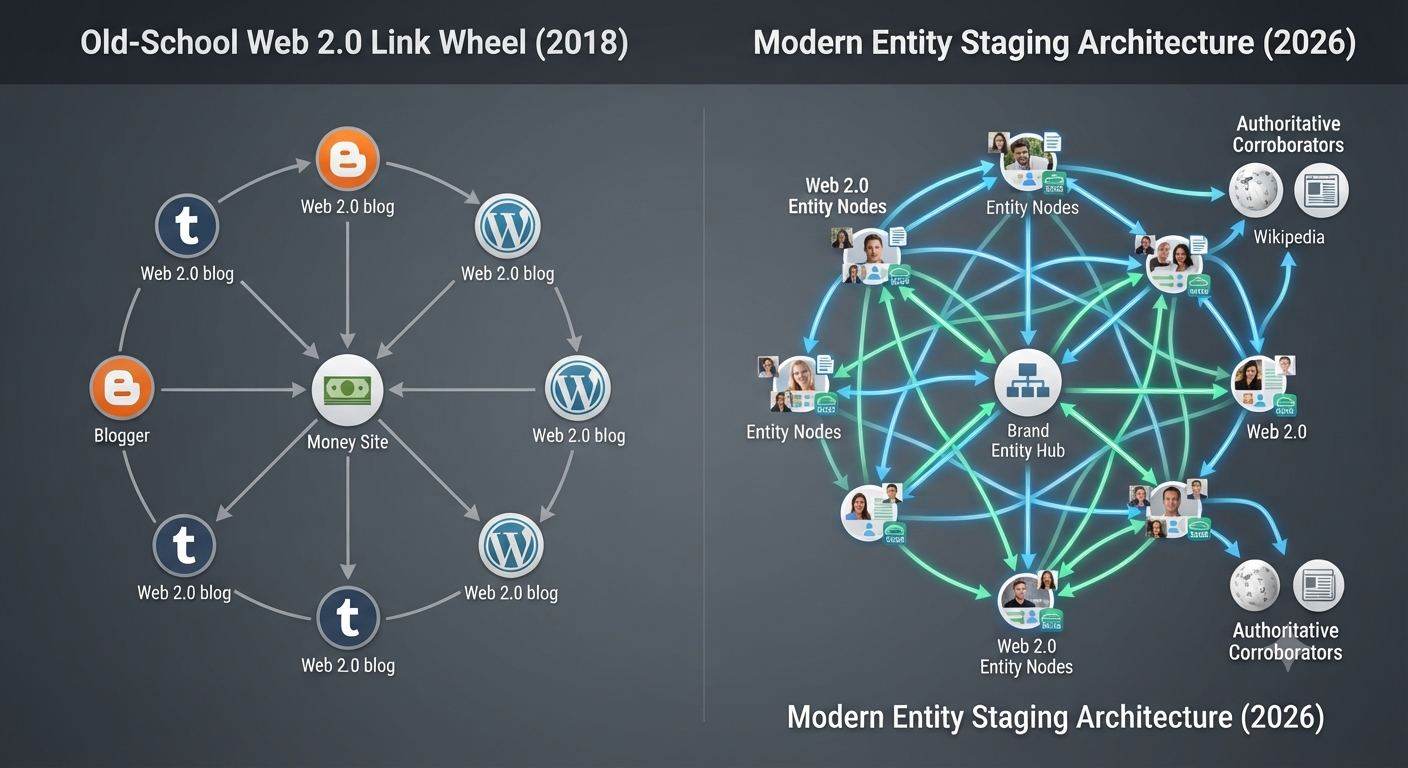
Let’s be honest for a second. Many SEOs complain that free blogging platforms don’t rank like they used to. They build a dozen profiles, drop links, and watch as Google bot ignores their subdomains entirely or strips them from the index within a few weeks.
If you want to know how to fix indexation drops and keep your buffer assets alive, check out my breakdown on how to fix web 2.0 backlink indexation drops (or read up on general recovery strategies via how to fix web 2.0 backlink indexation drops after Google spam updates).
The reason old tactics fail is simple: Algorithmic spam detection has learned to spot low-effort footprints instantly.
-
Thin Content: 300 words of unedited AI text or low-quality spun articles get filtered out immediately.
-
Orphaned Profiles: A standalone blog with no internal schema, no external citations, and zero contextual relevance looks like an unnatural footprint.
-
Naked Links: Pointing aggressive anchor text directly from an unoptimized, zero-trust profile triggers automated algorithmic filters.
To bypass this, you need a strategy designed for generative engines. You have to feed the AI what it wants: clean context, clear entity relationships, and verifiable authority. If you are looking to scale this approach across competitive verticals—even in demanding niches like iGaming SEO—staging your entities properly is non-negotiable.
Step-by-Step Blueprint: Setting Up Entity-Optimized Web 2.0s for 2026 and Beyond
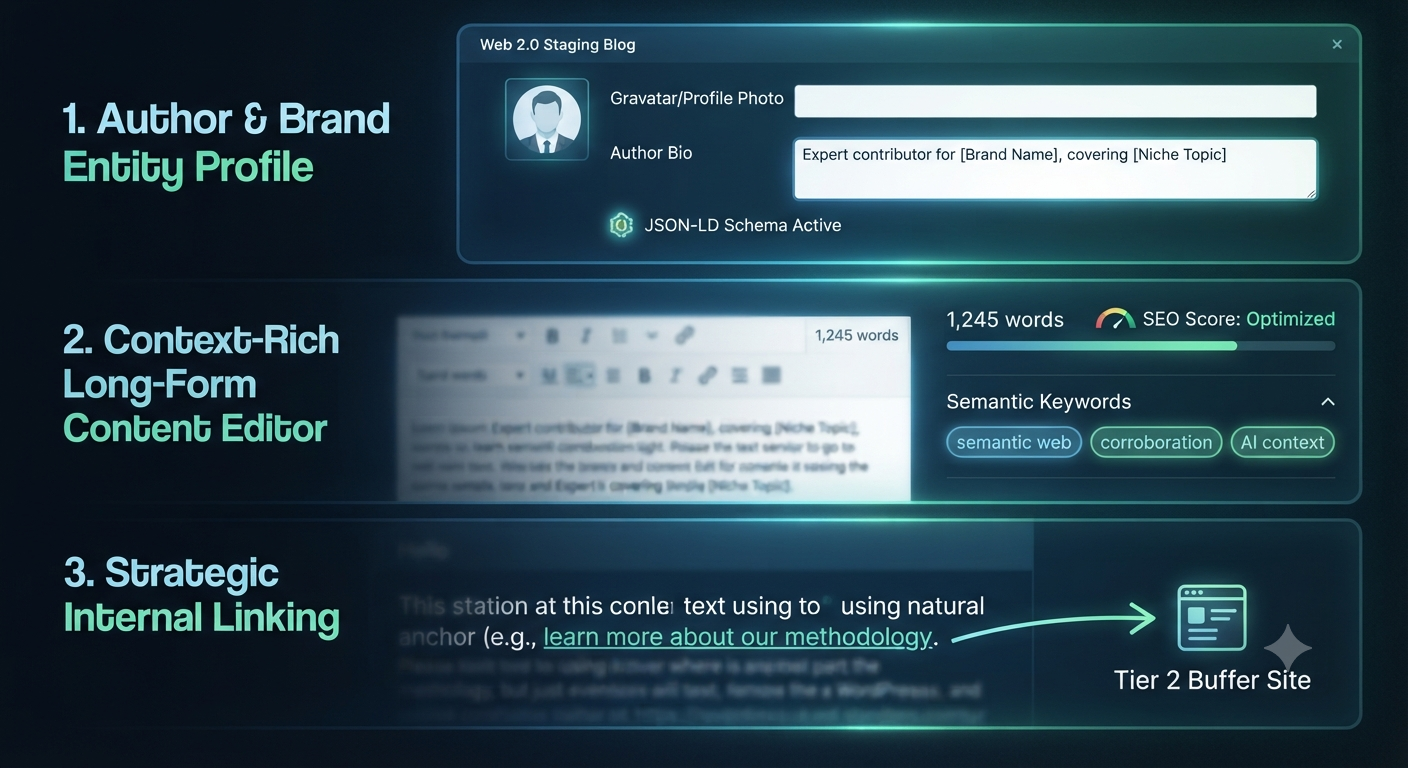
If you want your staging properties to successfully influence AI Overviews and push your main domain to position #1, you need to execute a precise, multi-step setup. Here is the exact framework I use.
Step 1: Establish a Clear Author and Brand Entity on the Subdomain
Before you write a single word of content on your Web 2.0 property, you must establish who owns it in the eyes of an LLM.
-
Use a consistent author bio across your staging network that matches your primary brand or a designated expert persona.
-
Link out to authoritative, non-competing external sources (such as Wikipedia, industry standards bodies, or major news outlets) to help Google’s crawlers contextualize the niche.
-
Integrate basic JSON-LD schema markup where permitted (such as on custom WordPress.com or Blogger setups) to explicitly declare the organization and author entity.
Step 2: Craft Long-Form, Context-Rich Content
Generative engines crawl content to synthesize answers for users. If your Web 2.0 article reads like a shallow list of keywords, it won’t be referenced.
-
Write comprehensive, human-sounding content (ranging from 800 to 1,500 words) that answers specific sub-queries related to your main topic.
-
Use natural semantic variations and related terms so that machine learning models recognize the page as an authority on the broader subject matter.
-
If you are looking for ways to scale your outreach and support these staging properties with premium off-page assets, you can explore options on how to buy backlinks safely and effectively.
Step 3: Implement Strategic Internal Linking and Tiered Staging
A Web 2.0 property should never exist in a vacuum. It needs to be part of a structured ecosystem.
-
Link internally between your different Web 2.0 properties to form a tight, cohesive semantic web.
-
Point your contextual links back to your money site using natural, brand-forward anchor text ratios.
-
To see how these tactical structures compare to other modern off-page methods, read my comparison on Web 2.0 backlinks vs Cloud Stacking.
How AI Overviews Read and Cite Web 2.0 Staging Nodes
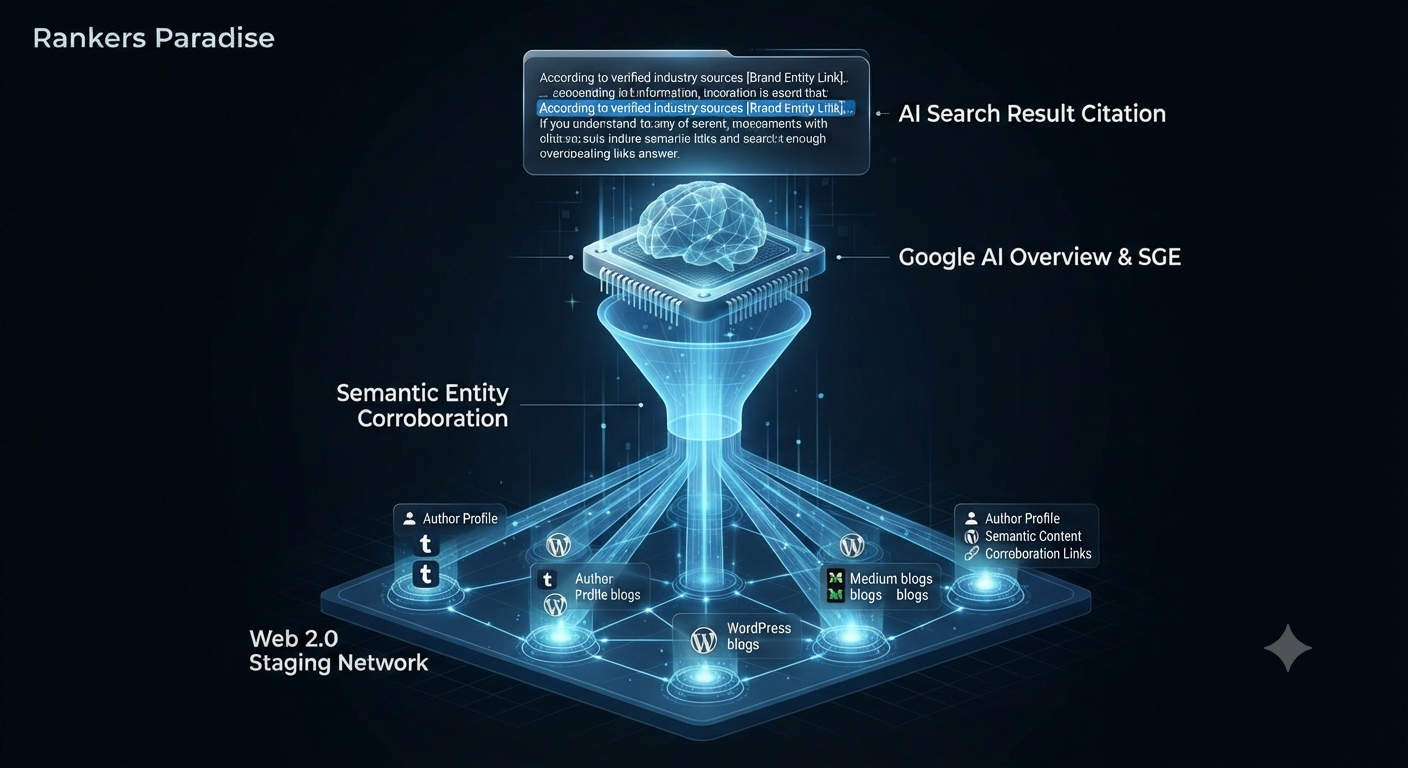
When an AI Search Generative Engine compiles an answer for a high-intent user query, it evaluates sources based on consensus and entity corroboration.
If your primary money site is the only place talking about a specific product, service, or framework, the AI might hesitate to cite you as the definitive authority. However, when Google bot crawls your structured Web 2.0 staging network—and sees consistent brand mentions, aligned author entities, and supportive contextual links pointing toward your domain—it builds a web of confidence.
The AI recognizes that your brand is corroborated across multiple independent hosting environments. This drastically increases the probability that your content will be pulled directly into the coveted AI Overview box at the top of the search results.
Final Thoughts
The search landscape is changing faster than ever, but the core fundamentals of off-page dominance remain the same: those who adapt to algorithm shifts early win the lion’s share of the traffic.
By shifting your mindset away from spammy link-building and moving toward Web 2.0 Entity Staging for AI Overviews and Search Generative Engines, you future-proof your assets against every upcoming Google update. Take action on this framework today, build your staging nodes with precision, and watch your organic rankings climb to the top of the SERPs.