
If you are looking at web 2.0 backlink packages, I am going to save you some time.
Do not buy a package just because it contains hundreds of links.
I have been building and testing backlinks for years at Rankers Paradise. I have used Web 2.0 sites as Tier 1 links, Tier 2 links, standalone properties and as part of link wheels. I have tested different anchor text, different amounts of content and different ways of getting the URLs crawled.
One thing has remained pretty consistent.
More links does not automatically mean better rankings.
I would rather have a small package of properly built Web 2.0 properties containing decent content than 500 empty accounts created by software.
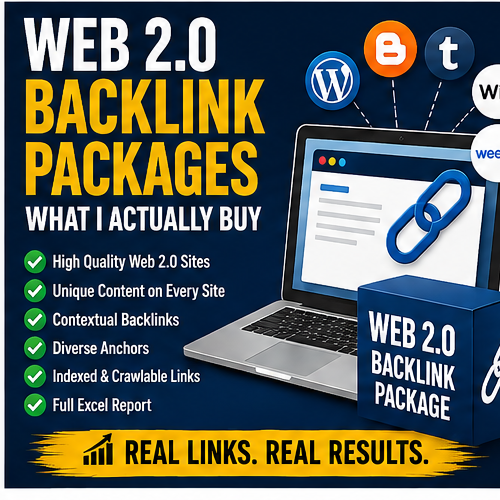
There is a big difference between the two.
In fact, you can build these backlinks yourself for free.
The platforms are not what you are really paying for when you buy a package. You are paying somebody to do the boring work for you.
And there is quite a lot of boring work.
You need to create the accounts, set up the sites, write the content, add images, place the links, vary the anchors, publish everything, record the URLs and then make sure search engine crawlers can actually discover what you built.
That takes time.
So let’s look at what I think you should actually be getting for your money.
What Is a Web 2.0 Backlink Package?
It is simply a bundle of backlinks created on websites that allow users to create their own pages, blogs or sites.
Some of the platforms I have used over the years include:
- WordPress.com
- Blogger
- Tumblr
- Wix
- Weebly
- Strikingly
- SITE123
You create an account, build a page or blog, add some relevant content and place a contextual link within that content.
That sounds easy.
It is.
The problem is that doing it properly takes considerably longer than blasting out a load of accounts with software.
This is where cheap packages normally fall apart.
You might receive a spreadsheet containing 100 URLs, but when you actually start opening them you discover thin pages, duplicated text, irrelevant content, dead accounts or links sitting on pages that search engines have little reason to crawl.
I am not interested in how impressive a spreadsheet looks.
I am interested in what happens to the keyword ranking.
That is the whole point of building the links in the first place.
Web 2.0 Backlink Packages Are Really Time-Saving Packages
This is the easiest way to look at them.
WordPress.com does not charge you $20 every time you put a backlink on a free blog.
Neither does Blogger.
You can go and create the properties yourself.
I have an entire guide showing exactly how I build web 2.0 backlinks step-by-step. If you have the time, follow that and do the work yourself.
There is nothing magical hiding behind the curtain.
When you buy a package, what you should be paying for is:
- Research.
- Account creation.
- Site setup.
- Content.
- On-page optimisation.
- Link placement.
- Sensible anchor text.
- Images and other media.
- Crawl discovery.
- Reporting.
That is where the value is.
If somebody removes most of those steps, the package can become very cheap.
It can also become fairly useless.
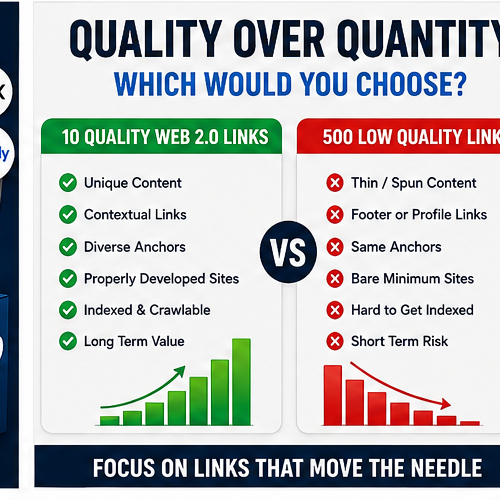
10 Web 2.0 Backlinks Can Be Better Than 500
People naturally gravitate towards the biggest number.
I understand why.
If one seller offers 10 links for $50 and somebody else offers 500 for $20, the second offer appears to give you considerably more for your money.
But SEO does not work like buying screws from a hardware shop.
A backlink isn’t a standard unit.
Two links can have completely different characteristics.
Take one properly developed WordPress blog.
It has a relevant name, an About page, unique content, images, several internal pages and a contextual backlink sitting naturally inside a useful article.
Now compare that with 50 automatically generated profiles containing a sentence of spun text and a link.
Would I swap the WordPress property for the 50 profiles?
No.
Not a chance.
This is one of the first things I look at when assessing any backlink package.
What am I actually buying?
Do not stop at the number.
What I Look for Before Buying a Package
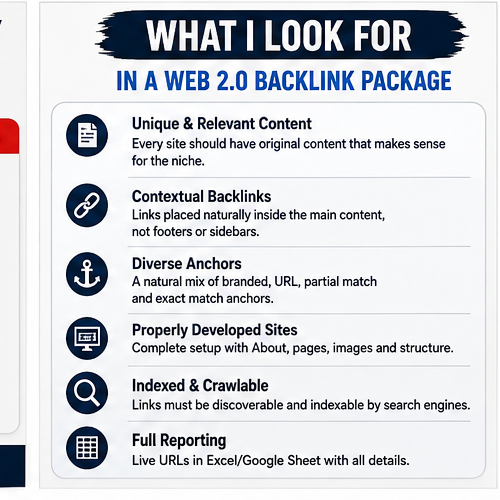
I have a pretty simple checklist.
Are the properties actually developed?
A blank Web 2.0 profile with one backlink on it is not what I want.
I want the property to resemble a genuine site.
It does not have to win a design award.
It just needs enough substance to give the page some purpose.
Is the content unique?
If exactly the same article has been dumped across 50 properties, I don’t like it.
I want different content on each site.
The content should also make sense for the website receiving the backlink.
If I am linking to a plumber in London, I don’t want an article about cryptocurrency surrounding the link.
Is the backlink contextual?
This is a big one.
I want the backlink sitting inside the main content.
I do not want every link shoved into a profile, footer or sidebar simply because that is faster to automate.
Context matters.
The words surrounding a backlink help establish what the linked page is about.
Are the anchors varied?
I do not want 50 backlinks all using exactly the same money keyword.
That is lazy link building.
I use a mixture.
Brand anchors.
URLs.
Page titles.
Generic anchors.
Partial matches.
And carefully selected exact-match anchors when appropriate.
You do not need to scream your keyword at Google from every backlink you create.
Can the pages be crawled?
This one gets overlooked all the time.
You can build the greatest Web 2.0 page in the world, but if search engine crawlers never discover the URL, what exactly have you achieved?
This is why I pay attention to crawl discovery after the properties are built.
The Biggest Mistake I See With Cheap Web 2.0 Packages
Automation itself is not the problem.
Bad automation is.
I have used SEO software myself for years. Software can save an enormous amount of time.
But there is a difference between using software to speed up repetitive jobs and allowing software to make every decision.
That is where footprints appear.
Imagine creating 100 sites at exactly the same time.
Every site uses the same template.
Every article has the same structure.
Every backlink uses the same anchor.
Every property links to the same page.
Nothing else gets added.
That does not look like 100 independent websites.
It looks like somebody pressed a button.
I prefer variation.
The internet is messy.
Your backlinks can be messy too.
New Web 2.0 Properties vs Aged Properties
You will see sellers charging more for aged Web 2.0 backlinks.
Sometimes the additional cost is justified.
Sometimes it isn’t.
An old account isn’t automatically powerful because somebody registered it five years ago.
I want to know what happened to that property during those five years.
Does it have backlinks?
Does it have content?
Has the content been crawled?
Does the site have any history?
Is the property still healthy?
An aged property with history can be interesting.
An empty five-year-old account isn’t suddenly an SEO monster because there is an old registration date attached to it.
Do not pay for the word aged.
Pay for what the property actually has.
Should the Web 2.0 Content Be Long?
It needs to be long enough to do the job.
I don’t use a silly rule such as every article must contain exactly 1,000 words.
Sometimes 600 words is plenty.
Sometimes I want considerably more.
The page should properly cover the subject surrounding the backlink.
That gives you somewhere natural to place the link, related terminology, headings, images and additional resources.
I also prefer a property to contain more than one page where practical.
Think about how real websites look.
They aren’t normally one page containing 700 words and a backlink followed by absolutely nothing else.
The more effort you put into the property, the more useful the asset becomes.
And remember that you control it.
You can return later and add another article.
You can point another link into it.
You can update old content.
You can use it to support another relevant page.
This is why I have always liked Web 2.0 properties.
You are building an asset rather than renting a link placement you might lose next month.
What Should Web 2.0 Backlink Packages Cost?
This is difficult to answer with one number because the work can be completely different.
Think about two packages.
Package A
100 links.
Automated account creation.
Thin content.
No proper site setup.
No crawl work.
No useful report beyond a URL list.
Package B
10 manually developed properties.
Different content on every site.
Images.
Contextual backlinks.
Mixed anchors.
Proper site setup.
Crawl discovery.
Full report.
Package A can obviously be sold much cheaper.
There is hardly any labour involved.
So when comparing prices, calculate what is actually being done rather than dividing the price by the number of links.
Cost per backlink can be a terrible way to buy SEO.
A cheap link that does nothing isn’t a bargain.
Do Web 2.0 Backlinks Still Work?
I don’t like answering SEO questions from theory when I can test them.
So I tested this.
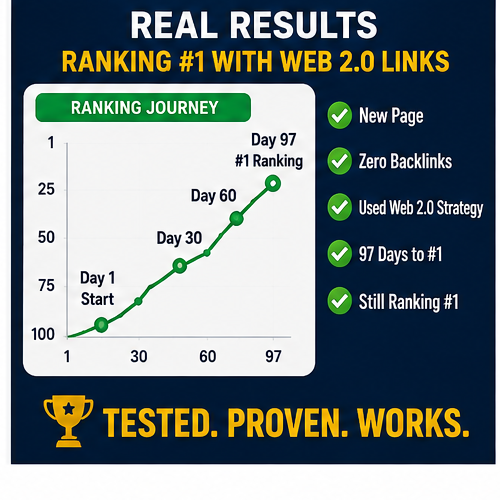
I created a page on Rankers Paradise and used Web 2.0 properties to build backlinks to it. I recorded the ranking movement publicly rather than simply telling people the strategy worked.
The page climbed through Google’s organic results over the following months.
After 97 days it reached the number one position for the target keyword.
I continued checking it.
The page was still sitting at number one when I updated the case study in 2026.
You can see the screenshots and follow the experiment yourself in my Web 2.0 guide.
That is much more useful to me than somebody on an SEO forum saying:
“Web 2.0 links stopped working years ago.”
Did they?
I tested them.
They moved the page.
That doesn’t mean you can throw 5,000 junk Web 2.0 links at every website and expect the same result.
It means I know the strategy can still produce ranking movement when I control how it is done.
There is a difference.
I Prefer Testing Links to Arguing About Them
SEO gets unnecessarily complicated.
People argue about whether a type of backlink works.
I would rather build the backlink and watch the SERPs.
That tells me what I need to know.
I have done the same thing with link wheels.
Instead of writing a theoretical article about what a link wheel might do, I built one and tracked the result.
If you want to see the structure, take a look at my Web 2.0 link wheel tutorial.
The principle behind my SEO has always been pretty simple:
Build. Track. Adjust. Repeat.
If rankings improve, I have something worth investigating further.
If nothing happens, I change the strategy.
There is no point becoming emotionally attached to a backlink type.
Google does not care what your favourite SEO strategy is.
What About Google’s Link Spam Policies?
You need to understand the other side of this before buying anything.
Google’s spam policies specifically discuss links created primarily to manipulate rankings and automated programs or services used to create links.
Read Google’s current spam policies for web search before starting a link campaign.
Don’t take my word for it.
Go directly to Google and read the policy yourself.
That is especially important if you are buying backlinks.
There is no backlink package that comes with a magic “Google safe” sticker.
Link building intended to manipulate rankings carries risk.
Understand what you are doing and make your own decision.
I cover this subject in considerably more detail in my guide on how to buy backlinks, including what I look for before spending money on a link.
Tier 1 or Tier 2?
Another question worth asking before ordering is where the links are going.
I use Web 2.0 properties in different places depending on the project.
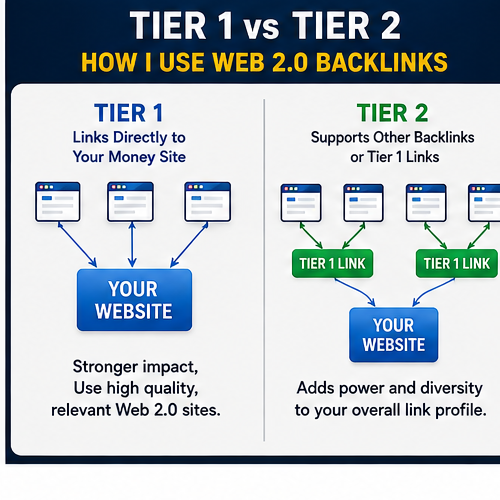
Tier 1
The Web 2.0 page links directly to the website I am trying to rank.
If I am doing this, I pay considerably more attention to the property.
I want better content.
I want sensible anchors.
I want relevance.
I want the page to look like somebody actually cared when they created it.
Tier 2
The Web 2.0 page supports another backlink rather than pointing directly to the money site.
This gives you another layer.
There are many ways to structure tiered campaigns, and I don’t use exactly the same setup for every website.
The keyword competition matters.
The existing backlink profile matters.
The age of the site matters.
What has already been done matters.
There isn’t one backlink package that magically fits every domain on the internet.
Link Wheels Are Another Option
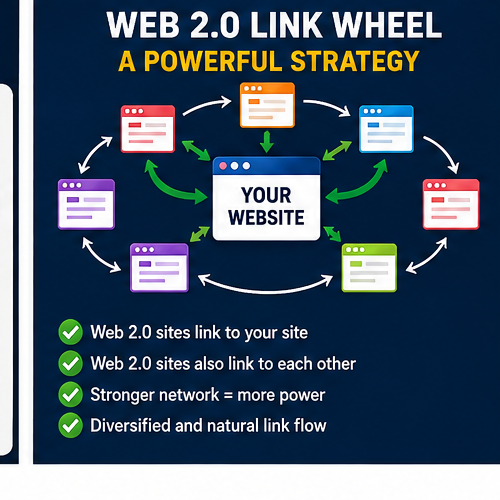
You can also connect the properties.
This is something I have tested extensively.
Imagine five Web 2.0 sites.
Site A links to your money site and Site B.
Site B links to your money site and Site C.
Site C links to your money site and Site D.
Continue the structure and eventually close the wheel.
Now the Web 2.0 pages are not sitting alone.
They have links flowing between them.
I have a complete tutorial showing how I have built and tested these structures.
Again, you don’t have to pay anybody.
You can copy the process and build one yourself.
What you are buying from a service is time.
How Many Web 2.0 Backlinks Do You Need?
There isn’t a universal number.
I wish there was because SEO would be much easier.
I look at the keyword first.
Then I look at the pages already ranking.
Then the site’s existing links.
Then the target page.
A very weak keyword might move with a handful of decent links.
A competitive commercial keyword can require an ongoing campaign involving several different link types.
This is why I don’t like the idea that:
10 links = position 10
20 links = position 5
50 links = position 1
Google doesn’t work like that.
Look at your competition before deciding what you need.
Do Not Ignore Your Existing Backlinks
Before piling another package onto an established website, see what is already there.
I have seen sites with enormous backlink profiles that needed cleaning up and better direction rather than another random batch of links.
Check:
- Referring domains.
- Anchor text.
- Lost links.
- Broken backlinks.
- Spammy domains.
- Strong existing links.
- Which pages receive links.
- Which pages don’t.
- What competitors have that you don’t.
I have put together a complete backlink audit process showing how I approach this.
Do that first if you have no idea what has previously been built to your site.
Otherwise you are buying links blind.
The Niche Changes the Way I Build
I don’t approach every website exactly the same.
This becomes particularly obvious in competitive markets.
Take gambling.
I documented an iGaming SEO project where we took a brand-new site from zero to a number one Google ranking.
Competitive niches force you to think beyond buying a random batch of backlinks.
You need to consider the entire site, target pages, internal links, content, link velocity, anchor distribution and what the competitors are doing.
That is why I would never tell somebody:
“Buy this exact package and you are guaranteed number one.”
Nobody can know that before looking at the keyword and website.
What I can do is show you what I have tested and the results I have actually recorded.
Then you can make a decision using evidence.
What I Would Avoid
There are a few things that immediately put me off a package.
Thousands of links delivered overnight.
I don’t need them.
Exactly the same content everywhere.
Lazy.
100% exact-match anchors.
No thanks.
No URLs supplied after completion.
If I paid for the work, I want to see it.
No information about where the links are being built.
What exactly am I buying?
Properties that disappear after a few weeks.
That is wasted work.
A seller guaranteeing a particular Google position.
Nobody controls Google.
Huge numbers at suspiciously low prices.
Ask yourself how much genuine human work can possibly go into 1,000 backlinks being sold for $10.
Probably not much.
What I Want Included in a Good Package
If I were buying today, this is what I would be looking for:
| Feature | What I Want |
|---|---|
| Creation | Manual or carefully supervised |
| Content | Unique and relevant |
| Placement | Contextual |
| Anchors | Mixed naturally |
| Platforms | Established Web 2.0 sites |
| Images | Different media where appropriate |
| Site setup | Properly developed properties |
| Crawl discovery | Included |
| Reporting | Every live URL supplied |
| Login details | Preferably supplied where possible |
| Delivery | Staggered when appropriate |
| Relevance | Content matched to the target |
| Quantity | Based on quality, not inflated numbers |
That is considerably more useful than seeing:
5,000 HIGH DA WEB 2.0 BACKLINKS — $9.99
Big numbers sell SEO services.
They don’t necessarily rank websites.
Should You Buy a Package or Build the Links Yourself?
If you are learning SEO, build them yourself first.
Seriously.
You will understand far more about link building after manually creating 10 Web 2.0 properties than you will after reading another 50 SEO articles.
You will see which platforms are easy to use.
You will see which ones delete accounts.
You will understand how long the work takes.
You will discover which pages get crawled quickly.
You will see how anchor text works inside contextual content.
And you will begin to understand why one backlink can be worth considerably more than another.
Once you understand the process, outsourcing it makes much more sense.
You know what you are paying somebody to do.
When I Would Pay Somebody Else
Time.
That’s it.
If I have a website that is making money and my time is better spent working on the business, I don’t necessarily want to spend an afternoon creating accounts and formatting blog posts.
At that point outsourcing makes sense.
But I still want the work done the way I would do it myself.
This is how I approach client sites at Rankers Paradise.
We work on the website as if it was our own.
That means I care about what goes onto the report.
I don’t want to hand somebody a spreadsheet containing rubbish simply because I can say the order has been completed.
The backlinks have a job to do.
Do Not Buy a Package and Forget About It
This is another mistake.
SEO is not:
Buy links → wait three days → rank #1 → finished forever.
Track the target keyword.
Record the starting position.
Build the links.
Give search engines time to discover them.
Watch what happens.
If the page moves from position 40 to position 19, something happened.
If it moves from 19 to 8, you are getting somewhere.
If nothing changes, investigate why.
Maybe the links haven’t been crawled.
Maybe the page itself isn’t good enough.
Maybe your keyword is considerably harder than you thought.
Maybe competitors are building links too.
Maybe you need another link type.
SEO is a moving target.
You need to monitor it.
My Simple Web 2.0 Package Strategy
If I were starting a fresh campaign today, I would keep things simple.
Step 1: Choose the target page.
Do not scatter links around without knowing what you are trying to rank.
Step 2: Choose the target keyword.
Look at the actual Google results.
Step 3: Check your current backlink profile.
Know your starting point.
Step 4: Build a small batch of quality Web 2.0 properties.
Do not immediately go crazy with volume.
Step 5: Mix the anchors.
Brand, URL, title, generic and selected keyword variations.
Step 6: Get the URLs discovered.
A backlink nobody finds isn’t much use to you.
Step 7: Track the keyword.
Write down the starting position.
Step 8: Wait and observe.
SEO isn’t instant.
Step 9: Adjust the campaign from the results.
If you get movement, you have data.
Step 10: Keep good links flowing.
This is where patience wins.
I have watched rankings crawl upwards over weeks and months.
People often quit because nothing dramatic happened after seven days.
Then somebody else keeps building and takes the position they wanted.
Frequently Asked Questions
Are Web 2.0 backlink packages worth buying?
They can be if the properties are properly developed and you are paying to save yourself time. I would judge the package by the quality of the properties, content, contextual placements and reporting rather than the raw backlink count.
Are Web 2.0 backlinks free?
You can create many of them yourself without paying for the platform. When you purchase a service, you are primarily paying for the labour, content, setup and management involved in building them.
How many should I buy?
Base the quantity on your website, keyword competition and existing backlink profile. There is no fixed number that guarantees a particular Google position.
Are 100 Web 2.0 backlinks better than 10?
Not automatically. I would choose 10 properly developed properties over 100 junk pages if those were my only options.
Should every backlink use my target keyword?
No. I use a varied anchor profile rather than repeating the same exact-match anchor on every property.
Should the links point directly to my website?
They can. That is a Tier 1 placement. Web 2.0 properties can also be used on secondary tiers to support other backlinks.
Do Web 2.0 backlinks still work in 2026?
I have tested them on Rankers Paradise and documented the ranking movement publicly. One of my tests reached the number one Google position after 97 days, and later checks showed the page retaining number one rankings for its targets.
Can Web 2.0 links hurt a website?
Any manipulative link-building activity can carry risk, particularly when it is automated at scale or creates obvious unnatural patterns. Read Google’s spam policies and understand that risk before building or purchasing links.
What platforms can be used?
WordPress.com, Blogger, Wix, Weebly, Tumblr, Strikingly and SITE123 are examples of platforms I have used. Platforms change over time, so I don’t assume a site that worked years ago is automatically worth using today.
What is the most important thing to check before ordering?
I would ask exactly what gets created. “50 Web 2.0 backlinks” tells me almost nothing. I want to know about the properties, content, anchors, placement, crawl process and reporting.
Final Thoughts
I have been doing this long enough to know that the shiny package with the biggest number is not always the one I want.
I don’t care if somebody promises me 100, 1,000 or 10,000 links.
Show me the actual work.
Show me where the backlink goes.
Show me the content surrounding it.
Show me the anchor strategy.
Show me the live URLs.
And then I will watch what happens to my rankings.
That is how I approach link building.
You can build Web 2.0 properties yourself for free, and I have published the process so you can copy what I do.
If you don’t have the time, then paying somebody to do the work makes sense.
Just make sure you are buying the work, not an impressive number on a sales page.
Quality first. Track the results. Keep the links flowing.
That is what matters.