
If you’ve been searching for PBN links for sale, you’ve probably seen the same promises everywhere:
“High-authority domains.”
“DA 50+ websites.”
“Permanent dofollow links.”
“Safe private blog network.”
Sounds impressive. Often, it’s pure nonsense.
Many sellers are offering recycled domains, thin content, inflated metrics, and the same website inventory to dozens of customers. You pay for “powerful” links, wait for rankings to move, and get absolute silence.
I’ve tested link-building methods for years. I’ve seen strong campaigns produce real movement, and I’ve seen cheap PBN packages burn budgets while delivering nothing but a spreadsheet full of junk URLs.
This guide shows you how to inspect PBN links before you buy them, what red flags to avoid, and when a safer backlink strategy makes more sense.
The uncomfortable truth about “private” blog networks
A private blog network is usually a group of websites controlled by one person or company. The domains are often aged or expired, rebuilt with new content, and used to link to selected money sites.
The problem is obvious: if someone is publicly advertising the network and selling placements to anyone, it isn’t truly private anymore.
A genuine private network is controlled for limited use. A public network selling PBN links at scale is a different animal. It often leaves footprints:
- Similar hosting or server patterns
- Reused WordPress themes
- Thin, generic articles
- Identical site structures
- Unrelated commercial niches
- Excessive outbound links
- Repeated anchor-text patterns
- The same domains sold to multiple buyers
That doesn’t mean every domain with an aged history is worthless. It means you need to investigate the actual website instead of trusting a shiny DA or DR number.
Google also classifies links created primarily to manipulate rankings as link spam. Review Google’s link spam policies before you invest. A “premium” label doesn’t remove the underlying risk.
What do PBN links for sale usually include?
Most PBN packages follow a familiar structure. A seller offers a fixed number of links on aged domains, usually with claims about authority, permanent placement, homepage visibility, contextual content, and fast delivery.
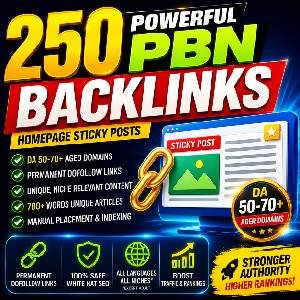
For example, the Rankers Paradise PBN backlinks service advertises 250 homepage sticky-post placements on aged domains with advertised DA50–70+ metrics, unique niche-relevant articles, multiple languages, and a backlink report.
Those are clear deliverables. But clear deliverables aren’t the same as guaranteed ranking value. You still need to assess:
- Whether the domains have genuine organic traffic
- Whether the content is useful and relevant
- Whether the sites are indexed
- Whether the domains link to suspicious industries
- Whether the network shows technical or editorial footprints
- Whether the links fit your broader SEO strategy
This is where inexperienced buyers get caught. They purchase based on volume and metrics, then discover that the links are ignored or disappear after a few months.
How to spot a real website behind the sales pitch
Before you buy PBN links, inspect the domain as if you were considering buying the entire business.
1. Check organic traffic, not just DA or DR
DA and DR are third-party metrics. They’re useful for comparison, but they’re not proof of quality.
A seller can advertise a domain with DR 60, yet the site may have almost no organic traffic. That often points to:
- A dropped domain
- A manipulated backlink profile
- A domain hit by an algorithm update
- A site built only to sell links
- Traffic that existed years ago but has since vanished
Use Ahrefs, Semrush, or another reliable tool to inspect the traffic trend. Look for stable or growing visibility over time. A sudden cliff is a warning sign.
A high metric with zero traffic is not authority. It’s decoration.
2. Inspect the domain’s history
Use the Wayback Machine or a comparable archive to see what the domain used to be.
Was it previously a real business, publication, community, or organisation? Or was it a completely unrelated site that changed topic three times?
A domain that was once about gardening, then became a crypto blog, then turned into a casino website has a messy history. That doesn’t automatically make it useless, but it should make you slow down.
You also need to check whether the domain was previously used for:
- Adult content
- Gambling
- Pharmaceuticals
- Foreign-language spam
- Auto-generated pages
- Link directories
- Redirect schemes
Domain history matters because search engines don’t forget every old signal simply because a new logo was added.
3. Read the recent articles
Open the last 10 to 20 posts. Don’t skim only the page where your link will appear.
Ask yourself:
- Are the topics connected?
- Do the articles help a real audience?
- Are they written in a consistent voice?
- Do they contain useful research or original insight?
- Does every post contain a commercial backlink?
- Are the articles full of awkward keyword insertions?
A real website can publish sponsored content. That’s not the same as publishing nothing but paid SEO articles.
If the site links to a casino, a payday loan company, a CBD store, a crypto project, and a plumbing business within the same week, you’re looking at a junk neighbourhood.

4. Look for shared technical footprints
You don’t need to be a forensic SEO expert to spot obvious patterns.
Compare multiple domains from the seller’s list. Look for:
- Identical themes and layouts
- Matching menus and category structures
- Similar author profiles
- Repeated image styles
- Shared analytics or tracking patterns
- The same hosting provider or IP range
- Similar publication schedules
- Identical contact pages
- Cross-linking between network websites
One shared signal doesn’t prove a network. Several signals together are the problem.
The phrase “no footprint” is another red flag. Every website has signals. The question is whether the provider has built a credible group of sites or a wall of generic junk designed to sell links.
5. Analyse the backlink profile
Open the referring domains and anchor-text reports.
Watch for:
- Hundreds of links from unrelated countries
- Exact-match commercial anchors used repeatedly
- Casino, adult, pharma, or gambling anchors
- Huge numbers of sitewide links
- Links from obvious directories
- A high number of deleted or lost links
- Very few genuine editorial references
A healthy site doesn’t need a perfect backlink profile. Real websites are messy. But there should be a believable connection between the site’s content, audience, links, and authority.
If the backlink profile looks manufactured, the domain probably won’t give your campaign the clean boost you’re expecting.
The biggest warning signs when you purchase high quality backlinks
Be cautious if a provider promises any of the following:
- Guaranteed first-page rankings
- Hundreds of links delivered in a few days
- “Permanent” links with no replacement policy
- DA or DR as the only quality measure
- Exact-match anchor text on every placement
- A private network with thousands of public customers
- No sample domains before payment
- No information about traffic or indexation
- Identical content across every placement
- Prices that are dramatically below the market
Cheap links aren’t always bad. Expensive links aren’t always good. But extremely cheap, high-volume packages usually cut corners somewhere: domain quality, content, vetting, reporting, or all four.
Do not buy a package just because the number looks impressive.
Two relevant links from real sites can be more useful than 250 ignored placements. Quality over quantity isn’t a slogan here. It’s the difference between building authority and buying noise.
PBN links versus safer editorial placements
PBN links can provide a short-term signal in some campaigns, but they carry a higher level of risk because the network is controlled and created primarily for link manipulation.
Editorial placements, niche edits, digital PR, and legitimate guest posts work differently. The linking site has its own audience, subject matter, editorial standards, and reason to publish content.
That doesn’t make paid placements automatically risk-free. Google’s policies still matter. But a relevant article on a real, traffic-earning website is a much stronger asset than a thin post on a public link farm.

Before you invest, ask:
- Would this website exist if it didn’t sell links?
- Would a real reader find the article useful?
- Does the link fit naturally in the surrounding content?
- Does the site receive genuine search traffic?
- Is the anchor text natural?
- Can the provider show you the exact placement?
- Will you receive a complete report?
If the answer to most of these questions is no, walk away.
A practical vetting checklist
Use this checklist before you order any PBN or paid backlink package:
- Organic traffic is visible and reasonably stable
- Traffic matches the website’s claimed niche
- The domain has a clean and believable history
- Recent content is unique and readable
- The website has a clear audience
- Outbound links are relevant and controlled
- Anchors are not aggressively exact match
- The site is indexed in Google
- The provider shares sample URLs
- Reporting includes live placement URLs
- The campaign supports your wider SEO plan
If a seller refuses to provide basic information, that refusal is information.
You can also review our practical guide on choosing a backlink provider before committing to a campaign. For a broader framework covering traffic, topical relevance, anchor distribution, and indexation, read our guide to backlink evaluation and acquisition.
So, should you buy PBN links?
The honest answer is: only if you understand the risk and have a controlled reason for using them.
PBN links aren’t a magic button. They won’t fix weak content, technical problems, poor internal linking, or an irrelevant offer. They also won’t protect you from a manual action or algorithmic devaluation.
If your website is a serious long-term brand, prioritise relevant editorial links, quality content, digital PR, and transparent link-building campaigns. If you’re evaluating PBN links for sale, judge the actual domains: not the seller’s buzzwords.
I’ve seen too many businesses waste money chasing “powerful” links that were never powerful at all.
Check the traffic. Check the history. Check the content. Check the neighbourhood.
Then make the decision with your eyes open.
That’s how you avoid the garbage.