
Let’s be honest for a second.
Most local SEO guides tell you the exact same thing: “Claim your Google Business Profile, get 5 local citations, and ask your plumber buddy for a link.”
That’s fine if you’re operating in a tiny town with zero competition. But what happens when you’re trying to rank a local plumber in a major city, or push a multi-location service business into the top 3 spots of the Google Map Pack?
Generic citations aren’t going to cut it. High-authority local guest posts cost a fortune, and most outreach takes forever.
That is where web 2.0 backlinks come into play.
When done right, Web 2.0 buffer blogs give you 100% control over the content, anchor text, location signals, and outgoing link power. When done wrong? You end up with zero indexing, zero rank movement, and a complete waste of time.
In this guide, I’m going to walk you through the exact step-by-step strategy to construct, optimize, and supercharge Web 2.0 properties specifically for local search rankings.
Do Web 2.0 Backlinks Still Work for Local SEO?
Yes—if you stop treating them like disposable spam sites from 2012.
Google’s search algorithm doesn’t hate Web 2.0 platforms like WordPress.com, Blogger, Medium, or Tumblr. In fact, Google loves these subdomains because they carry massive baseline domain authority and trust.
What Google does hate is thin, 300-word spun articles posted on a default theme with an exact-match anchor text slapped in the middle.
When you adapt Web 2.0 properties for Local SEO, you aren’t just sending raw link equity (PageRank) to your money site. You are injecting geo-relevancy signals into Google’s local index.
Why Local Web 2.0s Move the Needle:
-
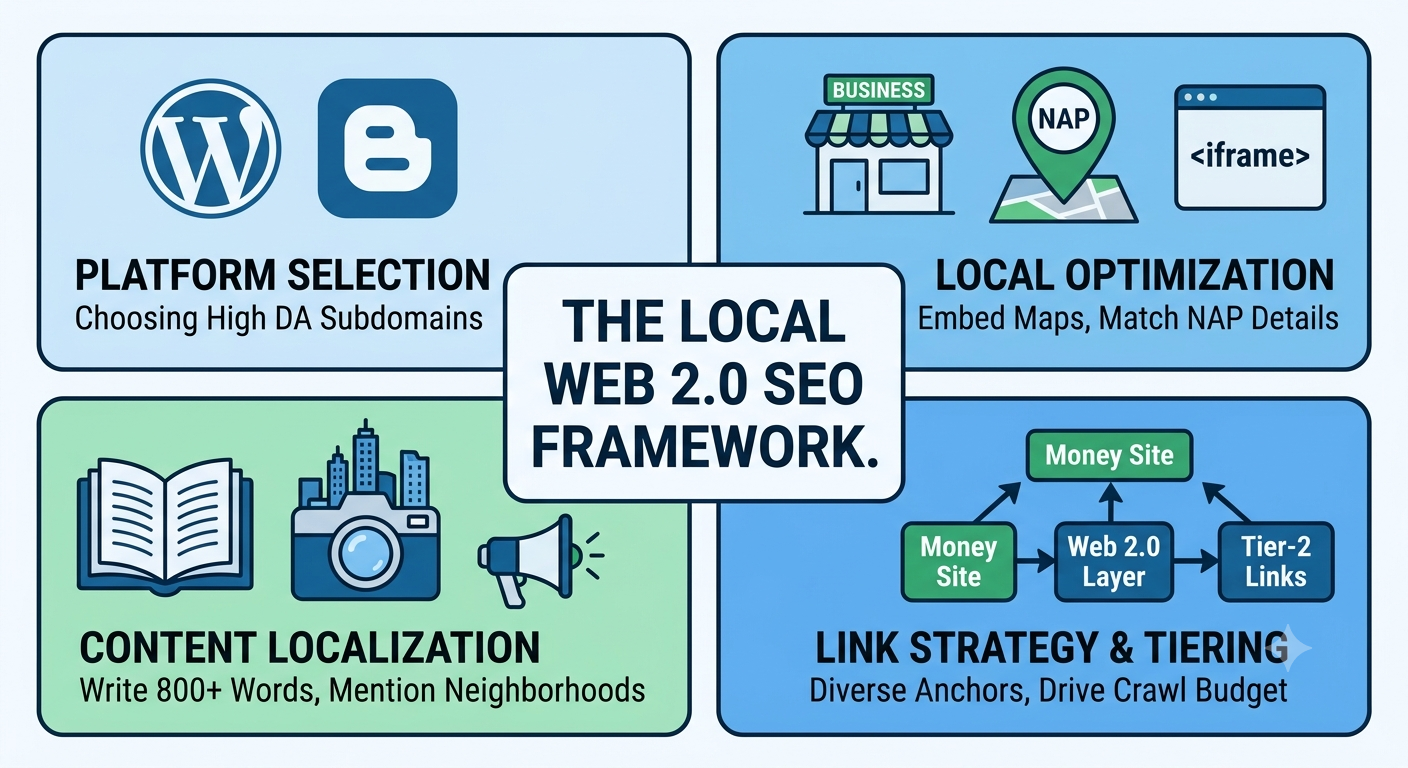
Geographic Entity Stacking: You can embed Google Maps, local NAP (Name, Address, Phone) details, and localized schema directly on high-DA domains.
-
Controlled Anchor Text Ratios: You can safely test local keyword variations (
[City] + [Service]) without risking a direct penalty on your target domain. -
Topical Relevance Buffer: You build a mini-network of localized web properties that pass contextual signals straight to your Google Business Profile (GBP) landing page.
Step 1: Choosing the Best Web 2.0 Platforms for Local SEO
You don’t need 100 random platforms. You only need 5 to 10 high-quality, reliable platforms that index fast and allow rich media embeds.
Here are the top picks for local link building:
| Platform | Domain Authority / Trust | Best Local Feature |
| WordPress.com | High | Full HTML control, custom widgets, schema integration |
| Blogger (blogspot) | High | Direct Google integration, fast indexing, easy iframe embeds |
| Medium | Very High | Massive topical authority, ranks quickly for long-tail geo terms |
| Tumblr | High | Great for image-heavy local content, reblog network signals |
| Wix / Weebly | Medium-High | Drag-and-drop local contact forms, clean footer NAP styling |
Step 2: Optimizing Your Web 2.0 Blog for Geo-Relevance
If your Web 2.0 post looks like an affiliate product review, Google will ignore it. It needs to read like an authentic, locally-focused resource hub.
1. The Localized Naming Convention
When registering your account and subdomain, incorporate the local area or service topic:
-
Bad:
bestseo491.wordpress.com -
Good:
denverplumbingsolutions.wordpress.comorcoloradohomeservices.blogger.com
2. Matching the NAP (Name, Address, Phone) Exactly
Include the exact Name, Address, and Phone number of the local business in the sidebar, footer, or author box of the Web 2.0 page. Ensure this data matches your Google Business Profile down to the exact abbreviation (e.g., “Suite 100” vs “#100”).
3. Embed the Google Map & GBP CID
This step is crucial for local map rankings.
-
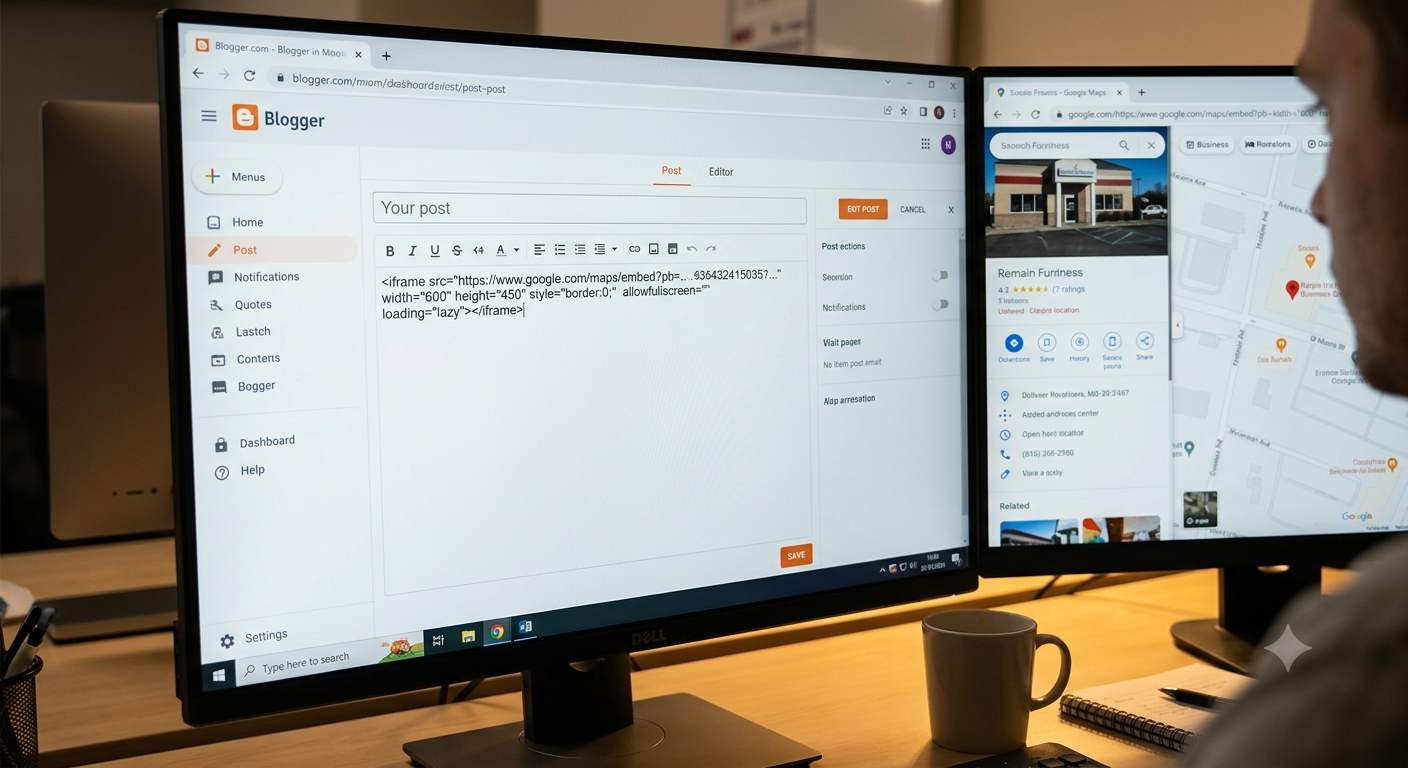
Head to Google Maps, pull up the target business listing, click Share, select Embed a map, and paste the iframe code directly into the Web 2.0 HTML body.
-
Alternatively, embed a custom Google My Maps route map showing directions from a local landmark to the business location.
HTML
<!-- Example Local Web 2.0 Embed Zone -->
<h3>Visit Our Local Office</h3>
<p><strong>Denver Plumbing Pros</strong><br>
123 Main St, Denver, CO 80202<br>
Phone: (303) 555-0199</p>

<!-- Google Map Iframe Embed -->
<iframe src="https://www.google.com/maps/embed?pb=YOUR_CUSTOM_MAP_CODE" width="100%" height="300" style="border:0;" allowfullscreen="" loading="lazy"></iframe>
Step 3: Writing High-Quality, Human-Level Local Content
To avoid AI detection and automatic web spam sweeps, your Web 2.0 content must look handcrafted.
Content Checklist for Local Web 2.0 Posts:
-
Length: Minimum 800 to 1,200 words per property.
-
Local References: Mention real local landmarks, nearby neighborhoods, city highways, local events, and weather quirks. (e.g., “Serving homeowners across Capitol Hill, Cherry Creek, and Highlands”).
-
Rich Media: Embed a relevant YouTube video about the service (or a video from the client’s own YouTube channel) and include 2-3 compressed, original geotagged photos.
-
Outbound Authority Links: Link out to 1-2 non-competing local authority sites (e.g., the local Chamber of Commerce, city government portal, or local Wikipedia page).
Step 4: Structuring Your Local Anchor Text Strategy
One of the biggest mistakes local SEOs make is over-optimizing their exact-match anchors on Web 2.0 properties. If every link points back to your homepage using “Emergency Plumber Denver”, Google will eventually slap your profile.
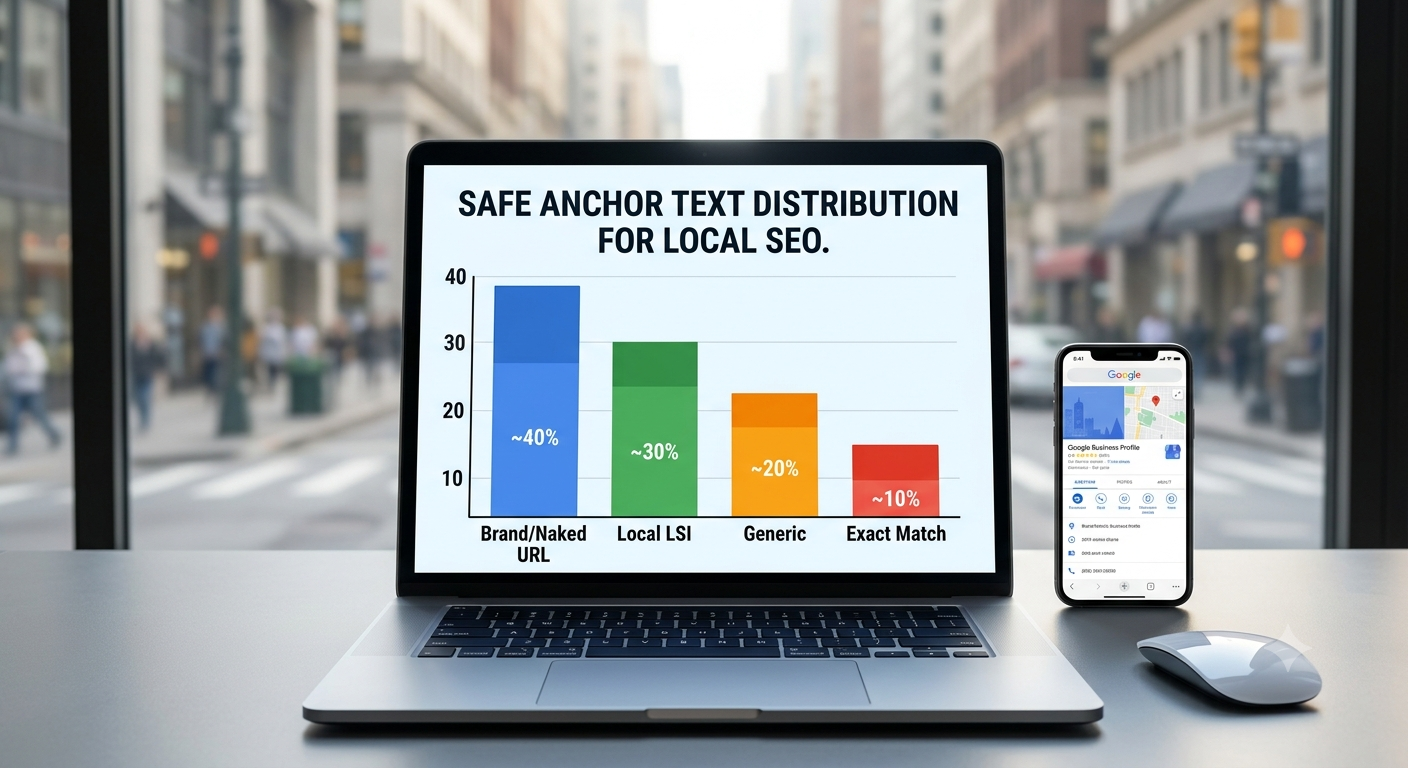
Use a natural anchor text distribution across your Web 2.0 layer:
[Target Money Site / GBP]
       ▲
       │─── 40% Brand / Naked URL ("Denver Plumbing Pros", "www.denverplumbingpros.com")
       │─── 30% Local LSI / Partial Match ("affordable plumbing in Denver", "view local services")
       │─── 20% Generic / Natural ("click here", "visit website", "check map")
       └─── 10% Exact Match ("Denver plumber")
If you prefer to skip the manual labor of hand-crafting dozens of buffer properties, you can always buy backlinks through trusted, done-for-you local packages that build manually-verified Web 2.0 link wheels.
Step 5: Indexing and Supercharging Your Web 2.0 Properties (Tier-2 Signals)
A Web 2.0 backlink that isn’t indexed by Google passes zero ranking value. Because Google has tightened its crawling budget for free subdomains, you must actively trigger indexation.
The Tier-2 Local Stack Blueprint
Instead of sending spam directly to your money site, use a multi-tiered link building approach. Build secondary links (Tier-2) pointing straight to your Web 2.0 properties:
-
Social Bookmarks & Pings: Share your Web 2.0 URLs across Reddit, Pinterest, and Twitter/X to generate instant referral traffic.
-
Tier-2 Citation Blast: Run a light tier of secondary directory links or social signals pointing directly at the Web 2.0 URL.
-
RSS Aggregation: Submit the RSS feed of your WordPress or Blogger property to RSS aggregators to force Googlebot to re-crawl the page.
For a deeper technical walkthrough on how to build interconnected buffer sites, check out our guide on how Google indexes backlinks directly from official documentation.
Key Takeaways for Local SEO Web 2.0 Success
-
Focus on Geo-Entities: Always embed Google Maps, local NAP data, and city-specific landmarks inside every Web 2.0 buffer post.
-
Diversify Your Anchor Text: Keep exact match anchors under 10-15% across your entire off-page footprint.
-
Quality Over Quantity: 5 deeply optimized, index-verified Web 2.0 properties with 1,000 words of localized content will outperform 100 auto-generated, thin blog posts every single time.
-
Feed the Buffers: Use Tier-2 indexing signals to push crawl frequency and authority into your Web 2.0 layer.
By turning standard Web 2.0 blogs into localized asset hubs, you pass strong geographic signals directly to your target pages, driving your business straight into the Google Map Pack and organic top spot.