
I am going to show you exactly how to audit a link building agency before buying backlinks. Follow this step-by-step guide to protect your money, protect your domain from manual penalties, and ensure every single dollar you spend on off-page SEO delivers real keyword ranking results in the Google organic SERPs.
Buying backlinks is one of the fastest ways to push your website to the top of Google. But if you hand over your hard-earned cash to an agency without auditing them first, you are playing russian roulette with your domain authority. Many link building vendors use glossy sales pages to hide low-quality PBNs, automated spam blasts, and dead sites with zero organic traffic.
If you want to buy backlinks safely, you need to know how to look under the hood. In this guide, I will walk you through my exact 7-step audit framework that you can use today to vet any agency or provider before you place an order.
What is a Link Building Agency Audit?
A link building agency audit is a manual check of an agency’s link acquisition methods, domain pool quality, and delivery transparency before you buy their service.
Instead of taking Domain Rating (DR) or Domain Authority (DA) numbers at face value, an audit checks the underlying metrics that Google bot actually cares about:
-
Real, consistent organic search traffic
-
Indexation speed and stability
-
Outbound link ratios and thematic relevance
-
Clean anchor text patterns and lack of footprint overlap
When you know how to run this audit step-by-step, you will instantly separate authentic, high-impact link builders from low-quality resellers.
Why You Must Audit Link Providers Before Purchasing
Most webmasters think that if an agency advertises “DR 50+ Guest Posts” or “High-Authority Niche Edits,” the links are guaranteed to move the needle. Unfortunately, third-party authority metrics are very easy to manipulate.
A seller can easily inflate a domain’s DR from 0 to 60 in less than 30 days by spamming thousands of automated links from redirect domains or low-grade platforms. Google bot completely ignores this artificial metric surge. If you buy a link on one of these bloated domains, you end up wasting your budget on a site that passes zero real ranking power.
By following this step-by-step audit, you eliminate the risk of burning your domain and ensure every link you purchase passes genuine trust to your site.
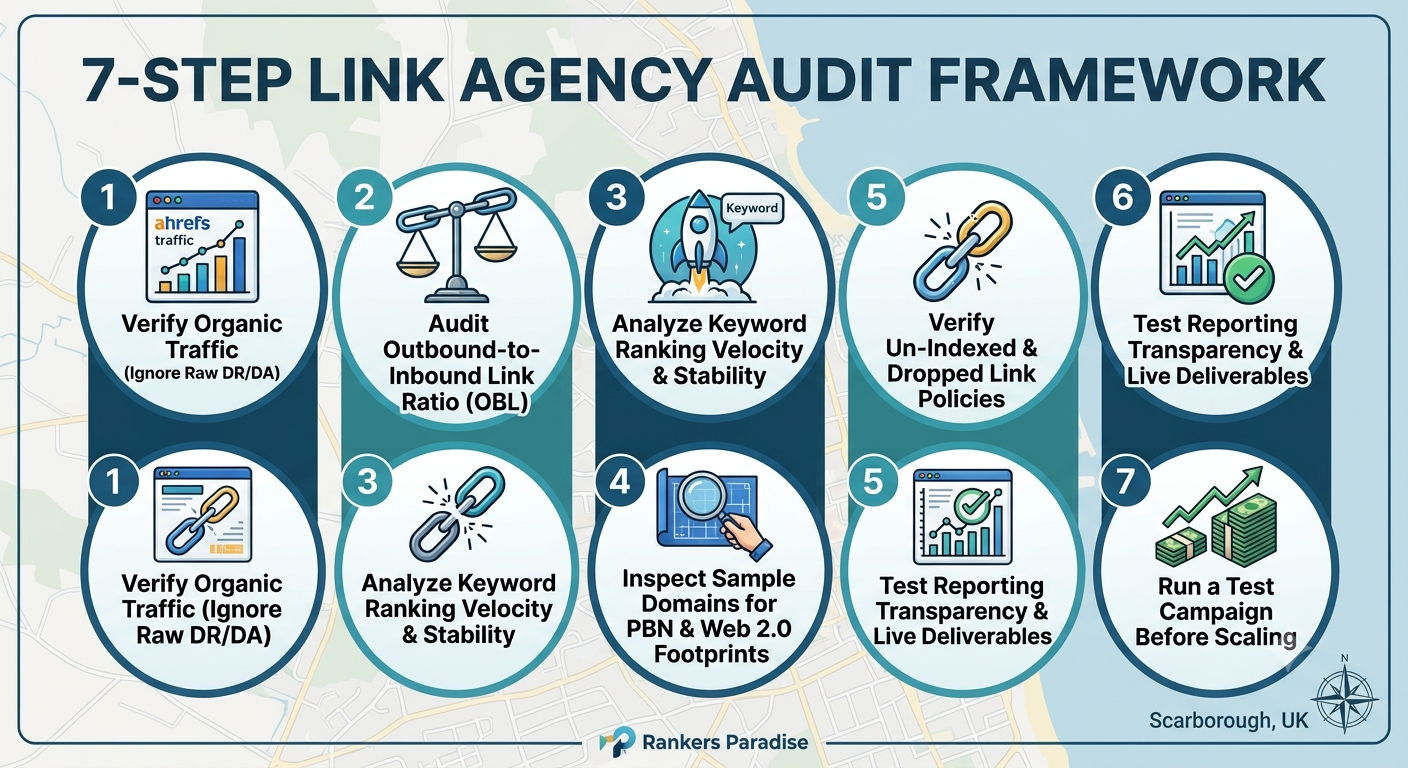
How to Audit a Link Building Agency Before Buying Backlinks (Step-by-Step)
Follow these 7 direct steps to vet any vendor, freelancer, or SEO company before sending payment.
+-------------------------------------------------------------------+
|              7-STEP LINK AGENCY AUDIT FRAMEWORK                   |
+-------------------------------------------------------------------+
|  [Step 1] Verify Organic Traffic (Ignore Raw DR/DA)                |
|  [Step 2] Audit Outbound-to-Inbound Link Ratio (OBL)               |
|  [Step 3] Analyze Keyword Ranking Velocity & Stability            |
|  [Step 4] Inspect Sample Domains for PBN & Web 2.0 Footprints      |
|  [Step 5] Verify Un-Indexed & Dropped Link Policies                |
|  [Step 6] Test Reporting Transparency & Live Deliverables          |
|  [Step 7] Run a Test Campaign Before Scaling                      |
+-------------------------------------------------------------------+
Step 1: Verify Real Organic Search Traffic (Ignore Raw DR/DA)
The first thing you must do when an agency gives you a sample list of domains is check their organic traffic trends using an SEO tool like Ahrefs, Semrush, or SE Ranking.
Never buy a backlink on a site that has high DA or DR but zero organic traffic.
-
What to look for: Look at the 12-month organic traffic trend line. You want to see a stable or steadily growing traffic curve.
-
Red Flag: If the site had 50,000 monthly visitors last year and suddenly crashed down to 100 visits, that domain was likely hit by a Google helpful content update or spam action. A link from a penalized domain will pass zero rank juice to your target pages.
Step 2: Audit the Outbound-to-Inbound Link Ratio (OBL)
A classic sign of a low-quality “link farm” is a website that exists purely to sell guest posts. These sites publish dozens of thin articles every day, linking out to casino, crypto, essay, and pharma sites across completely unrelated niches.
-
Grab a sample domain from the agency.
-
Check the total number of outbound links versus inbound referring domains.
-
If a site has 200 referring domains pointing to it but is linking out to 5,000 external commercial websites, its authority is completely diluted.
Always ensure the target site maintains a healthy link equity balance and does not link out to toxic or bad neighborhood niches.
Step 3: Analyze Keyword Ranking Velocity & Stability
A healthy domain ranks for real, commercial and informational search queries in its local market.
-
Pop the vendor’s sample URL into your keyword research tool.
-
Inspect the ranking positions for the top 20 keywords.
-
Ensure the site ranks for search terms related to its core subject matter, not random foreign spam keywords or zero-volume junk.
If Google is actively ranking the vendor’s target placement domain for relevant search terms, Google bot trusts that domain. That is the exact type of site you want sending a contextual link to your money page.
Step 4: Inspect Sample Domains for PBN & Web 2.0 Footprints
If you are buying multi-tiered link packages or web 2.0 networks, you must verify that the provider builds clean, footprint-free assets.
When done correctly, using web 2.0 backlinks gives you massive control over your anchor text and thematic relevance. But if the provider uses identical themes, default placeholder graphics, automated AI text without formatting, and the exact same bio details across fifty sites, Google bot will group them as a network and ignore them.
Ask the agency for a sample report or live demonstration. Verify that:
-
Every post contains original, formatted content with images and headings.
-
Content is indexed in Google search results.
-
Distinct IP addresses and hosting setups are used across network properties.
Step 5: Verify Un-Indexed & Dropped Link Replacement Policies
Even high-quality links can occasionally drop out of the Google SERPs or fail to index if the host site updates its URL structure.
Before buying backlinks, ask the agency these three simple questions:
“How do you handle links that fail to index within 30 days?”
“Do you provide free replacements if a placement is removed by the webmaster within 12 months?”
“What indexing tools or workflows do you use to ensure Google bot crawls the deliverables?”
A reputable agency will clearly state their indexation guarantee and replacement window in writing. If they evade the question or offer zero post-delivery support, find another provider.
Step 6: Test Reporting Transparency & Live Deliverables
When your order is complete, you should receive a detailed, easy-to-read report showing every single backlink built.
| Report Component | What You Should See | Why It Matters |
| Exact Live URL | Direct, clickable link to the page hosting your backlink | Confirms the link is live and contextual |
| Anchor Text Used | The precise target or brand phrase wrapped in the link | Ensures proper anchor text ratio management |
| Target URL | Your exact destination page URL | Verifies the link points to the correct target page |
| Index Status | Google indexation status confirmation | Proves Google bot has discovered the link |
If an agency provides vague reports hiding URLs behind “proprietary privacy policies,” you cannot verify what you paid for.
Step 7: Run a Test Campaign Before Scaling Your Budget
Never dump your entire annual link building budget into an untested agency on day one.
-
Select 1 or 2 low-competition long-tail target keywords.
-
Order a small starter package or single placement campaign.
-
Track the deliverable speed, report accuracy, indexation rate, and resulting keyword ranking movement in Google Search Console over 30 to 60 days.
Once the agency proves they deliver indexed, footprint-free links that move your target keywords up the SERPs, you can confidently scale your budget.
Quick Comparison: Good vs. Bad Link Building Agencies
Use this cheat sheet to quickly evaluate link sellers during your audit:
+-----------------------------------+-----------------------------------+
|   SAFE / AUDITED AGENCY           |   RISKY / UNVETTED VENDOR         |
+-----------------------------------+-----------------------------------+
| Real organic traffic on placements| Zero traffic, manipulated DR/DA   |
| Clear replacement guarantees      | "No refunds / No replacements"    |
| Transparent live URL reporting    | Hidden URLs or masked reports     |
| Natural outbound link balance     | Excessive OBL on link farms       |
| Fully indexed placements           | Placements never crawl or index   |
+-----------------------------------+-----------------------------------+
Summary Checklist to Audit Any Agency in 5 Minutes
Before sending your next payment for a link building service, run down this quick checklist:
-
[ ] Traffic Check: Does the placement site have active, stable organic search traffic on Ahrefs/Semrush?
-
[ ] OBL Check: Is the outbound link count reasonable compared to inbound referring domains?
-
[ ] Footprint Check: Are the content, layout, and hosting IP details unique across samples?
-
[ ] Indexation Check: Do sample URLs show up in Google SERPs when running a
site:search? -
[ ] Policy Check: Does the agency offer written guarantees for dropped or un-indexed links?
If the vendor passes all 5 checks, you can proceed with confidence. Auditing your agency first takes less than 10 minutes, but it saves thousands of dollars and keeps your website ranking safely at the top of Google.