
If you’re staring at a limited SEO budget and wondering whether to buy PBN links or invest in Web 2.0 backlinks, you’re asking the wrong question first.
The real question is this:
What will give you the strongest ranking opportunity without burning your budget or putting your website on a countdown timer?
You’ve probably seen the offers already:
- “PBN links for sale : powerful aged domains”
- “500 Web 2.0 backlinks delivered fast”
- “Guaranteed Page 1 rankings”
- “High DA links for only $20”
That market is packed with junk. Some links can move rankings temporarily. Others are ignored before they ever have a chance. And plenty of cheap packages create more cleanup work than SEO value.
I’ve tested link-building strategies across competitive niches for years. I’ve seen PBN links move difficult keywords quickly. I’ve also seen entire networks disappear, taking rankings with them. Web 2.0s can support a campaign, but bulk spammy pages rarely become a serious ranking asset.
So let’s compare the buying decision properly: risk, cost, effort, control, and the situation where each approach makes sense.
The short answer: PBNs are stronger, Web 2.0s are cheaper
Here’s the blunt version:
- PBN links can create faster ranking movement, but they carry serious algorithmic and business risk.
- Web 2.0 backlinks are cheaper and easier to control, but they’re usually too weak to drive competitive rankings alone.
- Neither should receive most of your budget if you’re building a long-term business website.
- Your main investment should go into relevant editorial placements, quality content, digital PR, and links from real websites with real visitors.
That’s the part many sellers leave out.
They promise power. They don’t explain durability.

What are you actually buying?
PBN links
Private Blog Network links come from a group of websites controlled by one owner or operator. These sites are often built on expired domains with existing authority.
The attraction is obvious. A PBN operator can control:
- The page where your link appears
- The anchor text
- The surrounding content
- The timing of publication
- The number of links pointing toward your target page
That control is why people search for pbn links for sale. They want a shortcut around slow outreach and difficult editorial negotiations.
But control creates a footprint. If the network is poorly managed, sites may share hosting, templates, authors, design patterns, analytics codes, writing styles, or publishing behaviour.
Google’s official spam policies classify buying or selling links for ranking purposes as link spam. Google also identifies expired-domain abuse and low-value content created primarily to manipulate rankings.
PBNs aren’t a secret loophole. They’re a calculated risk.
Web 2.0 backlinks
Web 2.0 backlinks are links published on platforms such as blogging, publishing, profile, or user-generated content sites. The classic approach involves creating a small property, publishing useful content, and linking back to your main website.
Done properly, a Web 2.0 property can provide:
- Supporting topical context
- Brand and URL mentions
- A controlled secondary asset
- A possible tier-two layer supporting stronger links
- Some referral traffic if the content is genuinely useful
Done badly, it becomes a wall of generic articles with no audience, no engagement, and no reason to exist.
That’s the problem with most bulk backlinks Web 2.0 packages. They sell volume, not usefulness.
PBN links vs Web 2.0 backlinks: practical comparison
| Factor | PBN links | Web 2.0 backlinks |
|---|---|---|
| Ranking impact | Potentially strong and fast | Usually modest |
| Upfront cost | Medium to high | Low to medium |
| Control | Very high | High |
| Content effort | Moderate | Moderate to high if done properly |
| Detection risk | High | Low to medium when used sparingly |
| Durability | Unpredictable | Better, but still dependent on quality |
| Best use | Short-term testing or high-risk projects | Supporting content and secondary layers |
| Suitability for a real business | Poor | Limited but useful in moderation |
The table tells you something important: the “cheaper” option isn’t automatically better.
Web 2.0 links may cost less per link, but if you need 50 weak properties to create the impact of a few strong editorial placements, your labour cost quickly climbs. You’re paying with money, time, or both.
When buying PBN links makes sense
Let’s be clear: I wouldn’t make PBN links the foundation of a brand, SaaS company, e-commerce store, law firm, or local service business.
Those websites have something to lose:
- Brand reputation
- Customer trust
- Lead flow
- Organic revenue
- Resale value
- Years of content and authority
If a PBN network gets devalued, your link equity can vanish. If your website relies heavily on those links, rankings can flatline just as quickly.
There are situations where experienced operators still test PBN links:
- Disposable affiliate projects
- Churn-and-burn campaigns
- Short-term lead-generation experiments
- Secondary websites where failure is financially acceptable
- Controlled testing environments
But don’t confuse “it can work” with “it’s safe.”
PBNs can move rankings. That doesn’t make them a sensible investment for every website.
If a provider sells you PBN links for a serious business, ask why they’re putting your long-term asset behind a network you don’t control. If they can’t answer clearly, walk away.
When Web 2.0 backlinks make sense
Web 2.0 backlinks are more useful when you treat them as support rather than your primary ranking weapon.
They can make sense when you want to:
- Build a small branded content layer
- Support a guest post or niche edit
- Create additional topical references
- Diversify a secondary link profile
- Publish useful content on relevant platforms
- Add controlled supporting links without spending heavily
Keep the footprint small. Use a handful of relevant platforms rather than blasting hundreds of near-identical pages.
Each property should have:
- Original content
- A clear topic
- A credible profile
- Useful formatting
- Natural internal and external links
- A reason for a real person to read it
One useful article is worth more than a hundred pages of spun garbage.
And don’t force every link back to your money page. Link to genuinely helpful resources, supporting articles, and relevant sections of your site. That creates a more believable structure and a better experience for visitors.
Where should you put your SEO budget in 2026?
If you’re building a long-term website, your budget needs a hierarchy.

1. Fix the foundation first
Before buying any link, check your website.
Is the target page technically sound? Is the content genuinely useful? Are internal links supporting it? Does the page satisfy the search intent?
Buying links to a weak page is like putting premium fuel into a broken engine.
2. Prioritise real editorial placements
Your main budget should go toward relevant sites with:
- Verifiable organic traffic
- Stable or growing visibility
- Strong topical alignment
- Useful content
- Sensible outbound links
- Transparent reporting
A link from a real industry website can provide more value than a flashy DA 70 domain with no meaningful traffic.
3. Use Web 2.0s as a support layer
A small Web 2.0 campaign can support your broader strategy. Keep it controlled, manual, and content-led.
Do not buy a package just because it includes 1,000 links. That’s usually a volume trick.
4. Keep PBN testing separate
If you insist on testing PBN links, don’t make them the centre of your campaign. Use a limited budget, track the target pages separately, and understand that the experiment can fail.
Never put your entire commercial website at risk to prove that a shortcut works.
The Google policy issue you can’t ignore
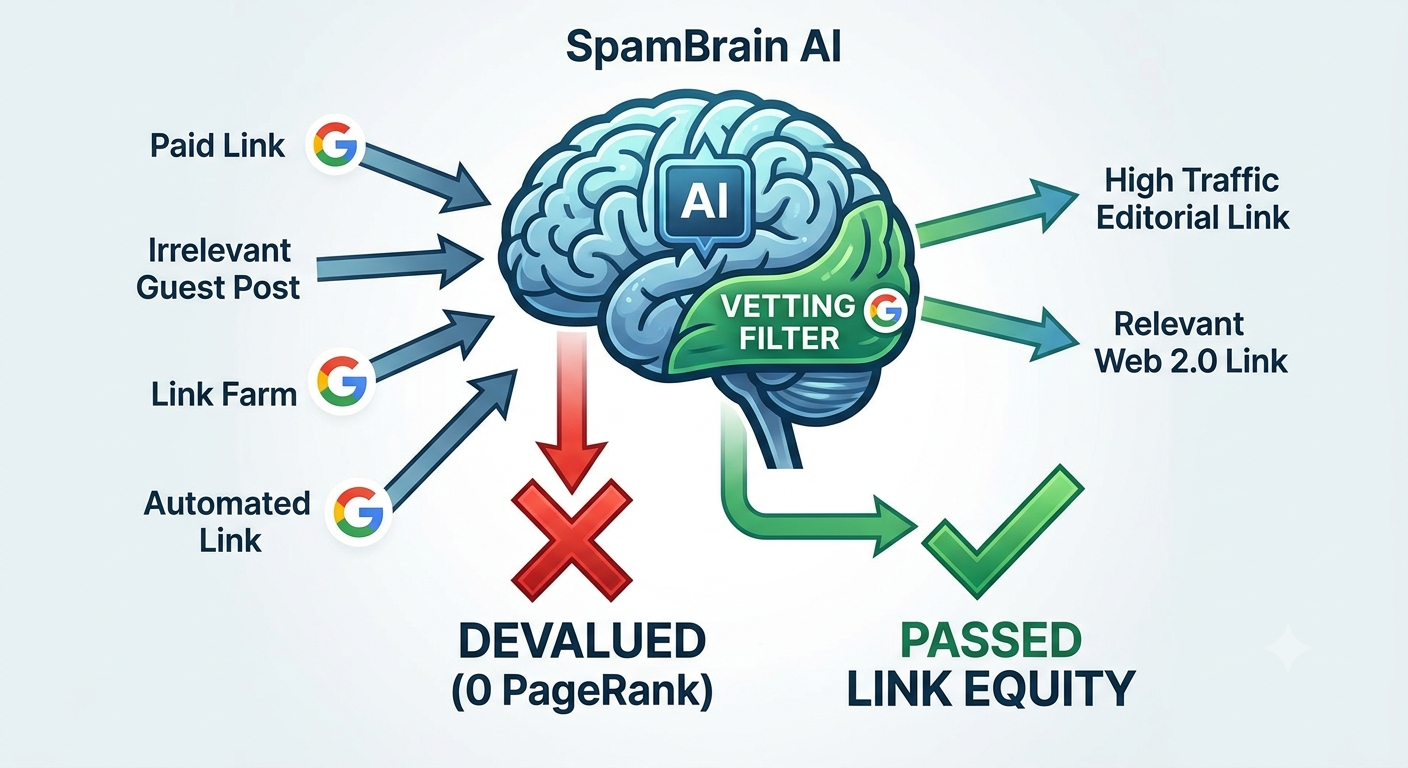
Google states that buying or selling links for ranking purposes is link spam. This includes exchanging money for links or posts that contain links, automated link creation, low-quality directory links, and low-value content created primarily to manipulate rankings.
Paid links can still exist for advertising or sponsorship purposes when they’re appropriately qualified with rel="nofollow" or rel="sponsored".
That distinction matters.
A provider promising “guaranteed ranking power” through a private network isn’t offering a risk-free service. They’re offering a tactic that sits directly inside Google’s enforcement area.
How to vet any backlink offer before paying
Whether you’re reviewing PBN links, Web 2.0 backlinks, guest posts, or niche edits, use this checklist:
- Check organic traffic, not just DA or DR.
- Review the site’s niche and audience.
- Inspect recent publishing history.
- Look for excessive outbound commercial links.
- Ask for live examples.
- Confirm whether content is unique.
- Avoid guaranteed ranking promises.
- Avoid thousands of links delivered overnight.
- Use a natural anchor text mix.
- Confirm the exact URLs in the final report.
A credible provider should explain the process instead of hiding behind vague claims like “authority network” or “premium inventory.”
You can also read our practical guide on how to buy backlinks before committing budget to any campaign.
The final decision
So, should you buy PBN links or Web 2.0 backlinks?
Choose PBN links only if:
- You’re working on a disposable or high-risk project.
- You understand the possibility of devaluation.
- You can afford to lose the domain.
- You’re testing rather than building a permanent brand.
Choose Web 2.0 backlinks if:
- You want a low-cost supporting layer.
- You’re prepared to create useful original content.
- You’re using a small number of relevant properties.
- You don’t expect them to rank a competitive page alone.
Choose neither as your main strategy if:
- Your website generates serious revenue.
- You’re building a brand for the long term.
- You need stable rankings and predictable growth.
- You care about resale value and customer trust.
The best budget allocation in 2026 is straightforward: build strong pages, earn or acquire relevant editorial links, improve your internal linking, and use supporting assets carefully.
PBNs may move rankings faster. Web 2.0s may cost less. But the tactic that matters most is the one that still has value after the next update.
That’s the standard you should use before you buy anything.
Want a transparent link-building plan for your niche? Contact Rankers Paradise and let’s review your targets, budget, and risk tolerance before you spend a penny.