
Want to buy website traffic but don’t fancy throwing your money away on visitors who never buy anything? Good. You’re already thinking about this the right way.
Getting people onto a website is one thing. Getting the right people onto that website is something completely different.
I’ve seen website owners spend money on advertising, backlinks, traffic packages and all sorts of SEO services without stopping to ask one simple question.
Where are these visitors coming from, and what are they going to do when they arrive?
You can have 10,000 visitors landing on your website every month and still struggle to make a sale. On the other hand, 100 visitors searching for exactly what you sell could be worth considerably more.
That’s why I prefer to look at traffic quality before traffic quantity.
If you’re looking to buy website traffic, there are several ways to go about it. Some will bring visitors almost immediately. Others take more time but can continue bringing people to your website long after the initial work has finished.
In this guide, I’m going to explain the different options, what they cost, which ones are worth considering and how backlinks fit into the bigger picture.
No complicated SEO terminology. Just the information you need to make a sensible decision before spending your money.
Can You Really Buy Website Traffic?
Yes, absolutely.
You can pay for people to visit your website through advertising platforms, sponsored placements, influencer promotions and dedicated traffic services.
You can also invest in SEO services designed to improve your website’s visibility in organic search results.
But there’s a big difference between these two approaches.
Buying visitors directly means paying for traffic. Investing in SEO means paying for work that may help your website attract visitors naturally.
Neither approach guarantees sales.
Let’s say you own a website selling garden furniture.
You could purchase 5,000 visits from a traffic provider. That might make your visitor statistics look impressive, but what happens if those people aren’t interested in garden furniture?
Probably nothing.
Now imagine your website starts appearing on Google when somebody searches for a garden table, outdoor furniture set or another product you actually sell.
Those visitors have a reason to be there.
They’re already looking for something relevant to your business.
That’s the type of website traffic I’d be concentrating on.
The Best Ways to Buy Website Traffic
There isn’t one perfect method for every website.
A brand-new online shop has different requirements from an established business that’s already appearing on page two of Google.
Here’s how the main options compare.
| Traffic method | How quickly can it work? | What are you paying for? |
|---|---|---|
| Google Ads | Potentially the same day | Clicks from search advertising |
| Facebook and Instagram Ads | Potentially the same day | Advertising exposure and clicks |
| Sponsored articles | Once published and promoted | Exposure to another website’s audience |
| Guest posting | Once published; SEO effects are uncertain | Content creation and publication |
| Niche edits | Once the placement is live | A contextual link within existing content |
| Web 2.0 backlinks | After content creation and indexing | Supporting content and links |
| General backlink services | Varies | Link acquisition or creation |
| Monthly SEO services | Usually a longer-term investment | Ongoing website optimisation |
The first two options buy advertising traffic directly.
The others primarily buy content, placements or SEO work. They may generate referral visitors, and legitimate editorial links can support search visibility, but they do not guarantee Google rankings or a particular number of visitors.
That’s an important distinction.
1. Buy Website Traffic With Google Ads
Google Ads is one of the most direct ways to attract people who are already searching for your products or services.
Your advertisement can appear when somebody searches for a keyword you’re targeting.
For example, if you sell replacement laptop batteries, you could advertise for searches related to the specific batteries you stock.
When somebody clicks your advertisement, you pay for that click.
The cost depends on the keyword, competition, advertising quality and several other factors.
Some searches are relatively inexpensive. Others can cost a considerable amount per click.
The advantage is speed.
You don’t have to wait months for a new website to start ranking organically.
The disadvantage?
Once you stop paying for advertisements, the paid traffic stops.
You also need to watch your conversion rates. Paying for 500 clicks is no use if your landing page doesn’t persuade anybody to buy.
You can find out more about how the advertising platform works at Google Ads.
2. Buy Website Visitors Through Social Media Advertising
Facebook and Instagram advertising can work well when you’ve got a product that people are likely to notice while scrolling.
Think clothing, home improvements, gifts, fitness products and other visually appealing items.
Unlike search advertising, the person seeing your advertisement might not be actively searching for your product.
You’re trying to capture their interest.
That means the advertisement itself becomes extremely important.
A good image, a clear offer and a properly designed landing page can make a considerable difference.
Social advertising is worth testing if you know who your ideal customers are.
But I wouldn’t throw a large advertising budget at it straight away.
Start small, measure the results and increase your spending when you’ve got evidence that the campaign is working.
3. Buy Website Traffic Through SEO and Backlinks
Now we’re getting into the area I find particularly interesting.
Search engine optimisation.
Rather than paying every time somebody clicks an advertisement, you’re working towards getting your website discovered through Google’s organic search results.
There are several parts to SEO.
Your website needs useful content, sensible internal linking, pages that search engines can access and a good experience for visitors.
Backlinks are another consideration.
A backlink is simply a link from one website to another.
If somebody publishes an article and links to your website, that’s a backlink.
Some links send visitors directly. Some help search engines discover pages. Relevant editorial links can also contribute to a website’s search visibility.
But not every backlink is worth having.
And buying links purely to manipulate rankings violates Google’s spam policies.
That’s why I wouldn’t judge a backlink service by the number of links alone.
I’d want to know where the links come from, whether the content is relevant, how the placement is made and whether there’s any genuine reason for somebody to follow the link.
If you’re considering purchasing links, read my guide on buy backlinks.
It explains the different options and what website owners should look for before spending money.
Why Backlinks Matter When You’re Trying to Increase Website Traffic
Imagine you’ve just launched a new website.
You’ve got your homepage, product pages and a few articles published.
Everything looks good.
But nobody is visiting.
This is where a lot of new website owners become frustrated.
They’ve done the work creating the website, but they haven’t given people enough opportunities to discover it.
Publishing content is a start.
Promoting that content is another part of the job.
Backlinks can help people find your website from other websites, and relevant links may support organic search visibility.
However, the link itself isn’t the whole story.
If your website is targeting the wrong keywords, your content doesn’t answer the searcher’s question or your product pages are poor, backlinks won’t magically fix everything.
I prefer to look at the page we’re trying to promote before deciding what link-building work makes sense.
Does it target a keyword people actually search for?
Is the page useful?
Does it deserve to appear above the pages already ranking?
And most importantly, what happens when somebody lands on it?
There’s little point sending traffic to a page that doesn’t give visitors what they came for.
Web 2.0 Backlinks: A Starting Point for Building Supporting Content
Web 2.0 backlinks are links created through content published on platforms that allow users to create their own pages or websites.
Depending on the platform, you might publish an article, build a small supporting website or create a useful resource related to your main website.
For somebody completely new to SEO, this can be a way to learn how content, linking and indexing work together.
But the quality of the content matters.
Publishing hundreds of thin articles filled with links isn’t something I’d recommend.
A better approach is to create useful supporting content that makes sense on its own.
Let’s say your main website sells fishing equipment.
You could publish a genuinely useful guide about choosing fishing tackle, explaining the different options and linking to a relevant resource on your main website where appropriate.
That gives the link some context.
It also gives readers a reason to visit.
If you want to understand this method properly, I’ve written a separate guide explaining web 2.0 backlinks.
It covers how these platforms work and the considerations involved when using them.
One thing worth remembering is that Google can disregard self-created links, and large-scale artificial link building can create problems. Treat Web 2.0 content as a supporting publishing method rather than a guaranteed ranking shortcut.
Buy Niche Edits to Get Links From Existing Content
Niche edits are another option you’ll come across when researching backlink services.
Instead of publishing a completely new article, a link is added to an article that already exists.
For example, imagine a gardening website has an established article about growing vegetables.
You sell gardening tools.
If the article genuinely benefits from recommending a useful gardening resource, a relevant link could make sense.
That’s the basic idea behind a niche edit.
The advantage of an existing article is that it may already have readers, search visibility and links pointing to it.
But don’t assume that every existing article has traffic.
Some pages have been online for years without attracting visitors.
Others might have very little relevance to your business.
Before paying for a placement, I’d want to check the actual page, not just the website’s domain authority score.
Look at its topic, quality, visibility, outgoing links and whether the placement would be useful to readers.
If you’re considering this type of service, take a look at my guide on how to buy niche edits.
Remember that paid links intended to pass ranking credit fall under Google’s link spam rules. Properly disclosed sponsored placements should use the appropriate link attributes.
Buy Guest Posts to Reach Relevant Website Audiences
Guest posting works differently.
Instead of inserting a link into an existing article, you contribute a new piece of content to another website.
That article might contain a relevant reference to your business or a useful resource on your website.
For example, somebody selling home security equipment could contribute an article about improving home security to a website covering home improvement.
If the publication has a genuine audience, the article might introduce the business to people who otherwise wouldn’t have discovered it.
That’s one reason I like the idea of guest posting as a marketing method.
You’re not necessarily relying on Google rankings alone.
You’re also putting useful content in front of another audience.
Of course, the website publishing the article matters.
A guest post on an irrelevant website with no genuine readers isn’t the same as a contribution to an established publication in your industry.
And paying for a guest post doesn’t automatically mean Google will give the link ranking value.
If you’re exploring this option, my buy guest posts guide explains what to consider before choosing a placement.
My advice is to concentrate on relevance and readership rather than chasing impressive-looking metrics.
Which Backlink Service Is Best for Website Traffic?
This is where people often get caught out.
They assume the package containing the most backlinks must be the best.
Not necessarily.
I’d rather have one genuinely useful placement on a relevant website with real readers than a large collection of links that nobody ever visits.
That doesn’t mean smaller supporting links have no place in a broader content-promotion strategy.
It means you need to understand what you’re buying.
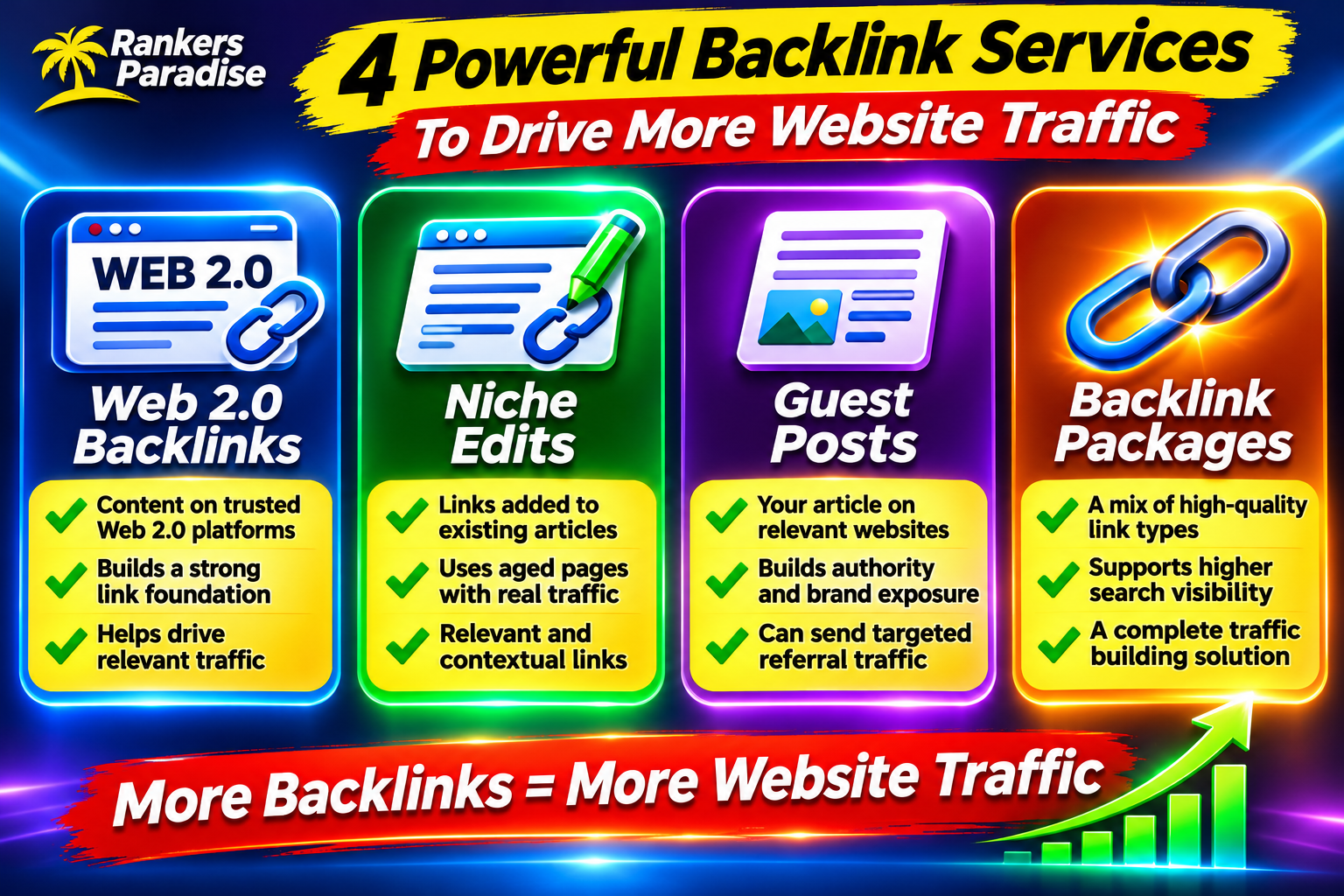
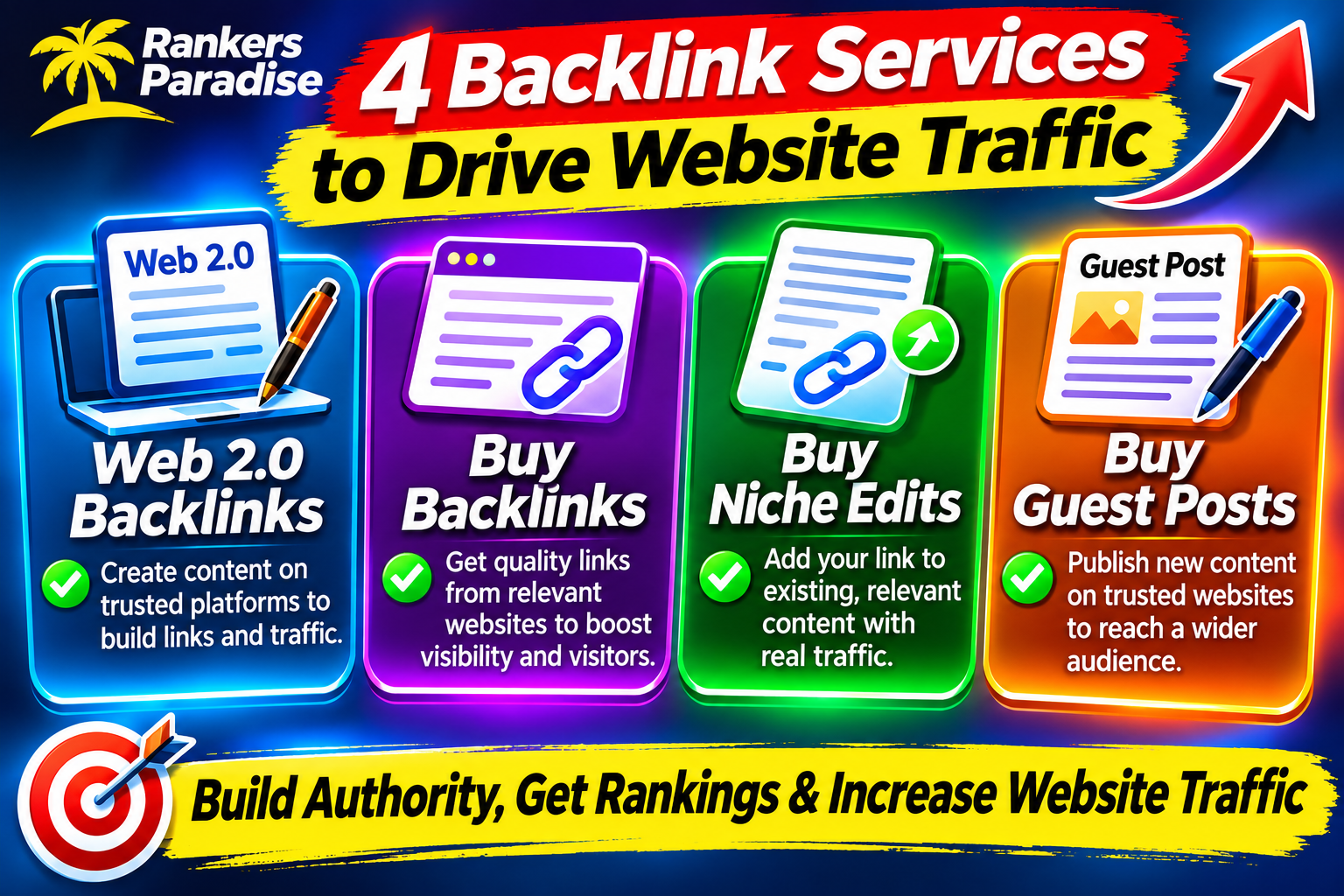
Here’s how I’d compare the four main approaches.
| Service | Main purpose | What I’d check first |
|---|---|---|
| Web 2.0 backlinks | Supporting content and website discovery | Content quality and platform relevance |
| General backlink packages | Broader link acquisition | Placement quality and link-building methods |
| Niche edits | Contextual placements in existing articles | Existing page relevance and real traffic |
| Guest posts | Publishing content on other websites | Audience, editorial standards and topic relevance |
For a brand-new website, I’d start by making sure the important pages are ready to receive visitors.
For an established website struggling to attract organic traffic, I’d investigate which pages already have search impressions and which keywords offer realistic opportunities.
The correct link-building approach depends on the website.
There’s no single package that’s automatically right for everybody.
How Much Does It Cost to Buy Website Traffic?
The answer depends on what you’re actually buying.
Direct advertising usually charges for clicks, impressions or another measurable advertising action.
SEO services generally charge for work completed, placements secured or ongoing management.
Let’s look at a simple example.
Suppose you’re running an advertising campaign with a budget of $300.
If your average click costs $1, you could receive approximately 300 clicks.
If the average click costs $3, the same budget would buy around 100 clicks.
Those are illustrations, not guaranteed advertising rates.
Now suppose you spend $300 improving website content and arranging legitimate promotional placements.
You might not see an immediate increase in visitors.
The work could take longer to produce measurable results, and some of it may never generate additional organic traffic.
However, useful content and ongoing visibility can continue providing value without requiring payment for every individual click.
That’s why comparing advertising and SEO purely on the initial price isn’t particularly helpful.
You’re buying two different things.
Should You Choose Cheap Website Traffic Packages?
Be careful with any provider promising thousands of visitors for an extremely low price.
Ask where those visitors come from.
Are they real people?
Are they interested in your website?
Can you identify the traffic sources in your analytics?
Is the provider using bots, incentivised visits or misleading redirects?
A large number of low-quality visits can make your statistics look better without helping your business.
It can also make your analytics harder to interpret.
I’d rather see a modest increase in relevant visitors who spend time reading the website than a sudden spike of meaningless traffic.
Buy Website Traffic or Invest in Monthly SEO?
If you need visitors immediately, paid advertising is usually the more direct option.
If you’re trying to build an ongoing source of organic visitors, SEO deserves consideration.
But there’s no reason you can’t use both.
In fact, the two methods can complement each other.
Advertising can help you discover which keywords and landing pages generate enquiries or sales.
You can then use that information when deciding which pages deserve more SEO attention.
For example, suppose you discover that visitors searching for a particular product convert particularly well.
That tells you something useful.
You might decide to create a better organic landing page targeting related searches.
You could improve the content, add useful internal links, fix technical problems and promote the page to relevant audiences.
That’s a more sensible approach than choosing keywords simply because a tool says they receive thousands of searches.
At Rankers Paradise, we also offer monthly SEO packages for website owners who prefer an ongoing approach rather than arranging individual services separately.
The important thing is choosing a strategy that fits your website, budget and objectives.
How to Buy Website Traffic Without Wasting Your Money
Before you purchase anything, there are a few things I’d check.
Check Whether Your Website Is Ready
Open your website and pretend you’re visiting it for the first time.
Can you understand what the business offers within a few seconds?
Is the navigation straightforward?
Do the pages load properly on a mobile phone?
Is there an obvious way to purchase, enquire or contact the business?
If the answer to those questions is no, fix those problems first.
There’s no point paying to attract visitors and then making it difficult for them to become customers.
Find Keywords That Bring Potential Customers
Not every keyword is worth targeting.
A keyword might receive thousands of monthly searches but have very little commercial value.
Another keyword might receive far fewer searches but attract people who are ready to buy.
Let’s say you sell running shoes.
Somebody searching for general information about running might not be interested in purchasing anything.
Somebody searching for a particular type of running shoe is much closer to making a decision.
Both searches can be useful, but they serve different purposes.
When deciding where to spend money, I’d look closely at the intention behind the search.
Check Your Existing Google Rankings
You might already have pages that Google is showing to potential customers.
They’re just not appearing high enough to receive many clicks.
Before starting from scratch, investigate those pages.
You can use Google Search Console to see which search queries generate impressions and clicks.
Look for pages that already appear for relevant searches but aren’t attracting the traffic you’d like.
Those pages may be worth improving before you create another article covering the same subject.
Don’t Ignore Internal Linking
Internal links are links between pages on your own website.
They’re simple, but they’re important.
If you’ve written a useful article explaining a particular subject, link to other relevant pages that help the reader take the next step.
For example, an article discussing website traffic might link to guides about backlink services, keyword research, technical SEO or conversion improvements.
The link should make sense within the content.
Don’t force the same keyword into every paragraph.
Make it easy for visitors to find the information they need.
Measure What Happens After Visitors Arrive
Getting traffic is only half the job.
You need to know what those visitors do.
Are they reading your articles?
Are they visiting product pages?
Are they submitting enquiries?
Are they buying anything?
Google Analytics can help you understand traffic sources and visitor behaviour.
I’d also recommend tracking conversions rather than relying entirely on page views.
If you spend $200 attracting visitors and generate $1,000 in profitable sales, that’s very different from spending $200 and generating nothing.
Of course, revenue isn’t the same as profit. Product costs, advertising expenses and other business costs still need to be considered.
The point is to measure results that matter to your business.
How Long Does It Take to Get Website Traffic From SEO?
This is one of the most common questions new website owners ask.
And there’s no fixed answer.
Some pages can begin appearing in search results relatively quickly.
Others take months to establish meaningful visibility.
Some never achieve the rankings their owners hoped for.
It depends on the competition, the website, the content, the technical setup and many other factors.
That’s why I wouldn’t trust anybody guaranteeing that a particular backlink package will put your website at number one on Google.
Nobody outside Google controls those rankings.
What you can control is the work you put into your website.
You can improve your pages, target relevant searches, fix problems, publish useful information and build awareness of your business.
Then you can monitor what happens and adjust your approach.
That’s how I’d treat SEO: an ongoing process rather than a one-off purchase with a guaranteed result.
Is It Better to Buy Website Traffic or Get Free Organic Traffic?
People often describe organic traffic as free traffic.
Technically, you’re not paying Google for each organic click.
But getting those rankings usually requires an investment.
That might be your own time.
It might be content writing, technical improvements, outreach or professional SEO services.
So organic traffic isn’t necessarily free.
The difference is how you pay for it.
With advertising, you generally pay for exposure or clicks.
With SEO, you’re investing in improving the website and its ability to attract visitors.
A successful organic page can continue receiving visitors without a charge for every click.
But rankings can change, competitors can improve their websites and search demand can fluctuate.
I wouldn’t build an entire business around the assumption that today’s Google rankings will remain unchanged forever.
A combination of organic search, direct visitors, referrals, email marketing and paid advertising is often a healthier position.
Common Mistakes People Make When Buying Website Traffic
I’ve already mentioned a few of these, but they’re worth bringing together because they’re exactly the sort of mistakes that can eat through a marketing budget.
Buying traffic without knowing the source. If a provider can’t explain where visitors come from, I’d be cautious.
Choosing backlinks based entirely on quantity. More links don’t automatically mean better rankings or more visitors.
Targeting keywords that don’t lead to sales. Search volume is useful, but commercial intent matters too.
Ignoring the landing page. Even excellent traffic can be wasted on a poor website.
Expecting instant SEO results. SEO work doesn’t come with a guaranteed timetable.
Buying paid links without understanding the risks. Google’s spam policies explicitly address links purchased to manipulate rankings. Sponsored placements should be appropriately qualified.
Failing to measure conversions. Visitor numbers are interesting. Enquiries, sales and profit are considerably more useful.
Avoiding those mistakes won’t guarantee success, but it will put you in a much better position to make informed decisions.
Frequently Asked Questions About Buying Website Traffic
Can I buy website traffic that converts into sales?
Yes, you can purchase advertising that reaches people likely to be interested in your products or services. However, no legitimate provider can guarantee that every visitor will buy. Your offer, targeting, pricing and landing page all affect conversions.
What is the cheapest way to get website traffic?
Creating useful content, improving existing pages and promoting your website through relevant communities can be inexpensive in direct monetary terms. Paid advertising and SEO services involve additional costs. The cheapest visitor isn’t necessarily the most valuable visitor.
Can backlinks increase website traffic?
Yes, relevant backlinks can send referral visitors directly. Editorial links can also contribute to organic search visibility. However, links don’t guarantee ranking improvements, and manipulative link schemes can violate Google’s policies.
Is buying website traffic safe for SEO?
Legitimate advertising is a normal marketing activity. Buying artificial visits or participating in manipulative linking schemes is a different matter. Always understand how the traffic or links are being obtained before purchasing.
How many visitors does a new website need?
There’s no magic number. A website selling expensive specialist equipment might do well with a relatively small number of highly targeted visitors. Another business might need thousands of visits to generate enough sales. Conversion rates and profitability matter more than raw visitor counts.
Should I buy backlinks for a brand-new website?
I’d make sure the website has useful content, working pages and a clear purpose before spending money on links. Relevant promotion and genuine editorial mentions can help people discover a new website, but purchasing links to manipulate Google rankings carries risks.
Are guest posts better than niche edits?
Neither is automatically better. Guest posts allow you to publish new content for another audience. Niche edits place a link within existing content. The value depends on the publication, relevance, audience, editorial quality and whether the placement is legitimate.
Can I get website traffic without paying for Google Ads?
Absolutely. Organic search, referral links, social media, email marketing and direct visits can all bring people to your website without paying Google for every click. They still require time, effort or other investment.
Final Thoughts: Buy Website Traffic That Has a Reason to Visit
If there’s one thing I’d like you to take away from this guide, it’s this.
Don’t buy website traffic just to make your visitor numbers look impressive.
Buy advertising that reaches potential customers, or invest in website improvements and legitimate promotion that give people a reason to discover your business.
If you’re considering backlinks, understand the difference between Web 2.0 content, guest posting, niche edits and general link-building services before making a purchase.
Each method has different costs, uses and risks.
And don’t forget the website itself.
Good traffic sent to a poor landing page can still be wasted.
If you want to explore the SEO services available for your website, have a look through the Rankers Paradise SEO services and compare the options with your goals and budget.
Start with the pages that matter most to your business. Give people useful information. Make it easy for them to take the next step.
Because at the end of the day, you don’t just want more visitors.
You want visitors who are actually interested in what you’re selling.