
If you are looking for the best backlinks to buy for SEO, you have probably already noticed one thing. There are hundreds of services selling backlinks, and every single one seems to claim its links are the best.
Some sellers offer guest posts on established websites. Others sell niche edits, Web 2.0 backlinks, or complete link building packages containing several different types of links.
So which ones should you actually spend your money on?
That is what I want to go through in this post.
I have been working with backlinks for years here at RankersParadise, and one thing I have learned is that you need to look beyond the numbers advertised on a sales page.
A package containing 500 backlinks is not automatically better than one containing 10. In fact, I would rather examine where those 10 links are coming from before spending money on another 500 links that might never get indexed.
The important things to consider are the websites linking to you, the content surrounding those links, whether the pages are indexed, and whether the links make sense for your website.
I am going to compare four popular backlink options:
- Guest post backlinks.
- Niche edit backlinks.
- Web 2.0 backlinks.
- Mixed backlink packages.
I will also explain what I look for when evaluating links, where people waste money, and how to choose a service that suits their website.
Before we start, remember that Google treats links purchased primarily to manipulate rankings as link spam. Paid editorial placements should use the appropriate sponsored or nofollow attributes. That is an important risk to understand before buying anything.
Now let’s get into it.
What Are the Best Backlinks to Buy for SEO?
There is no single type of backlink that will be the best option for every website.
A brand-new website has different requirements from an established business that already has hundreds of referring domains.
The same applies to your budget.
If you have $50 to spend, you will be looking at different services from somebody with $500 or $1,000 available.
Here is a quick comparison.
| Backlink Type | Main Advantage | What to Check | Best Suited For |
|---|---|---|---|
| Guest posts | New content on relevant websites | Real traffic, editorial quality and topical relevance | Businesses wanting exposure to a relevant audience |
| Niche edits | Placement within existing articles | Existing page quality, context and link relevance | Websites looking for relevant established content |
| Web 2.0 backlinks | Control over supporting content | Content quality, indexing and platform rules | Content publishing and supporting website resources |
| Mixed backlink packages | Several link types in one order | Exact placements, quality and reporting | Website owners comparing multiple approaches |
My preference is always to examine the individual placements rather than assume one category is automatically better.
A well-written guest post on a relevant website can be worth far more to a business than dozens of links placed on websites nobody visits.
But an existing article with genuine traffic and a natural reason to reference your website may be more useful than a guest post published on a completely unrelated blog.
It depends on the actual pages involved.
1. Guest Post Backlinks: Are They Worth Buying?
Guest posts are one of the most recognisable forms of link building.
The idea is simple.
You publish an article on another website and include a link pointing back to your own website where it is relevant to the subject.
For example, imagine you own a business selling garden furniture.
An article discussing how to prepare a garden for summer could naturally mention your products or reference a useful guide on your website.
That makes sense to somebody reading the article.
Now imagine that same garden furniture website receiving a link from an unrelated article about cryptocurrency trading.
Would that make much sense?
Not really.
This is why I always recommend looking at relevance before getting excited about domain authority metrics.
What Makes a Good Guest Post Backlink?
The first thing I would check is the website itself.
Does it publish useful articles?
Are those articles written for real readers?
Does the website cover subjects related to your business?
And, importantly, does anybody actually visit it?
You can use tools such as Ahrefs or Semrush to estimate organic traffic and examine the website’s backlink profile.
Remember that these tools provide estimates. Their traffic figures are not the same as actual Google Analytics data.
I would also check several recently published articles.
If every article contains obvious commercial anchor text linking to unrelated businesses, I would be cautious.
Another thing to check is whether the website is indexed in Google.
You can search for a specific article URL or use Google’s site search operator to investigate whether pages appear in the search results.
Just remember that the site: operator is not a complete indexing report.
Should You Buy Guest Posts on High-Authority Websites?
Not just because a seller advertises a high authority score.
Domain Rating and Domain Authority are third-party metrics. They can help with research, but neither is a Google ranking score.
I would rather see a relevant website with a genuine readership than an unrelated website being sold purely on a large DR number.
Ask to see examples of previous placements.
Look at the articles.
Check the topics.
Then decide whether the website is somewhere you would genuinely want your business mentioned.
If you want to compare the available options, take a look at our guide on how to buy guest posts.
It will help you understand the different types of guest post placements before choosing a package.
2. Niche Edit Backlinks: Links Added to Existing Articles
Niche edits work differently from guest posts.
Instead of publishing a completely new article, a link is added to an article that already exists.
You may also see these advertised as contextual link insertions.
The main attraction is that the article may already have a history in Google.
It could already be indexed.
It might have existing backlinks.
It may even receive organic search traffic.
That sounds appealing, doesn’t it?
But there is something you need to understand.
An old article is not automatically a good article, and an indexed page is not automatically a valuable backlink source.
You still need to examine the website and the individual page.
What I Would Check Before Buying Niche Edits
Let’s say somebody offers you a niche edit on a website with a Domain Rating of 60.
Sounds good at first.
But what about the actual article?
Does it have any organic traffic?
Does it cover a subject relevant to your business?
Has it been updated recently?
Does the new link fit naturally into the surrounding paragraph?
These are the questions I would ask.
I would also look at how many other commercial links have been inserted into the article.
If it looks like somebody has been selling links from the same page to every business imaginable, that would put me off.
You want a placement that makes sense to the reader.
Guest Posts vs Niche Edits: Which Would I Choose?
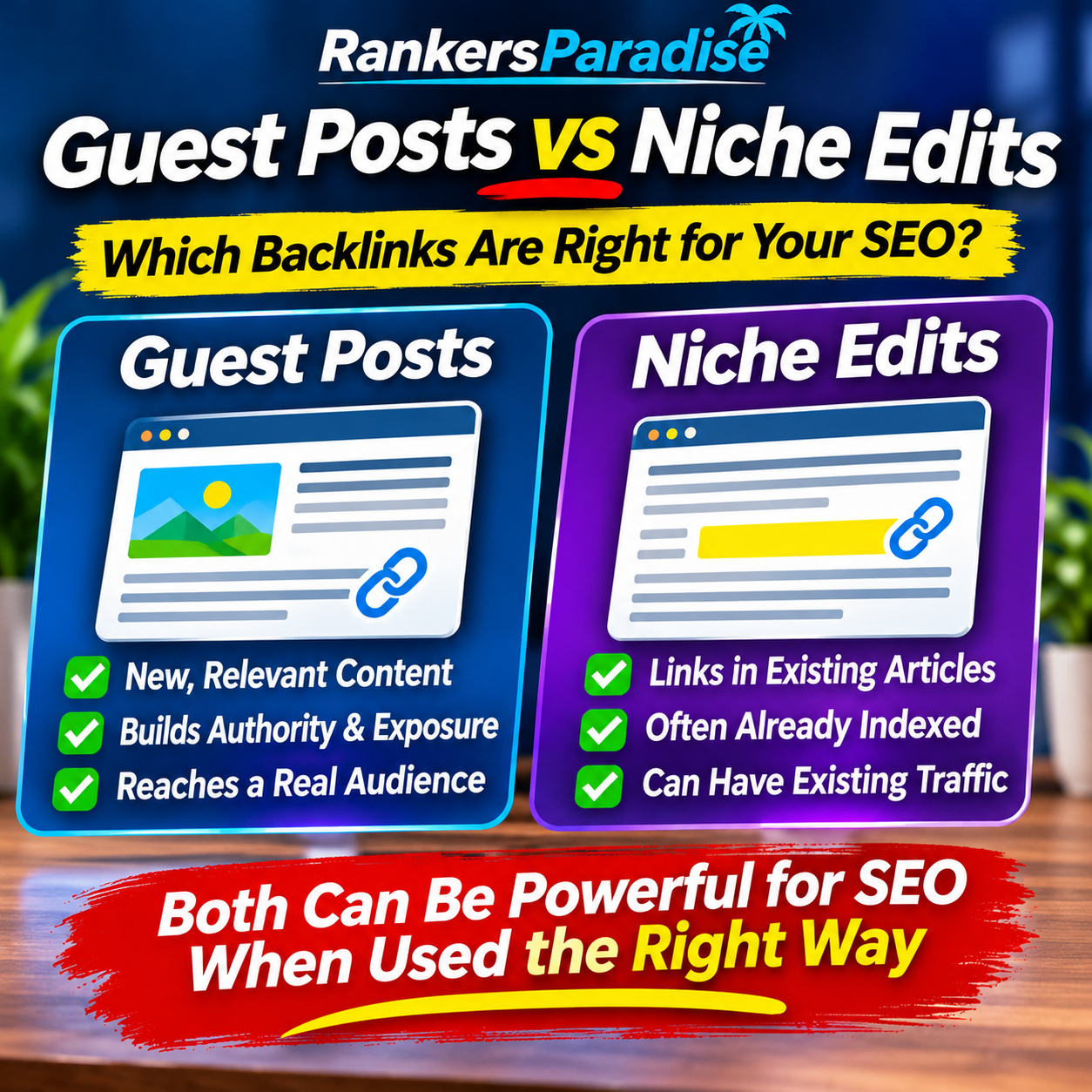
If I had to choose between a guest post on a completely new article and a niche edit on an established article, I would compare the two actual pages.
I would not automatically choose the niche edit because the article is older.
And I would not automatically choose the guest post because it comes with fresh content.
For example:
Option A: A new guest post on a relevant industry website that receives regular organic visitors.
Option B: A niche edit on a five-year-old article that receives no measurable traffic and contains numerous unrelated outbound links.
I would be more interested in Option A.
Now reverse the situation.
If the existing article receives relevant visitors and the new guest post would appear on an abandoned website, Option B becomes more interesting.
That is why you should never judge links by their category alone.
For a more detailed explanation of the service and the available options, see our guide on how to buy niche edits.
3. Web 2.0 Backlinks: My Own Ranking Experiment
Now we come to a type of backlink I have spent a considerable amount of time working with.
Web 2.0 backlinks.
These are links placed within content published on platforms that allow users to create their own websites, blogs or articles.
I have written extensively about this subject on RankersParadise, including a documented ranking experiment.
And rather than just tell you these links work, I published updates showing what happened during the test.
What Happened During My Web 2.0 Backlink Test?
I started documenting a Web 2.0 link building experiment in 2024.
The idea was to build supporting content and backlinks, then monitor the target keyword’s position in Google’s organic search results.
On 2 October 2024, I reported that the target page had reached position three.
The following day, on 3 October 2024, the page reached position one.
That was 97 days into the experiment.
I continued updating the case study afterwards, including ranking observations in 2025 and 2026.
By July 2026, I was still reporting number-one positions for the keywords tracked in that particular experiment.
You can read the full experiment, see the screenshots and learn about the platforms used in my guide to web 2.0 backlinks.
Now, there is an important distinction here.
The experiment documents what happened to one page during a particular campaign. It does not prove that every website will achieve the same result or that Web 2.0 links alone caused every ranking movement.
Google rankings can change for several reasons.
Nevertheless, I believe it is worth documenting real observations rather than simply repeating what everybody else says about link building.
Why Web 2.0 Content Quality Matters
One mistake people make is creating hundreds of empty blogs containing nothing but a link.
I would not recommend that approach.
If you are publishing on a Web 2.0 platform, give the article a reason to exist.
Write something useful.
Make it relevant to the subject.
Include information that somebody searching for that topic would actually want to read.
A link surrounded by irrelevant, automatically generated nonsense is not something I would want associated with my website.
And remember that many platforms have their own rules about promotional content and external links.
Some links may also be marked nofollow or user-generated content.
That changes how they should be evaluated.
Should You Build Web 2.0 Backlinks Yourself?
You certainly can.
Many publishing platforms allow you to create accounts and publish content without paying for hosting.
The cost is your time.
You need to prepare articles, format them, publish them, maintain the accounts and check whether the content remains available.
That can become a considerable amount of work.
If you are short of time, you can compare managed Web 2.0 services instead.
But before purchasing, ask what content will be published, which platforms will be used, and what the final report will contain.
I would also avoid any service promising guaranteed Google rankings from a fixed number of links.
Nobody can guarantee that.
4. Mixed Backlink Packages: Is Buying Different Link Types Better?
This is another option worth examining.
Instead of purchasing only guest posts, niche edits or Web 2.0 links, you purchase a package containing several types of backlinks.
For example, a mixed package might contain contextual article placements, Web 2.0 posts, profile links and other supporting links.
The attraction is convenience.
You can order several services together rather than managing multiple suppliers.
But convenience should not be confused with quality.
Why the Number of Backlinks Can Be Misleading
Imagine you are comparing two packages.
One contains 25 links.
The other contains 500 links.
Which is better?
You cannot answer that question from the numbers alone.
You need to know where those links will appear.
Are they on relevant websites?
Are they editorial placements or automatically created profiles?
Will the linking pages contain original content?
Can you inspect examples before ordering?
Will you receive a complete list of the final URLs?
These details matter much more than a big number on a product page.
I would also check whether the seller counts sitewide links as multiple backlinks.
One website linking to you from hundreds of pages is not the same as hundreds of independent websites linking to you.
Buying Backlink Packages Without Wasting Money
My advice is to start by understanding what you are purchasing.
Read the full service description.
Check the delivery times.
Ask questions if something is unclear.
And make sure you know whether the service includes content writing or whether you need to supply your own articles.
At RankersParadise, we offer different backlink services for website owners with different requirements and budgets.
You can read our complete guide on how to buy backlinks to understand the options and what to check before ordering.
The important thing is to choose a service that suits your website rather than simply purchasing the biggest package you can afford.
How Much Should You Spend on Backlinks?
This is a question I see people asking regularly.
How much money do you actually need for backlinks?
The answer depends on what you are buying.
A manually researched editorial placement on a relevant publication involves different work from creating a profile on a free publishing platform.
There is also content writing, outreach, editing and reporting to consider.
Rather than give you made-up industry averages, I would compare the total cost against the actual deliverables.
For example:
| What You Are Paying For | Questions to Ask |
|---|---|
| Content creation | Is the content original and relevant? |
| Publisher research | Can you inspect the websites? |
| Editorial placement | Is the link useful to readers and properly disclosed? |
| Link insertion | Does the link fit the existing article? |
| Web 2.0 publishing | Which platforms and articles are included? |
| Reporting | Will you receive the live URLs? |
A cheap package can become expensive if most of the work has no value to your business.
Equally, an expensive placement is not automatically a good purchase.
Do not let price replace proper research.
My 7 Checks Before Spending Money on Any Backlink Service
Here is the checklist I would use when comparing providers.
1. Check the Website’s Relevance
Start with the subject of the website.
If you sell fishing equipment, a website publishing genuine fishing content is more relevant than a general blog covering hundreds of unrelated industries.
Relevance is not the only consideration, but it is a sensible starting point.
2. Look at the Organic Traffic
Use an SEO tool to estimate whether the website receives search traffic.
Do not assume a website is valuable just because it has a high authority metric.
Also check whether the traffic comes from relevant subjects and countries.
3. Examine the Actual Article
The linking page matters.
A website might have thousands of visitors, but the article containing your link could receive none.
Look at the content, its purpose and whether your website genuinely adds something useful.
4. Check the Outbound Links
I always recommend examining the other websites being linked to.
Are the links relevant?
Do they make sense within the articles?
Or does every paragraph contain another unrelated commercial link?
If the website looks like it exists purely to sell links, think carefully before spending money.
5. Understand the Anchor Text
Anchor text is the clickable wording used in a link.
For example, somebody writing about website optimisation might link to a useful resource using the words “SEO checklist”.
That tells the reader what to expect.
I prefer descriptive anchor text that fits naturally into the sentence.
Trying to force the same exact-match commercial keyword into every backlink can look unnatural and may violate Google’s link spam policies when used for ranking manipulation.
6. Ask About the Final Report
If you purchase a service, you should know what has been delivered.
At a minimum, I would want the URLs of the pages containing the placements.
A useful report should also identify the destination page and the anchor text where applicable.
This allows you to review the work yourself.
7. Avoid Guaranteed Ranking Claims
This is a big one.
Nobody can promise you a number-one Google ranking simply because you purchase a particular backlink package.
There are too many variables.
Your website’s content, technical setup, competition, search intent and existing reputation can all influence performance.
A good provider should explain what they will deliver.
They should not pretend they control Google’s search results.
Do Follow Backlinks Always Work Better Than Nofollow Links?
You will see plenty of backlink services advertising dofollow links.
A normal link without a qualifying attribute can be considered by search engines when evaluating a page.
A nofollow link uses an attribute that indicates the publisher does not want to endorse the destination in the usual way.
There are also sponsored and UGC attributes.
Google recommends rel="sponsored" for advertising and paid placements, while rel="nofollow" remains an acceptable alternative.
You can read Google’s explanation here:
Google Search Central: Qualify Outbound Links
This is worth understanding because a paid placement should not be treated as a guaranteed way of passing ranking credit.
A nofollow or sponsored link can still bring genuine visitors to your website.
If the placement sends interested customers who purchase your products, that may be commercially useful regardless of whether it improves keyword positions.
Do not overlook referral traffic when evaluating a link.
How Long Do Backlinks Take to Affect Google Rankings?
Another question people ask is how long they need to wait.
The first thing to understand is that publishing a backlink does not mean Google has immediately discovered it.
The page needs to be accessible.
Google needs to crawl it.
And even when a page is indexed, there is no guarantee that a particular link will produce a measurable ranking improvement.
My own Web 2.0 experiment took 97 days to reach the reported number-one position.
But that does not mean every campaign will take 97 days.
Some websites may see changes sooner.
Others may see no improvement at all.
I would monitor keyword positions, organic clicks and impressions over time rather than checking rankings every few hours.
You can use Google Search Console to see how your own website is performing in Google Search.
It is free and provides useful information about search queries, impressions and clicks.
Just make sure you compare sensible date ranges and remember that rankings can fluctuate.
Should You Buy Backlinks for a Brand-New Website?
If your website is new, I would concentrate on getting the basics right first.
Make sure Google can crawl your pages.
Check that the content answers the searcher’s question.
Give each important page a clear purpose.
Add useful internal links so visitors and search engines can find related content.
Then consider how you can earn relevant mentions and links from other websites.
For example, a local business might benefit from legitimate local directories, industry associations, suppliers and community websites.
An online shop could publish useful buying guides that other publishers might reference.
A specialist business might contribute genuine expertise to an industry publication.
These are all worth considering before spending money on a large backlink package.
And if you do purchase advertising or sponsored editorial coverage, make sure the links are qualified correctly.
The Biggest Mistakes People Make When Buying Backlinks
I see the same problems come up again and again.
Buying links based on quantity alone.
The number advertised on the package is not enough to judge its value.
Ignoring the linking website.
If you cannot inspect the websites or examples, you do not know what you are paying for.
Using irrelevant placements.
A link should make sense within the surrounding content.
Expecting immediate results.
Search performance takes time to measure, and improvements are never guaranteed.
Buying before improving the target page.
If your content does not satisfy search intent, you should fix that problem before worrying about additional links.
Not checking the report.
Always review what has actually been delivered.
And finally, do not assume that every link Google discovers will help your rankings.
Google has systems designed to identify and neutralise unnatural links.
You can read more in its official link spam policies.
Which Backlink Type Would I Choose for Different Websites?
Let’s look at a few practical examples.
An Established Online Shop
I would look for opportunities on websites covering the products being sold.
Relevant editorial coverage, product reviews and useful buying guides could bring interested visitors.
The quality of the audience would matter more to me than simply acquiring a large number of links.
A Local Service Business
I would begin with legitimate local and industry-specific opportunities.
Local business associations, relevant directories, suppliers and community publications may be more useful than unrelated international blogs.
A Specialist SEO or Marketing Website
I would look for relevant marketing publications, original research, useful case studies and genuine editorial mentions.
I would also keep publishing content that other website owners might want to reference.
A Website With a Small Budget
I would spend more time improving the content and researching free, legitimate publishing opportunities.
There is no point spending the entire budget on links if the website itself still needs considerable work.
How to Choose Between Guest Posts, Niche Edits and Web 2.0 Backlinks
If you are still undecided, here is how I would approach the decision.
Choose guest post opportunities when you have something useful to contribute to a relevant website and want to reach its readers.
Consider niche edit opportunities when an existing article has a genuine reason to reference your content and the publisher is willing to make an appropriate editorial update.
Explore Web 2.0 publishing when you want to create supporting content on platforms that permit it, while understanding that self-created links should not be assumed to carry ranking value.
Compare mixed backlink packages when you want several services delivered together, but only after checking exactly what each package contains.
Whatever you choose, avoid thinking of backlinks as a substitute for a good website.
They are only one part of SEO.
Frequently Asked Questions
What Are the Best Backlinks to Buy for SEO?
The most useful paid placements are generally those on relevant websites with genuine audiences, useful content and clear editorial standards. The best option depends on your website and business goals. Paid links intended to manipulate Google rankings violate its spam policies unless appropriately qualified.
Are Guest Posts Better Than Niche Edits?
Not automatically. A guest post may reach a relevant audience through new content, while a niche edit may add a useful reference to an existing article. Compare the actual websites, pages and audiences rather than choosing by link type alone.
Are Web 2.0 Backlinks Still Worth Using?
Web 2.0 platforms can be useful for publishing original content and reaching readers. I have documented a ranking experiment involving Web 2.0 links on RankersParadise, but the results of one experiment cannot guarantee the same outcome for another website.
How Many Backlinks Do I Need to Rank on Google?
There is no fixed number. Some pages rank with very few referring domains, while others compete in search results containing well-established websites. Content relevance, competition, website quality and many other factors matter.
Can You Rank on Google Without Buying Backlinks?
Yes. Purchasing backlinks is not a requirement for ranking. Google recommends creating useful content that people naturally want to reference. Depending on the keyword and competition, a page may rank without any purchased links.
Is Buying Backlinks Against Google’s Guidelines?
Buying advertising or sponsored editorial placements is permitted when links are properly qualified. Buying links primarily to manipulate search rankings is against Google’s spam policies. This distinction is important when comparing backlink services.
How Do I Know Whether a Backlink Has Been Indexed?
You can investigate whether the linking page appears in Google Search. However, a page appearing in the index does not mean Google is passing ranking value through every link on it.
What Is More Important: Backlink Quality or Quantity?
I would focus on relevance, editorial quality, audience and the usefulness of the linking page rather than simply counting links. Large quantities of poor-quality links do not guarantee better search rankings.
Final Thoughts: Which Backlinks Should You Spend Your Money On?
If you have read this far, you should now have a better understanding of the different backlink services available and what to look for before spending your money.
My advice is simple.
Do not buy a package just because it contains a large number of links.
Look at the websites.
Check the articles.
Understand what you are paying for.
And make sure your own website is worth visiting before investing in promotion.
I have spent years working with backlinks and documenting SEO experiments on RankersParadise. One thing I will always recommend is testing, measuring and looking at the actual results rather than believing every claim you see on a sales page.
If you want to investigate the four services discussed in this article, you can use the following guides:
- Buy backlinks — Compare backlink services, packages and purchasing considerations.
- Web 2.0 backlinks — Read my documented experiment and learn about the publishing platforms.
- Buy niche edits — Learn about contextual links placed within existing articles.
- Buy guest posts — Explore guest posting services and editorial placement options.
You can also explore the available SEO services at RankersParadise.
Take the time to compare what you are getting before placing an order.
A sensible SEO investment starts with knowing exactly what you are buying.