
If you’ve been running websites or managing client portfolios for any length of time, you already know the brutal reality of search engine optimization: content alone will not get you to the top spot for high-value commercial keywords.
You can spend weeks polishing your on-page setup, tuning technical metrics, writing pristine content, and getting every green light in your SEO plugin of choice. But the moment you enter competitive SERPs, your site hits a brick wall.
Why? Because your competitors aren’t relying on hope. They are pushing real domain authority directly into their money pages using structured off-page assets.
When you are competing against established brands, generic single-link orders barely make a ripple. Buying 5 random links here or a solitary blog post there won’t cut it. To move the needle on competitive keywords, you need a coordinated campaign—a structured enterprise SEO backlink bundle that combines foundational control, instant power, and high-relevance editorial authority.
I’ve been testing link-building strategies in the trenches since 2016. Algorithms have updated, spam filters have tightened, and Google has gotten far better at ignoring low-quality footprints. But the core mechanics of ranking haven’t changed: safe anchor text distribution, diverse link types, and tiered authority flow.
Let’s skip the theoretical fluff and break down exactly how enterprise-grade link bundles work, how to structure them for maximum safety, and how to deploy them to hit page one.
What Is an Enterprise SEO Backlink Bundle?
An enterprise SEO backlink bundle is a complete, multi-tiered off-page strategy wrapped into a single cohesive campaign. Instead of sourcing individual links haphazardly, an enterprise bundle coordinates multiple link types—each serving a specific functional role in your backlink profile.
When you buy backlinks individually without a master plan, you run into three big problems:
-
Unnatural Anchor Text Profiles: Oversaturating exact-match keywords on a single link type triggers ranking filters.
-
Velocity Spikes: Dropping 50 guest posts in one day with zero foundational links looks completely unnatural to Google’s web spammers team.
-
Wasted Authority: Driving high-powered links directly to unoptimized or unindexed target URLs wastes link juice that could be amplified through proper tiering.
A properly built commercial bundle solves this by combining three core off-page pillars into a unified pipeline:
-
Foundational Assets: High-control Tier 1 properties to establish topical relevance and absorb exact-match anchor text safely.
-
Aged Contextual Injections: Fast-acting power placed inside established, indexed content that Google already trusts.
-
Editorial Authority: Genuine outreach placements on high-traffic niche publications.
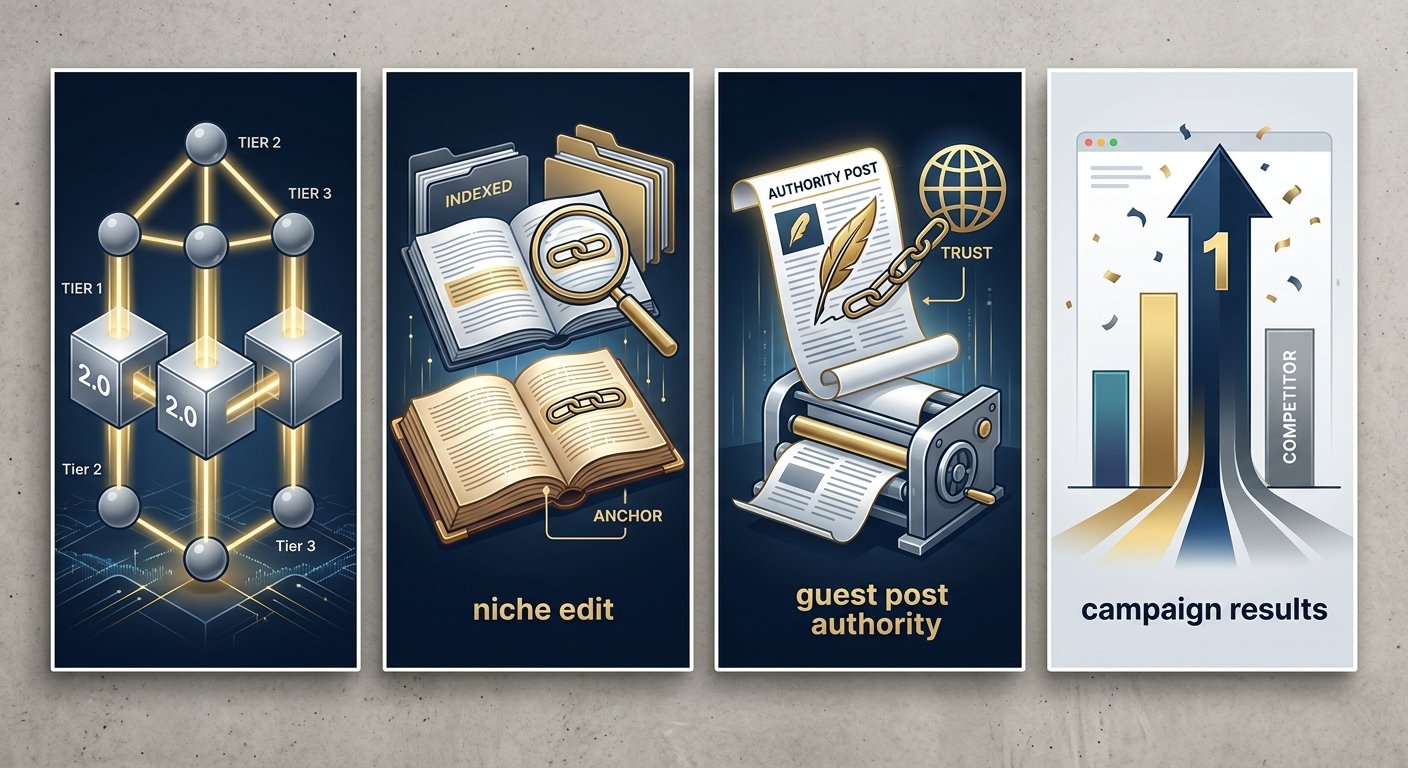
The 3 Essential Pillars of a Winning Backlink Bundle
To understand why enterprise bundles consistently outrank piecemeal link packages, you have to look at how each link asset performs inside your campaign structure.
                  [ High-Traffic Money Page ]
                             ▲
      ┌──────────────────────┼──────────────────────┐
      │                      │                      │
[ Editorial Guest Posts ] [ Aged Niche Edits ] [ Tier 1 Web 2.0 Assets ]
      ▲                      ▲                      ▲
      └──────────────────────┴──────────────────────┘
                             │
                  [ Tier 2 Backlink Layer ]
Pillar 1: Foundational Control with Web 2.0 Properties
Every safe SEO campaign starts with a solid foundation. Before pushing heavy authority directly into a sensitive money page, you need buffers that give you 100% control over your anchor text and content context.
This is where setting up structured web 2.0 backlinks comes into play.
Web 2.0 properties allow you to:
-
Control Anchor Text Ratios: Use branded, naked URL, and partial-match anchors freely on properties you control.
-
Build Tiered Stacks: Create secondary buffer layers (Tier 2 and Tier 3) that shoot raw power through your Tier 1 properties without pointing direct automated velocity at your money site.
-
Establish Topical Relevance: Surround your target links with complete, highly specific niche articles that signal clear topical context to search engines.
When built manually with unique content, proper multimedia, and clean IP management, Web 2.0s provide the ideal safety network for the rest of your campaign.
Pillar 2: Raw Power via Aged Niche Edits
Once your foundation is set, you need fast, direct link equity. Creating a brand new article and waiting for Google to crawl, index, and assign value to it takes time.
That’s why enterprise strategies lean heavily on existing indexed pages. When you buy niche edits, your contextual link is placed inside an existing blog post that Google indexed months or years ago.
The advantages of aged curated links are clear:
-
Instant Indexation: Google already crawls the host page regularly, meaning your link equity transfers almost immediately.
-
Existing Page Authority: Instead of starting at zero page authority (PA), your link sits on a page that may already have internal juice or existing external backlinks.
-
Natural Context: Placing your link within a relevant paragraph on an established post passes strong contextual signals directly to your target URL.
Pillar 3: High-Impact Editorial Guest Posts
The final piece of the puzzle is real editorial outreach. While Web 2.0s give you control and niche edits deliver speed, high-grade outreach placements provide the unmistakable trust signals Google demands in competitive niches.
When you buy guest posts on genuine, traffic-driving websites, you achieve two things simultaneously:
-
Unquestionable Domain Authority: Placements on real publisher sites validate your brand’s trust metrics in the eyes of Google’s algorithms.
-
Referral Traffic: A link on a well-ranked, active article drives real humans to your site, sending positive engagement signals that reinforce your organic rankings.
According to Google’s official Search Essentials guidelines, search engines prioritize links that demonstrate natural editorial placement, topical relevance, and real user value. Combining editorial outreach with controlled foundation layers satisfies every requirement Google looks for.
How to Structure Your Anchor Text for Maximum Safety
The biggest mistake site owners make when ordering enterprise backlink bundles is getting greedy with anchor text. If you send 80% exact-match commercial anchors directly to your target landing page, Google’s algorithms will flag your profile for manipulation.
When deploying a multi-asset bundle, follow this battle-tested anchor text ratio on your main target URL:
| Anchor Type | Target Allocation | Example |
| Branded & Domain | 40% – 50% | Rankers Paradise, RankersParadise.com |
| Naked URL | 20% – 25% | [https://rankersparadise.com/](https://rankersparadise.com/) |
| Generic / LSI | 15% – 20% | click here, check out this guide, learn more |
| Partial / Exact Match | 5% – 10% | enterprise SEO backlink bundles, buy backlinks |
Pro Tip: Use your exact-match and targeted commercial anchors primarily on your Tier 1 Web 2.0 properties and high-authority Niche Edits. Keep your direct outreach guest post anchors focused on natural branded or long-tail variations.
Step-by-Step Campaign Blueprint: From Launch to #1
If you want to run a successful off-page campaign using an enterprise bundle, follow this 4-step execution plan:
[Week 1: Site Audit & On-Page Verification]
                      │
                      ▼
[Week 2: Deploy Web 2.0 Tier 1 Foundation]
                      │
                      ▼
[Week 3: Inject Aged Niche Edits]
                      │
                      ▼
[Week 4: Publish High-DA Editorial Guest Posts]
Step 1: Audit Your On-Page Fundamentals
Never send authority links to a broken page. Before launching your backlink campaign, make sure:
-
Your target target page directly matches the commercial intent of your primary keyword.
-
Internal links are established pointing from related supporting articles on your blog to your main commercial landing page.
-
Page speed and Core Web Vitals pass basic usability standards using tools like Google PageSpeed Insights.
Step 2: Lay Down Your Foundation (Week 1–2)
Publish your Tier 1 Web 2.0 properties. Space out the indexing over 7 to 10 days to establish a steady baseline of natural link velocity. Use branded and long-tail anchor text to set up your buffer layer.
Step 3: Inject High-Power Niche Edits (Week 2–3)
Identify your primary money pages and insert niche edits into aged, indexed content. Use a mixture of partial-match and targeted anchors here to push raw authority directly into your money pages.
Step 4: Layer in Editorial Guest Posts (Week 3–4)
Finalize your campaign with high-DA editorial guest posts on relevant niche sites. This provides the final authority boost required to break through stubborn page-two bottlenecks and secure top three positions on Google organic SERPs.
Stop Guessing and Start Ranking
Off-page SEO doesn’t have to be a guessing game. You don’t need to waste months testing random link packages or chasing outreach webmasters who overcharge for low-quality placements.
If you are ready to stop spinning your wheels and want a structured, battle-tested campaign that moves the needle on real commercial keywords, check out our store and buy backlinks directly from team members who test links every single day in the trenches.
Pick your target keywords, set up your campaign, and let’s get your site to page one.