
If you run an online store and you are trying to get more free traffic from Google, then you need backlinks.
There is no getting around it.
You can have the best looking ecommerce website in your niche, but if nobody links to it, Google may not have enough trust signals to rank it where you want it to be.
This is where web 2.0 backlinks can help.
But there is a right way and a wrong way to use them.
Most people get this wrong with ecommerce websites.
They build a few weak Web 2.0 blogs, add thin content, point every link at a product page, use the same keyword over and over again, and then wonder why nothing happens.
That is not how I would do it.
When you are using web 2.0 backlinks for ecommerce websites, you need to think about the structure of the store, the quality of the product pages, the strength of the category pages, and whether the link actually makes sense.
A backlink will not save a bad ecommerce page.
If the product page is thin, fix the product page first.
If the category page has no useful content on it, improve the category page first.
If the page does not deserve to rank, do not expect a few links to magically push it to the top of Google.
In this guide, I am going to show you how I would use Web 2.0 backlinks for ecommerce websites, which pages I would link to, which pages I would avoid, and how to build the links in a way that gives your online store a better chance of ranking.
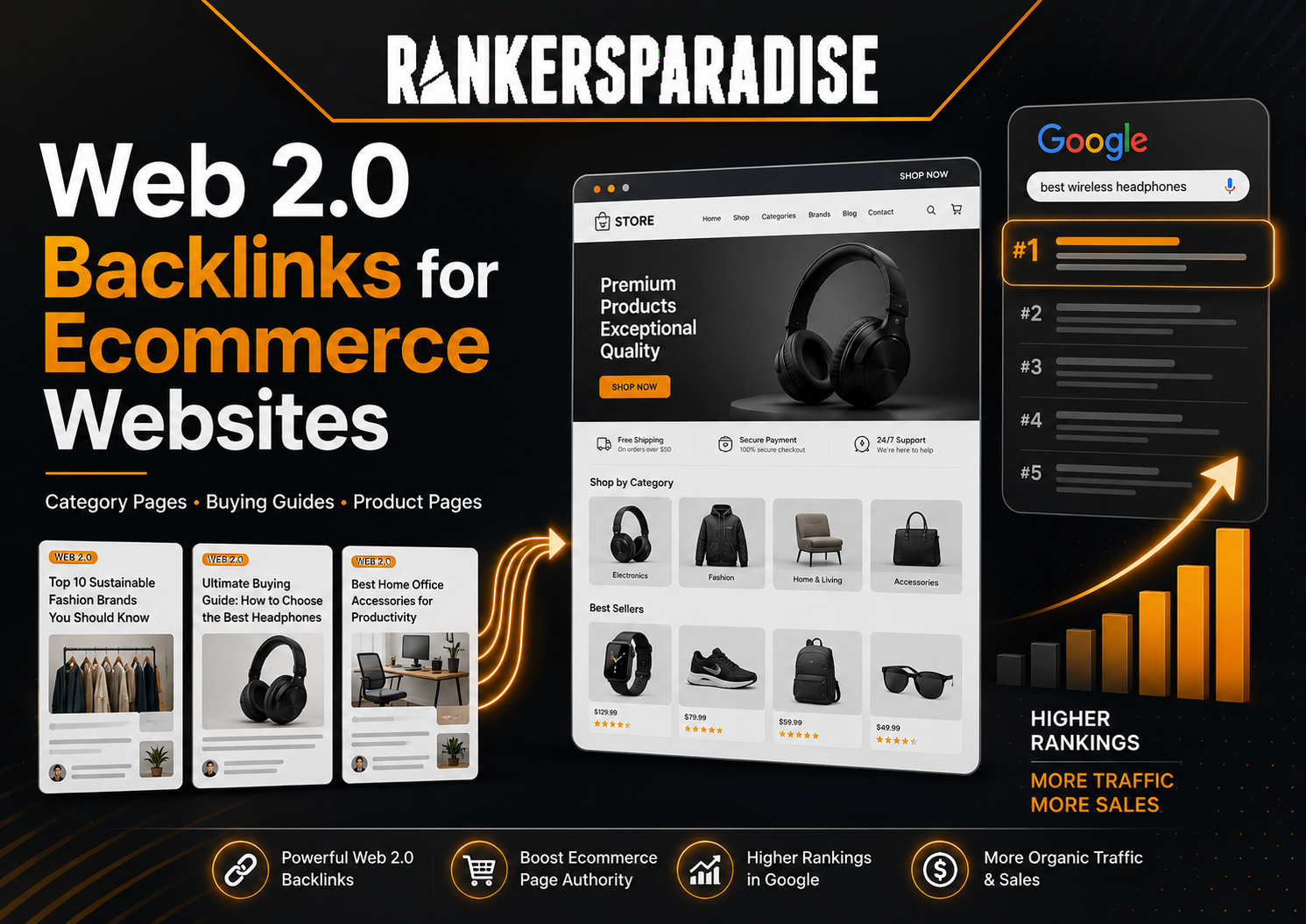
Can Web 2.0 Backlinks Help Ecommerce Websites?
Yes, Web 2.0 backlinks can help ecommerce websites.
But they work best when they are used as part of a proper ecommerce SEO strategy.
They are not magic.
They are not a replacement for good product pages.
They are not a replacement for good category content.
They are not a replacement for internal links, product descriptions, technical SEO, page speed, and good site structure.
They are a link building tool.
A useful one.
But still only one part of the full SEO picture.
Google has its own ecommerce SEO guidance explaining that ecommerce websites need to be discoverable, structured properly, and easy for Google to understand. Google also explains that sharing ecommerce data and site structure can help Google find and understand product content more easily. You can read Google’s ecommerce SEO guidance here: Google ecommerce SEO best practices.
So before you build Web 2.0 links, make sure your store is worth linking to.
If your ecommerce website is already decent, Web 2.0 backlinks can help push more relevance and authority into the pages you want to rank.
If your website is poor, fix the website first.
Why Ecommerce Websites Are Different From Blogs
Ranking an ecommerce website is not the same as ranking a blog post.
A blog post normally has lots of written content.
A product page normally does not.
A blog post may have 1,500 to 3,000 words.
A product page may have 150 words, a few bullet points, a price, and a buy button.
That is one reason ecommerce SEO can be harder.
Google needs to understand what the page is about, why the product matters, and why your page should rank above other stores selling the same or similar products.
This becomes even harder when ecommerce websites use copied manufacturer descriptions.
If 50 other websites use the same product description, why should Google rank yours?
It has no reason to.
That is why I always say this:
Do not build backlinks to weak pages.
Improve the page first, then build links.
For ecommerce SEO, the best ranking targets are usually:
- Category pages
- Collection pages
- Buying guides
- Comparison pages
- Strong product pages
- Blog posts that internally link to money pages
These pages give you more room to add content, answer buyer questions, add internal links, and build relevance.
That makes them better targets for Web 2.0 backlinks.
What Are Web 2.0 Backlinks?
Web 2.0 backlinks are backlinks built from user-generated publishing platforms.
These are platforms where you can create an account, publish content, add images, and link back to your own website.
Examples include:
- WordPress.com
- Blogger
- Tumblr
- Weebly
- Wix
- Medium
- Google Sites
- LiveJournal
- Strikingly
- Site123
The reason these links are popular is simple.
You can control the page.
You can control the content.
You can control the topic.
You can control where the link goes.
This is why Web 2.0 backlinks can be useful for ecommerce websites.
If your store sells leather wallets, you can create Web 2.0 content about choosing leather wallets, caring for leather wallets, or gift ideas for men who like leather goods.
If your store sells candles, you can create Web 2.0 content about candle scents, candle care, home fragrance, or relaxing bedroom ideas.
If your store sells dog beds, you can create Web 2.0 content about orthopedic dog beds, pet comfort, older dogs, or dog sleeping habits.
The backlink sits inside relevant content.
That is much better than a random link on a random page.
The Best Ecommerce Pages to Build Web 2.0 Backlinks To
Not every page on your ecommerce website deserves backlinks.
Some pages are worth pushing.
Some are not.
Here is how I would look at it.
| Ecommerce Page Type | Should You Build Web 2.0 Links? | Why |
|---|---|---|
| Homepage | Sometimes | Useful for brand trust, but not always the best keyword target |
| Category pages | Yes | Usually the best ecommerce money page to rank |
| Collection pages | Yes | Very strong for Shopify and product-based stores |
| Product pages | Carefully | Only if the product page has unique content |
| Buying guides | Yes | Great for long-tail buyer intent keywords |
| Comparison pages | Yes | Good for people close to buying |
| Blog posts | Yes | Good for supporting internal links to money pages |
| Sale pages | Usually no | Often temporary and not worth building links to |
| Out-of-stock pages | No | Do not waste links on pages that cannot convert |
| Thin product pages | No | Fix the page before building backlinks |
This is where a lot of ecommerce store owners waste money.
They build links to pages that are not ready.
A backlink should push a page that already has a chance of ranking.
If the target page is poor, the backlink is being wasted.
Web 2.0 Backlinks for Ecommerce Category Pages
Category pages are usually the best ecommerce pages to build Web 2.0 backlinks to.
Why?
Because category pages target commercial keywords.
These are keywords where people are already looking for products.
For example:
- Handmade leather wallets
- Luxury soy candles
- Dog grooming brushes
- Tennis training aids
- Organic skincare products
- Men’s leather belts
- Hunting accessories
- Baby gift boxes
- Home gym equipment
These keywords can bring buyers.
Not just readers.
Buyers.
That is why category pages are so important.
A good ecommerce category page should not just show a grid of products.
It should also include useful content.
Add a short introduction at the top.
Add helpful buying advice.
Add FAQs.
Add internal links to related categories.
Add product filters if needed.
Add unique text at the bottom of the page.
Make the page useful.
Google’s ecommerce guidance also talks about making ecommerce pages and structure easier for Google to understand. You can also look at Google’s advice on ecommerce URL structure if your category and product URLs are messy.
If your category page is strong, Web 2.0 backlinks can help it move.
If your category page is just a product grid with no content, improve it first.
Web 2.0 Backlinks for Product Pages
Can you build Web 2.0 backlinks to product pages?
Yes.
Should you always do it?
No.
Product pages are often weak.
A lot of ecommerce product pages have very little content.
They may only include:
- Product name
- Price
- Image
- Short description
- Add to cart button
That is not enough.
Before you build Web 2.0 backlinks to a product page, make sure the page has:
- A unique product description
- Good product images
- Clear benefits
- Product specifications
- FAQs
- Reviews if possible
- Internal links to related products
- Related category links
- Delivery information
- Returns information
- Product schema where suitable
Google explains that product structured data can help product information appear in richer ways in Google Search, including details such as price, availability, reviews, and shipping information. You can read Google’s product structured data guide here: Product structured data.
This does not mean schema alone will rank your product page.
It will not.
But it helps Google understand the product better.
And when you combine a strong product page with relevant backlinks, you give the page a better chance.
If the product page is thin, do not build links to it yet.
Fix the page first.
Web 2.0 Backlinks for Buying Guides
Buying guides are one of the best ecommerce SEO assets you can build.
This is where a lot of store owners miss out.
They only want to rank product pages.
But buying guides can bring in buyers before they make the final decision.
Examples:
- How to choose a leather wallet
- Best candle scents for bedrooms
- How to choose a dog bed for an older dog
- Best tennis training equipment for beginners
- What to look for when buying organic skincare
- Best gifts for people who love coffee
- How to choose a shotgun cartridge belt
- Best SEO services for new websites
A buying guide lets you educate the customer.
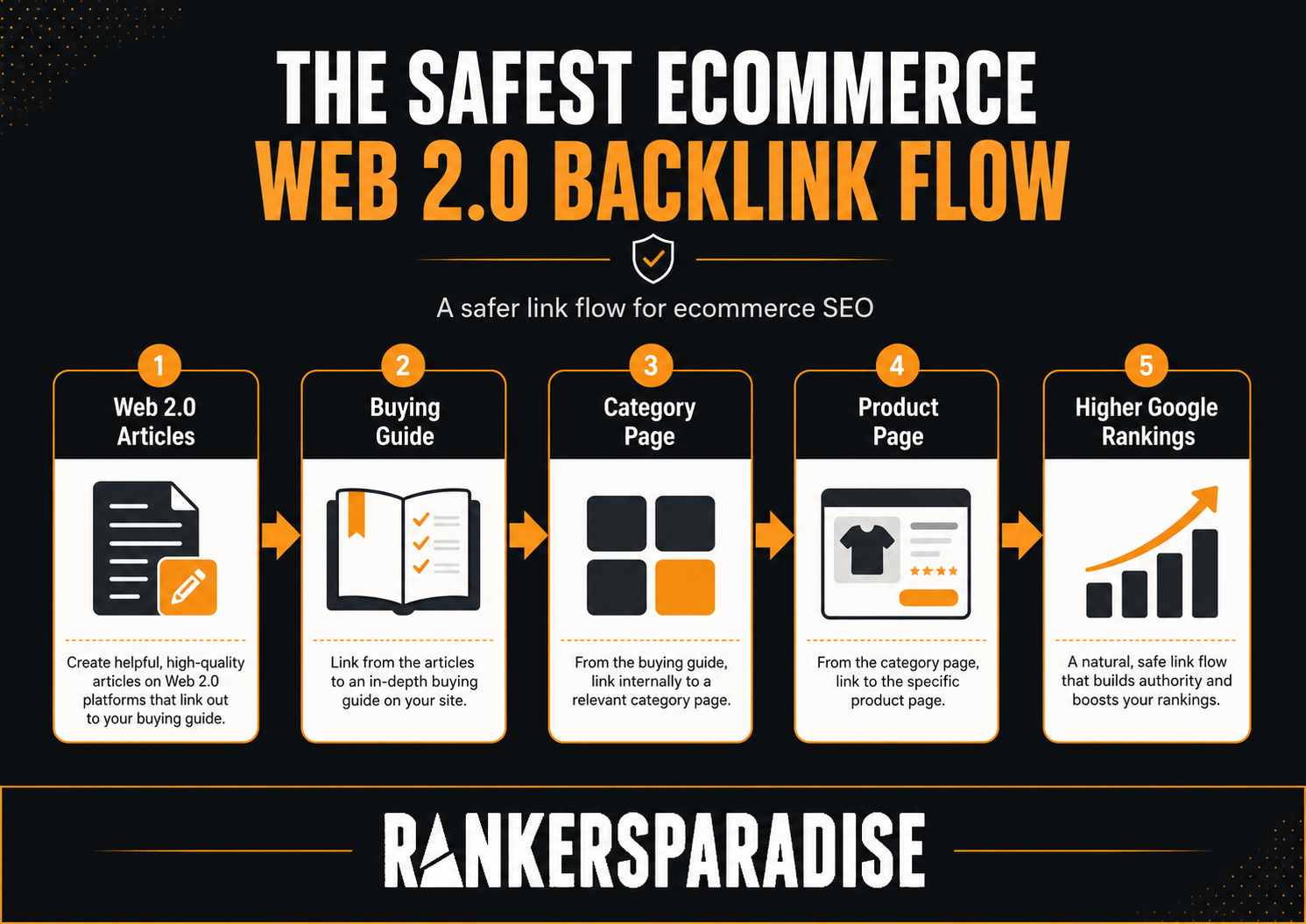
Then you can internally link to your product pages or category pages.
This is very powerful.
You can build Web 2.0 backlinks to the buying guide.
The buying guide can rank.
Then the buying guide can send visitors and internal link power to your money pages.
This is cleaner than forcing every backlink directly to a product page.
It also gives your site more topical depth.
Web 2.0 Backlinks for Ecommerce Blog Posts
Blog posts are useful for ecommerce websites.
I know a lot of store owners do not want to write blog content.
They just want sales.
That is understandable.
But blog content can help bring in traffic, build relevance, answer buyer questions, and support your product pages.
For example, if you sell candles, you can write:
- Best candle scents for sleep
- How to make your home smell relaxing
- Candle care tips for a longer burn
- Soy candles vs paraffin candles
- Candle gift ideas for her
If you sell leather goods, you can write:
- How to care for a leather wallet
- Full grain leather vs genuine leather
- Best leather gifts for men
- How to choose a leather belt
- Why handmade leather goods last longer
If you sell pet products, you can write:
- Best dog beds for older dogs
- How to keep your dog bed clean
- Dog harness vs collar
- Best grooming tools for long-haired dogs
- How to choose the right dog brush
Each blog post can link internally to the right category or product page.
Then you can build Web 2.0 backlinks to the blog post.
This is a safe way to strengthen your ecommerce SEO without pointing every link directly at a money page.
You can also read the Rankers Paradise guide on how to create backlinks to your site for free if you want a more hands-on backlink building process.
Pages You Should Not Build Web 2.0 Backlinks To
Do not waste links.
This is important.
I would not build Web 2.0 backlinks to:
- Out-of-stock products
- Discontinued products
- Thin product pages
- Duplicate manufacturer descriptions
- Temporary sale pages
- Tag pages with no real SEO value
- Search result pages
- Filtered URLs
- Broken pages
- Redirecting URLs
- Noindex pages
- Pages with poor loading speed
- Pages with no clear keyword target
If the page is not important, do not build links to it.
If the page cannot convert, do not build links to it.
If the page is not indexed, fix that first.
You need to be selective.
Good link building is not just about creating links.
It is about choosing the right pages to receive those links.
Example Web 2.0 Backlink Plan for an Ecommerce Store
Let’s say you run an ecommerce website selling luxury soy candles.
Your target category page is:
Luxury Soy Candles
Your target keyword is:
luxury soy candles
Instead of building five Web 2.0 posts all using the same boring title, you can create five different supporting articles.
| Web 2.0 Article | Link Target |
| How to Choose a Soy Candle for Your Bedroom | Luxury soy candle category page |
| Soy Candles vs Paraffin Candles: Which Is Better? | Buying guide on your site |
| Best Candle Scents for a Relaxing Home | Candle collection page |
| Candle Gift Ideas for Her | Gift guide blog post |
| How to Make Your Candle Last Longer | Candle care blog post |
This gives you a natural structure.
Not every link has to point to the same page.
You can spread the links across the ecommerce site in a way that makes sense.
Then your own internal links can pass strength back to the main category page.
That is a better strategy than forcing everything to one product page.
Example Web 2.0 Backlink Plan for a Leather Goods Store
Let’s say your ecommerce store sells handmade leather wallets.
Your main category page is:
Handmade Leather Wallets for Men
Your target keyword is:
handmade leather wallets for men
You could build Web 2.0 articles like this:
| Web 2.0 Article | Link Target |
| How to Choose a Leather Wallet That Lasts | Main wallet category page |
| Full Grain Leather vs Genuine Leather Wallets | Leather education blog post |
| Best Wallet Styles for Everyday Carry | Wallet collection page |
| Gift Ideas for Men Who Like Leather Accessories | Gift guide |
| How to Care for a Handmade Leather Wallet | Product care guide |
This is much more natural.
Each Web 2.0 article has its own reason to exist.
Each link makes sense.
The backlink is not just stuffed in.
It belongs there.
That is what you want.
Example Web 2.0 Backlink Plan for a Shopify Store
Shopify stores often rely heavily on collection pages.
That is where I would normally start.
Shopify’s own ecommerce SEO advice includes building backlinks and internal links to different types of content, focusing resources on collection pages, and creating a blog that builds niche authority. You can read Shopify’s ecommerce SEO best practices here: Shopify ecommerce SEO best practices.
If you run a Shopify store selling fitness products, your target page might be:
Home Gym Equipment
You could create Web 2.0 posts like this:
| Web 2.0 Article | Link Target |
| Best Home Gym Equipment for Beginners | Collection page |
| How to Build a Small Home Gym on a Budget | Blog buying guide |
| Dumbbells vs Resistance Bands | Comparison page |
| Simple Fitness Equipment for Small Spaces | Collection page |
| What to Buy Before Starting Home Workouts | Buyer guide |
This helps your Shopify store build relevance around the product category.
The key is to use Web 2.0 content to support your commercial pages, not just spam links at them.
Example Web 2.0 Backlink Plan for a WooCommerce Store
WooCommerce gives you a lot of SEO control because it runs on WordPress.
You can improve category content, product descriptions, blog posts, internal links, schema, and page layout more easily than on some hosted ecommerce platforms.
WooCommerce also explains that product categories, tags, and attributes help organize and display products in your store. You can read more here: WooCommerce product categories, tags and attributes.
If you run a WooCommerce store selling pet products, your target page might be:
Orthopedic Dog Beds
You could build Web 2.0 articles like this:
| Web 2.0 Article | Link Target |
| How to Choose a Dog Bed for an Older Dog | Category page |
| Orthopedic Dog Beds vs Standard Dog Beds | Comparison blog post |
| Signs Your Dog Needs a Better Bed | Buying guide |
| Best Dog Beds for Large Breeds | Collection page |
| How to Keep a Dog Bed Clean | Care guide |
This gives your store more supporting relevance.
It also gives you internal linking options.
The Web 2.0 backlinks push supporting content and commercial pages.
Your internal links help guide Google to the pages that matter most.
How Many Web 2.0 Backlinks Does an Ecommerce Website Need?
This depends on the keyword.
There is no magic number.
Anyone who tells you every ecommerce website needs exactly 10 Web 2.0 backlinks is guessing.
A low competition keyword may only need a few good links.
A medium keyword may need more.
A hard keyword may need Web 2.0 links plus guest posts, niche edits, citations, brand links, digital PR, and stronger authority links.
Here is a simple guide.
| Keyword Competition | Suggested Starting Point |
| Very low competition | 3 to 5 Web 2.0 backlinks |
| Low competition | 5 to 10 Web 2.0 backlinks |
| Medium competition | 10 to 20 Web 2.0 backlinks plus other links |
| High competition | Web 2.0 links alone are probably not enough |
Start small.
Track the rankings.
Then build more if needed.
Do not build 50 links on day one to a brand new ecommerce website.
That is not how I would do it.
Slow and steady is better, especially if the store is new.
Why Most Ecommerce Web 2.0 Backlinks Fail
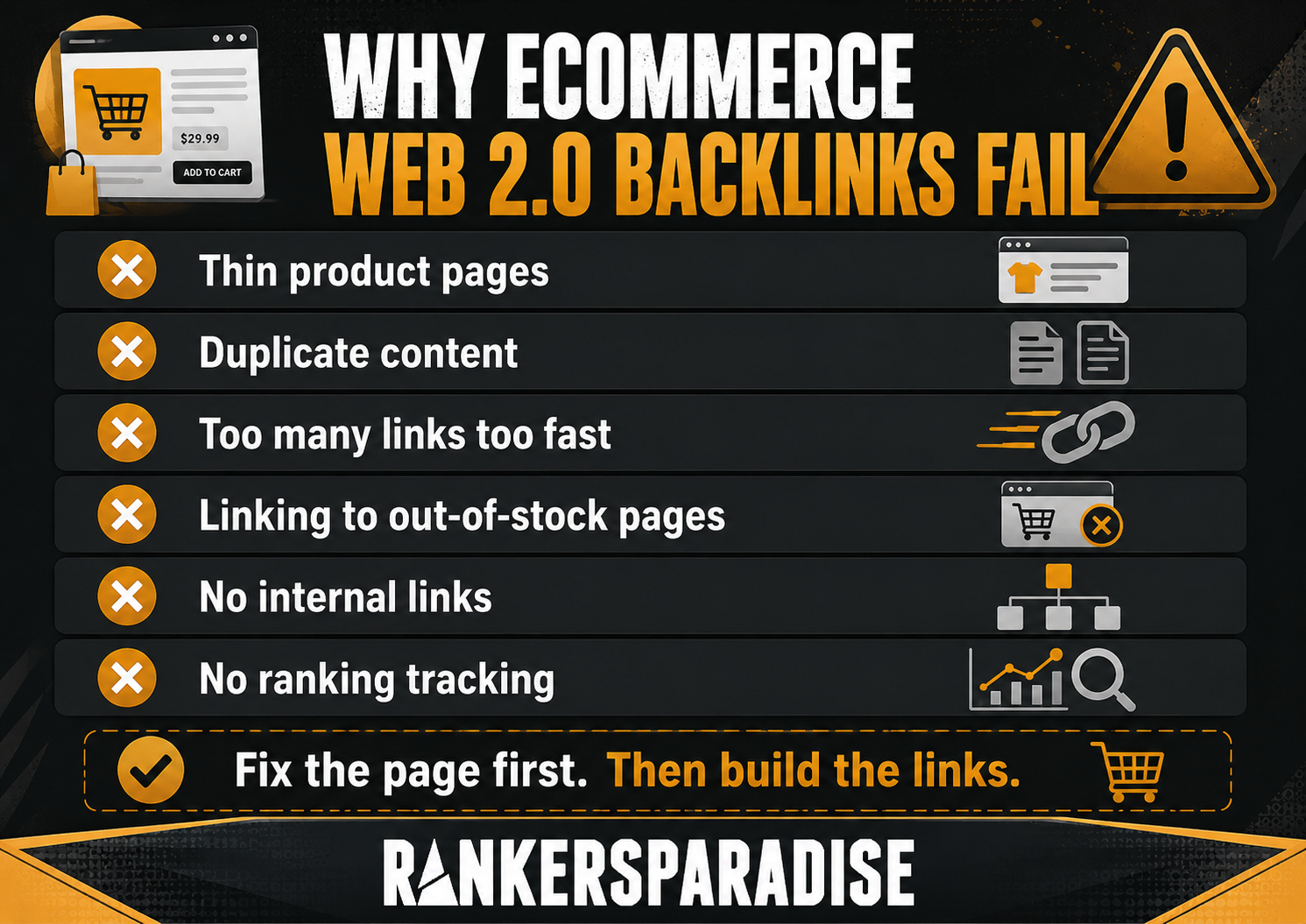
Most ecommerce Web 2.0 backlinks fail because the strategy is lazy.
People build links to the wrong pages.
They use thin content.
They use duplicate content.
They do not add images.
They link to weak product pages.
They use the same style of post every time.
They expect rankings without improving the actual ecommerce website.
That is the problem.
The backlink type is not always the issue.
The way the backlink is built is the issue.
A Web 2.0 backlink from a relevant article to a strong ecommerce category page can help.
A Web 2.0 backlink from a thin, badly written post to a weak product page probably will not do much.
You need to build links properly.
The content around the link matters.
The page receiving the link matters.
The keyword competition matters.
The internal links on your website matter.
The full picture matters.
How to Make Ecommerce Web 2.0 Backlinks Look Natural
The easiest way to make Web 2.0 backlinks look natural is to make the content useful.
Do not write the Web 2.0 post only for the link.
Write it like a real mini article.
Use:
- A proper title
- Short paragraphs
- Clear headings
- One or two images
- Useful advice
- A natural link placement
- One relevant external authority link if needed
- One link back to your ecommerce page
Do not make every post look the same.
Do not use the same layout every time.
Do not use the same image every time.
Do not use the same opening paragraph every time.
Do not link in the first sentence every time.
Mix things up.
Real content is not perfectly identical.
If every Web 2.0 property looks like it came from the same template, that is not ideal.
Should You Add External Links Inside Web 2.0 Posts?
Yes, sometimes.
Adding a relevant external link can make the article look more useful.
For example, if you write a Web 2.0 post about choosing candle materials, you might link to a trusted resource about candle safety.
If you write about product schema, you might link to Google’s structured data documentation.
If you write about ecommerce SEO, you might link to Google Search Central.
Do not add random external links.
Only add them if they make sense.
The external link should help the reader.
It should not be there just to tick a box.
Google’s link best practices also explain that links should be crawlable and that anchor text helps users and Google understand the linked page. You can read that here: Google link best practices.
Should You Interlink Web 2.0 Properties?
You can, but be careful.
Some people build Web 2.0 link wheels.
This means one Web 2.0 site links to another, and then those sites link back to your main website.
This can work when done carefully, but it can also look forced when done badly.
If you want to understand this strategy better, read the Rankers Paradise guide on Web 2.0 link wheels.
For ecommerce websites, I would keep things simple at first.
Build useful Web 2.0 posts.
Link back to relevant ecommerce pages.
Get the posts indexed.
Track the results.
You do not need to overcomplicate it straight away.
Web 2.0 Backlinks for New Ecommerce Websites
If your ecommerce website is new, be patient.
New websites often struggle because they have:
- No authority
- No backlinks
- Thin product pages
- Weak category pages
- Poor internal links
- Little or no blog content
- No brand signals
- No reviews
- No trust
You cannot fix all of that with five Web 2.0 backlinks.
But Web 2.0 backlinks can help you start building momentum.
For a new ecommerce website, I would start with:
- 1 strong category page
- 1 useful buying guide
- 3 to 5 Web 2.0 backlinks
- A few internal links
- Proper on-page SEO
- Product schema where suitable
- Unique product descriptions
Then track what happens.
If the page starts moving, build more.
If nothing happens, look at the page again.
Is the content good enough?
Is the keyword too hard?
Is the page indexed?
Is the internal linking poor?
Do not just keep building links blindly.
Diagnose the problem.
Web 2.0 Backlinks for Established Ecommerce Websites
Established ecommerce websites can be more aggressive.
If the store already has authority, traffic, indexed pages, and some backlinks, Web 2.0 links can be used to support specific pages.
For example, you may want to push:
- A new category page
- A seasonal collection
- A buyer guide
- A product comparison page
- A new product range
- A blog post targeting buyer intent
This is where Web 2.0 backlinks can be useful.
They can help support pages that are already close to ranking.
If a page is sitting on page two of Google, a few relevant links may help push it higher.
That is where I like using these links.
Find pages that are close.
Improve the content.
Add internal links.
Then build relevant Web 2.0 backlinks.
Web 2.0 Backlinks for Ecommerce Category Pages vs Product Pages
If you are unsure where to build links, choose the category page first.
Category pages usually have more ranking potential.
Product pages can rank, but they are often too narrow.
Here is a simple way to decide.
| Page Type | Best Use |
| Category page | Best for broader buyer keywords |
| Product page | Best for exact product searches |
| Buying guide | Best for research-stage buyers |
| Comparison page | Best for decision-stage buyers |
| Blog post | Best for informational traffic and internal links |
For most ecommerce websites, I would build Web 2.0 backlinks to the category page or buying guide before the product page.
Then use internal links to push product pages.
This keeps the strategy cleaner.
How to Choose Keywords for Ecommerce Web 2.0 Backlink Campaigns
Do not target keywords that are too hard at the start.
If your store is new, do not try to rank for a huge keyword like:
candles
That is too broad.
Target long-tail keywords instead.
Examples:
- Luxury soy candles for bedrooms
- Handmade leather wallets for men
- Orthopedic dog beds for older dogs
- Tennis training equipment for beginners
- Natural skincare products for dry skin
- Personalised baby gift boxes UK
- Handmade leather belts for jeans
These keywords are more specific.
They normally have lower competition.
They also bring in better visitors.
A person searching for “candles” could want anything.
A person searching for “luxury soy candles for bedrooms” is much closer to buying.
That is the kind of keyword I like.
Ecommerce Web 2.0 Content Ideas You Can Use
Here are some easy Web 2.0 content ideas for ecommerce websites.
Product Education Posts
These help people understand the product.
Examples:
- How to choose the right leather wallet
- Why soy wax candles are popular
- What to look for in a dog harness
- How to pick skincare for dry skin
- Best materials for outdoor gear
Buying Guide Posts
These help people make a buying decision.
Examples:
- Best gifts for candle lovers
- Best wallets for men who travel
- Best dog beds for large dogs
- Best tennis gear for beginners
- Best skincare products for sensitive skin
Problem Solving Posts
These work well because people search Google when they have a problem.
Examples:
- How to stop candles tunnelling
- How to clean a leather wallet
- How to choose shoes for foot pain
- How to keep dog beds smelling fresh
- How to protect leather accessories from rain
Comparison Posts
These catch buyers close to making a decision.
Examples:
- Soy candles vs paraffin candles
- Full grain leather vs genuine leather
- Dog harness vs dog collar
- Foam dog bed vs orthopedic dog bed
- Budget tennis racket vs premium tennis racket
Gift Guide Posts
Gift guides are brilliant for ecommerce.
Examples:
- Best gifts for men who like leather goods
- Best relaxing gifts for candle lovers
- Best gifts for dog owners
- Best sports gifts for beginners
- Best self-care gifts for women
Each of these can become a Web 2.0 article.
Each one can link back to a relevant ecommerce page.
Web 2.0 Backlinks and Internal Links
Do not ignore internal links.
Internal links are very important for ecommerce websites.
If you build Web 2.0 backlinks to a buying guide, that buying guide should link to the right category page.
If you build Web 2.0 backlinks to a blog post, that blog post should link to the product or category page.
If you build Web 2.0 backlinks to a category page, that category page should link to important products.
This is how link power moves through the site.
You can also support your ecommerce pages by using other safe backlink strategies. For example, Rankers Paradise has a full guide on how to buy backlinks if you want to understand how paid link building should be approached more carefully.
You can also read the Rankers Paradise guide on free backlinks if you want to build extra link diversity without spending money.
Should You Use Web 2.0 Backlinks Alone?
For very low competition ecommerce keywords, Web 2.0 backlinks may be enough to move the page.
For anything more competitive, I would not rely on them alone.
You may need a mix of:
- Web 2.0 backlinks
- Guest posts
- Niche edits
- Business profiles
- Social profiles
- Blog comments
- Digital PR
- Internal links
- Brand mentions
- Google stacks
- Content updates
This does not mean Web 2.0 backlinks are weak.
It just means competitive keywords need more than one type of signal.
If you are serious about ecommerce SEO, build a proper backlink profile.
Web 2.0 links can be part of that.
Are Web 2.0 Backlinks Safe for Ecommerce SEO?
They can be safe when they are built properly.
The risk comes from low-quality link building.
Google’s spam policies explain that tactics designed mainly to manipulate rankings can cause problems in search. You can read the policy here: Google spam policies.
That is why you should avoid spammy Web 2.0 link building.
Do not use spun content.
Do not create junk pages.
Do not blast thousands of links.
Do not use the same content everywhere.
Do not link to bad pages.
Build useful content.
Make the link relevant.
Keep the structure natural.
That is the sensible way to do it.
A Simple Web 2.0 Backlink Checklist for Ecommerce Websites
Before you build the link, check this:
- Is the ecommerce page indexed?
- Is the page targeting a real keyword?
- Is the keyword low enough competition?
- Is the page useful?
- Does the page have unique content?
- Is the page internally linked?
- Does the product/category page look trustworthy?
- Is the Web 2.0 article unique?
- Does the Web 2.0 article match the niche?
- Is the backlink placed naturally?
- Is the Web 2.0 page likely to index?
- Are you tracking the target keyword?
If the answer is no to most of these, fix the problem first.
Do not just build links and hope.
Hope is not an SEO strategy.
My Recommended Web 2.0 Strategy for Ecommerce Websites
If I was working on a new ecommerce website, this is what I would do.
First, I would pick one category page or buying guide.
Then I would make sure the page is properly optimized.
I would add useful content, FAQs, internal links, and unique copy.
Then I would create five Web 2.0 articles around the topic.
Each article would be different.
Each article would answer a real buyer question.
Each article would include one natural backlink.
I would use different Web 2.0 platforms.
I would add images.
I would try to get the Web 2.0 pages indexed.
Then I would track the rankings for a few weeks.
If the page moves, I would build more supporting links.
If the page does not move, I would improve the page or reassess the keyword.
This is simple.
But simple works when it is done properly.
FAQs About Web 2.0 Backlinks for Ecommerce Websites
Do Web 2.0 backlinks work for Shopify stores?
Yes, Web 2.0 backlinks can work for Shopify stores.
I would normally use them to support collection pages, buying guides, blog posts, and strong product pages.
Shopify collection pages are often better targets than individual product pages because they can rank for broader buyer keywords.
Do Web 2.0 backlinks work for WooCommerce websites?
Yes, Web 2.0 backlinks can work well for WooCommerce websites.
WooCommerce gives you a lot of control over content, categories, internal links, and product pages. This makes it easier to build strong target pages before building backlinks.
Can I build Web 2.0 backlinks directly to product pages?
Yes, but only if the product page is strong.
If the product page has thin content, copied descriptions, poor images, or no useful information, improve it first.
For most ecommerce websites, I would build links to category pages or buying guides before product pages.
How many Web 2.0 backlinks does an ecommerce website need?
It depends on the keyword competition.
For low competition keywords, 3 to 10 good Web 2.0 backlinks may help.
For medium competition keywords, you may need more links and a stronger backlink mix.
For hard ecommerce keywords, Web 2.0 backlinks alone are unlikely to be enough.
Are Web 2.0 backlinks good for ecommerce category pages?
Yes, category pages are usually one of the best ecommerce backlink targets.
They can rank for commercial keywords and send buyers directly into your store.
Just make sure the category page has useful content and is not only a product grid.
Should I build Web 2.0 backlinks to sale pages?
Usually no.
Sale pages are often temporary.
If the sale page will be removed or changed soon, do not waste backlinks on it.
Build links to permanent category pages, buying guides, or strong product pages instead.
Do Web 2.0 backlinks need to be indexed?
Yes, ideally.
If Google does not crawl or index the Web 2.0 page, the backlink is unlikely to help much.
Use unique content, images, good platforms, and natural posts to improve the chance of indexing.
Final Thoughts
Web 2.0 backlinks for ecommerce websites can work.
But only if you use them properly.
Do not build links to weak pages.
Do not use thin content.
Do not expect a bad product page to rank just because you pointed a few links at it.
The ecommerce page needs to be good first.
Then the backlinks can help.
For most online stores, I would start with category pages, collection pages, buying guides, and strong blog posts.
Then I would use Web 2.0 backlinks to support those pages with relevant content.
This gives Google more context.
It gives your ecommerce website more authority.
It gives your buyer pages more support.
And if the keyword is low competition, it can be enough to push the page higher in Google organic SERPs.
Doing nothing usually results in nothing happening.
If your ecommerce store needs more organic traffic, start by improving the page, then build the right links to it.
That is how I would use Web 2.0 backlinks for ecommerce SEO.