
If you’ve been throwing money at backlink packages and seeing absolutely nothing move, you’re not alone. You buy “high authority” links, receive a spreadsheet packed with URLs, and then wait.
A week passes. Two weeks. Your rankings stay flat.
That’s not SEO progress. That’s wasted budget dressed up as a report.
If you’re going to purchase high quality backlinks, you need a proper checklist. Not another fluffy article repeating “check DA and DR.” Those metrics matter, but they’re not enough. I’ve seen domains with impressive numbers and zero real search visibility. I’ve also seen smaller, highly relevant websites outperform much larger platforms.
The difference is quality, context, and real-world vetting.
I’m going to show you exactly what to inspect before you spend a penny.
First, understand the risk
Google’s link spam policies state that buying links intended to manipulate rankings can violate its guidelines. Paid advertising links should use rel="sponsored" or rel="nofollow".
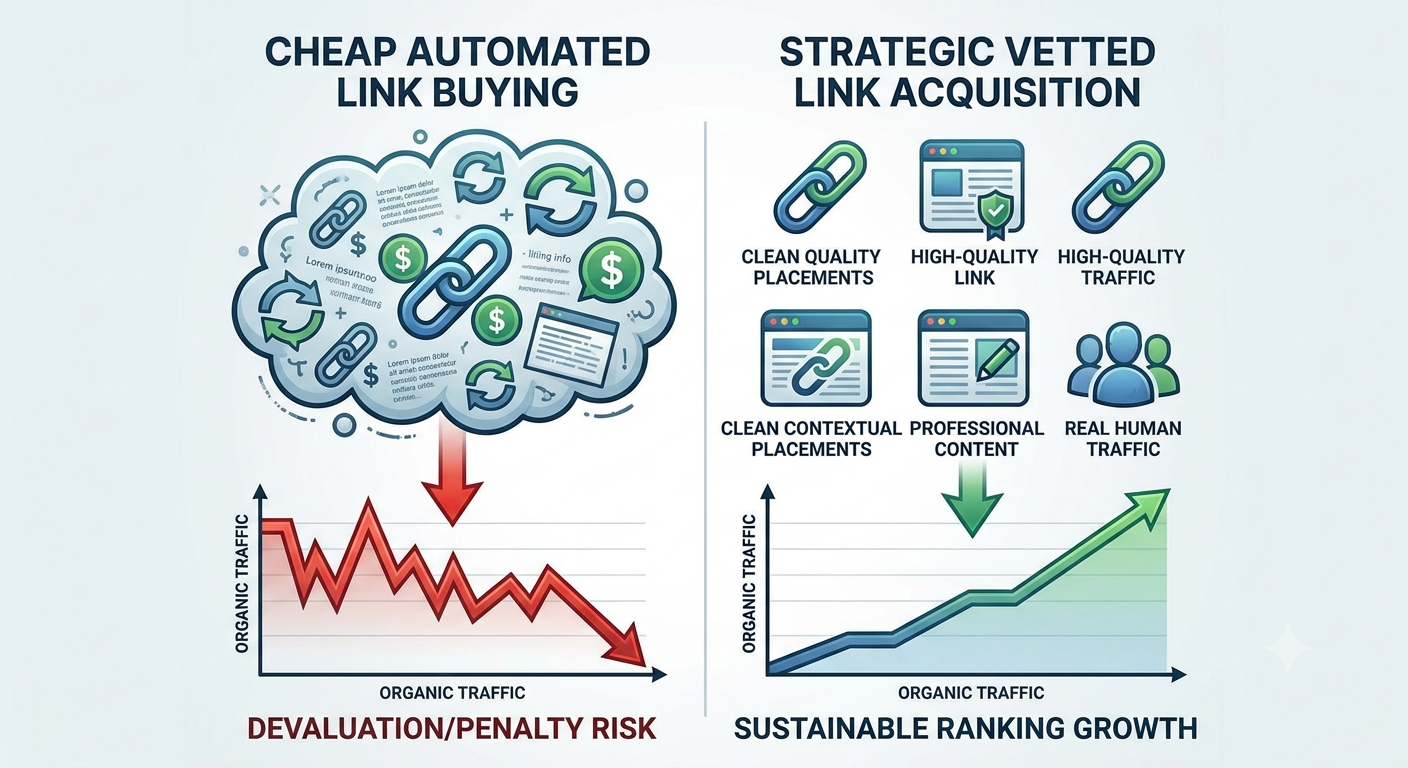
That doesn’t mean you should ignore backlinks. It means you shouldn’t blindly buy cheap, automated link packages and expect guaranteed rankings.
A strong backlink strategy focuses on:
- Relevant websites
- Useful editorial content
- Real audiences and organic traffic
- Natural anchor text
- Transparent reporting
- Manual quality control
The goal is not to create a wall of generic junk. The goal is to build visibility, referral traffic, brand authority, and a backlink profile that makes sense.
What makes a backlink genuinely high quality?
A high quality backlink should pass the common-sense test:
Would this link still be useful if Google didn’t exist?
If a reader clicked the link, would they find something relevant and helpful? If the answer is no, the placement is probably weak.
Here are the signals that matter most:
- Topical relevance: The website and page should relate to your industry.
- Real traffic: The site should have genuine organic visibility, not inflated third-party metrics.
- Contextual placement: The link should appear naturally inside useful body content.
- Editorial quality: The page should be written for readers, not created only to host links.
- Clean link neighbourhood: The site shouldn’t link to hundreds of unrelated businesses.
- Indexation: The page should be crawlable and indexed, or have a clear path to indexation.
- Natural anchors: Your backlink profile should include branded, URL, generic, partial-match, and limited exact-match anchors.
The high quality backlink purchase checklist
Use this checklist before choosing a provider, publisher, guest post, niche edit, or link-building campaign.
1. Check organic traffic first
Don’t get distracted by DA, DR, Trust Flow, or any other single score. These are useful comparison tools, but they can be manipulated.
Check whether the website has:
- Consistent organic traffic
- Ranking keywords relevant to its niche
- A stable traffic trend
- Traffic from the countries you care about
- Pages that are actually indexed
A site with a high authority score but no meaningful organic traffic is a serious warning sign. It could be a dropped domain, a neglected website, or a link farm built to sell placements.
A practical benchmark is to look for verifiable traffic rather than accepting a vendor’s screenshot. For competitive campaigns, many buyers use a 1,000-plus monthly organic traffic floor as an initial filter. It isn’t a magic number, but it helps remove obvious garbage.
2. Confirm strict topical relevance
A backlink from a relevant business, publication, or specialist blog makes sense. A backlink from an unrelated website usually doesn’t.
For example:
- A legal services website should be linked from legal, business, finance, or local community content.
- A SaaS company may benefit from links on technology, productivity, startup, or industry publications.
- A local plumber needs relevant trade, property, home improvement, and local websites.
The specific page matters too. A relevant domain with an irrelevant article is still a weak match.
Look at the surrounding paragraph. Does it discuss your subject naturally? Does your page genuinely add value? If the link is forced into a random sentence, move on.
3. Inspect the website’s outbound links
This is where many buyers get caught.
Open several recent articles. Review the links. Are they pointing to useful references and credible businesses, or are they stuffed with casinos, payday loans, pharmaceuticals, crypto projects, and unrelated commercial pages?
A website that publishes dozens of paid placements every week across every possible niche is not a trusted publication. It’s a link marketplace wearing a blog template.
Check:
- The number of commercial links on recent pages
- Whether outbound links are relevant
- Whether articles contain multiple money anchors
- Whether every post appears to be sponsored content
- Whether the site has genuine editorial standards
If the entire website screams “links for sale,” the backlink probably won’t carry much value.
4. Demand unique, useful content
Thin, spun, duplicated, or unreadable content is trash. It doesn’t help the reader, the publisher, or your brand.
Before you purchase high quality backlinks, ask who writes the content and how it is reviewed. Strong placements should include:
- Original writing
- Clear structure
- Accurate information
- Relevant examples
- Natural internal and external references
- A link that fits the article without disrupting it
The article doesn’t need to be 3,000 words of fluff. It needs to provide a reason for existing.
If a provider promises hundreds of placements using the same article template, you already know what you’re getting: noise.
5. Review the anchor text plan
Overusing exact-match anchors is playing with fire.
If every backlink uses the same commercial keyword, your profile won’t look natural. A sensible campaign should use a varied mix of:
- Brand names
- Naked URLs
- Generic phrases
- Partial-match anchors
- Topical phrases
- A small number of exact-match anchors
Don’t let a provider push you into using your target keyword in every placement. That’s not advanced SEO. That’s an obvious footprint.
Anchor text should fit the sentence and describe the destination accurately. If it sounds awkward when read aloud, it’s probably the wrong anchor.
6. Verify indexation and page quality
A link that never gets crawled or indexed is unlikely to deliver meaningful search value.
Check whether the publisher’s pages:
- Load properly
- Return a valid status
- Use HTTPS
- Are accessible on mobile
- Have clear navigation
- Appear in search results
- Contain useful, visible content
Indexation can take time, so don’t panic if a fresh placement isn’t visible immediately. But a provider should be able to explain how they monitor live placements and what happens if a page disappears.
Clear reporting matters. You should receive the live URL, anchor text, target page, publication date, and relevant placement details.
Red flags that should stop you immediately
Do not buy a backlink package just because it’s cheap. Walk away if the provider:
- Guarantees a number-one ranking
- Promises thousands of links in a few days
- Refuses to show sample placements
- Talks only about DA or DR
- Uses automated software for every link
- Offers the same domains to every customer
- Uses 100% exact-match anchors
- Cannot explain its quality-control process
- Hides the websites until after payment
- Relies on private blog networks or obvious link farms
“Guaranteed Google rankings” is pure nonsense. No honest provider can control Google, your competitors, your website quality, or future algorithm changes.
A serious provider can guarantee deliverables. They can’t guarantee a specific ranking position.
Should you handle the campaign yourself?
You can manage outreach yourself, but it takes time. You need to research websites, check traffic, review content, contact publishers, negotiate placements, write articles, monitor indexation, and report results.
That’s a lot of work.
If you already have the skills and time, build the process internally. If you don’t, work with a provider that offers clear deliverables and manual link building.
Rankers Paradise provides SEO link-building services for businesses across different niches and languages. You can also review the high quality backlink service to understand the type of campaign available.
Before placing an order, read our backlink buying guide. It explains how to compare providers, inspect placements, and avoid the cheap automated tactics that waste money.
A safer purchase process
Follow this sequence:
- Audit your current backlink profile. Check existing anchors, referring domains, and suspicious links.
- Choose one or two target pages. Don’t send every backlink to your homepage.
- Improve the target content first. A weak page won’t convert authority into results.
- Define your relevance requirements. Decide which industries, topics, countries, and audiences matter.
- Set an anchor text mix. Keep it natural and avoid aggressive exact-match use.
- Request sample placements. Review the websites before approving the campaign.
- Confirm reporting details. Know exactly what you’ll receive and when.
- Monitor rankings and traffic. Look for trends over weeks and months, not overnight miracles.
This process removes guesswork. It also makes it much harder for a provider to sell you a spreadsheet full of meaningless links.
Final checklist
Before you purchase high quality backlinks, confirm that:
- The website has real organic traffic.
- The domain and page are topically relevant.
- The site has a clean outbound link profile.
- The placement appears inside useful content.
- The content is unique and readable.
- The anchor text fits naturally.
- Exact-match anchors are limited.
- The page is crawlable and indexable.
- You’ll receive transparent reporting.
- The provider avoids ranking guarantees.
- The campaign supports your broader SEO strategy.
That’s the standard.
You don’t need more noise, more dashboards, or more inflated metrics. You need relevant placements, careful research, useful content, and a provider that tells you exactly what it will deliver.
Cheap backlinks can create a short-term spike, a long-term mess, or absolutely nothing. High quality backlink acquisition is slower and more deliberate; but it gives you a far better chance of building sustainable visibility and attracting the right traffic.
Want help choosing the right campaign? Browse the Rankers Paradise backlink service or contact the team for straightforward advice.