
I have been building Web 2.0 links for years and there is one thing about the pricing that has always made me laugh.
You can find someone selling hundreds of them for the price of a takeaway.
Then you find another SEO company charging hundreds of dollars for 10 or 20 links.
They both call them Web 2.0 backlinks.
They are not necessarily selling you the same thing.
That is the first thing you need to understand.
You are not really paying for a backlink from WordPress, Tumblr, Wix or another publishing platform. You can create many of these links yourself for free.
You are paying for the work that goes into creating the property, writing the content, placing the link, setting up the account, making the page look half decent and, most importantly, getting the backlink discovered.
This is why comparing two packages purely by the number of links is a bad way to buy them.
I have built these links myself, used them on my own websites and used them as part of client campaigns. I have also seen plenty of Web 2.0 properties disappear, fail to get crawled or sit there doing absolutely nothing.
So let’s look at what you should actually be paying.
Web 2.0 Backlinks Price: The Quick Answer
If you just want some numbers, here is roughly how I look at it.
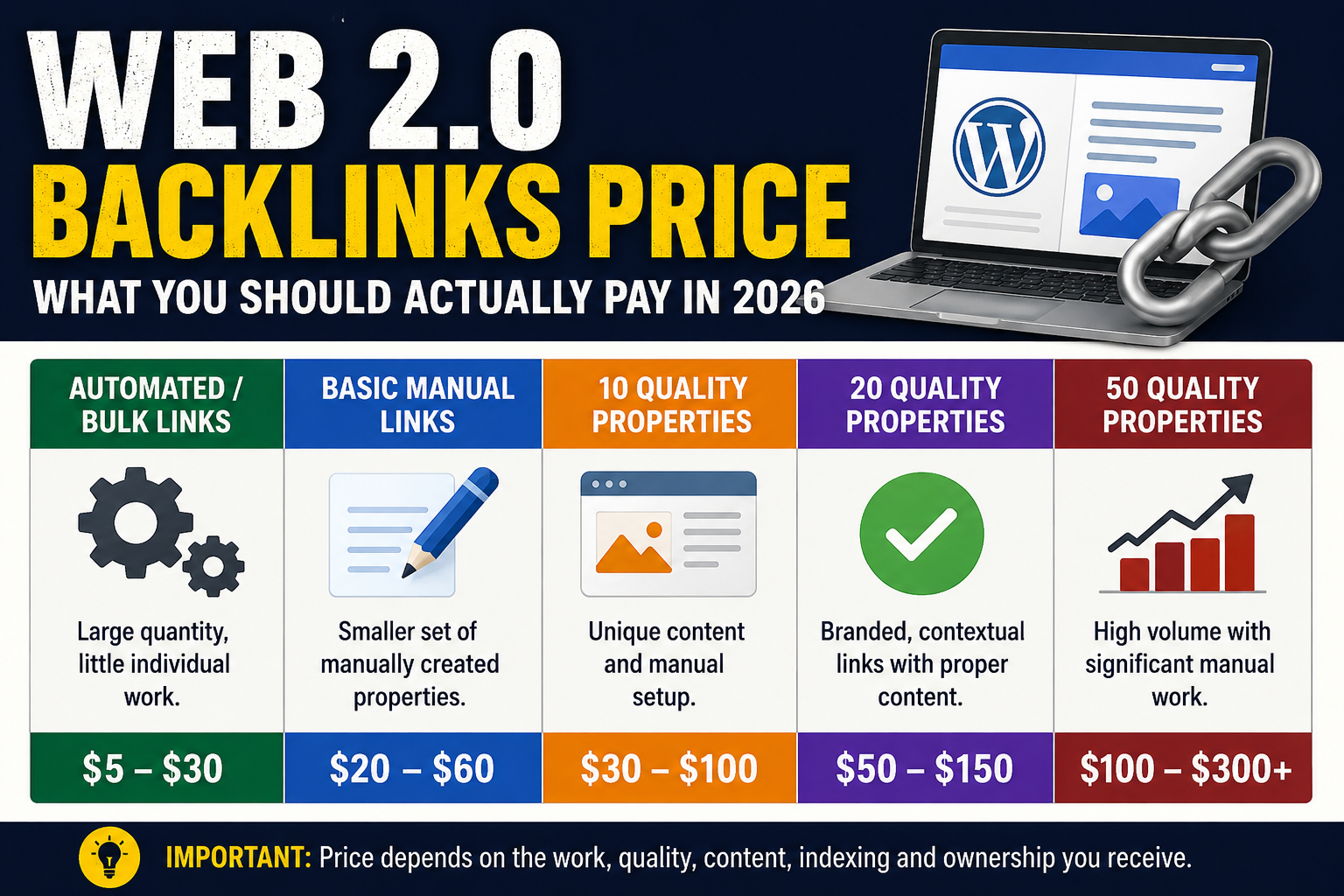
| Type of Web 2.0 Service | Price Range I Would Expect | What You Are Usually Getting |
|---|---|---|
| Automated/bulk links | $5–$30 | Large quantity, little individual work |
| Basic manually created links | $20–$60 | Smaller set of manually created properties |
| 10 quality properties | $30–$100 | Unique content and manual setup |
| 20 quality properties | $50–$150 | Properly built branded/content properties |
| 50 quality properties | $100–$300+ | Considerable manual work if genuinely built properly |
| Aged Web 2.0 placements | Varies massively | Existing properties rather than brand-new accounts |
| Managed Web 2.0 campaign | $100–$500+ | Content, links, account management, tiering and other SEO work |
Those are not fixed industry prices.
They are the sort of ranges I would expect to see when shopping around.
There are services cheaper than this and plenty that cost more.
The important question isn’t:
How many backlinks am I getting?
I would ask:
What exactly has been done to create each backlink?
That tells you much more.
Web 2.0 Backlinks Can Be Free
This is the funny part.
You don’t actually have to pay anything.
A lot of the platforms themselves allow you to create a website, blog, profile or page without paying for the backlink.
WordPress.com, for example, still allows users to create sites on a free .wordpress.com address. You can see the current options on the official WordPress.com website.
That means you can build the links yourself.
I have a complete guide showing how I build web 2.0 backlinks if you would rather spend your time instead of your money.
And that is really what you’re paying for.
Time.
Creating one property isn’t difficult.
Creating 20 properly takes considerably longer.
You need accounts.
You need content.
You need titles.
You need images if you’re doing the properties properly.
You need anchor text.
You need to publish everything.
Then you need to keep track of all those URLs.
And after all that, you still want the search engines to discover your links.
Do this once and it isn’t a big deal.
Do it across hundreds of SEO campaigns and suddenly the labour involved starts adding up.
Why Can Someone Sell 1,000 Web 2.0 Backlinks for $10?
Automation.
That is normally the first place I look.
There is no way somebody is sitting at a desk manually creating 1,000 proper mini-sites, writing 1,000 unique articles, branding everything and checking the finished pages for ten bucks.
The numbers don’t work.
This does not automatically mean that a cheap bulk service is useless.
That distinction is important.
I have used bulk links.
I use different types of backlinks for different jobs.
What I wouldn’t do is buy 1,000 automated links and pretend I had purchased 1,000 carefully built Tier 1 properties.
Those are completely different products.
A cheap bulk package may be useful further down a tiered structure where the objective is discovery, diversification or supporting other URLs.
If I want a small group of properties sitting closer to my money website, I want more control over them.
This is why price alone tells you very little.
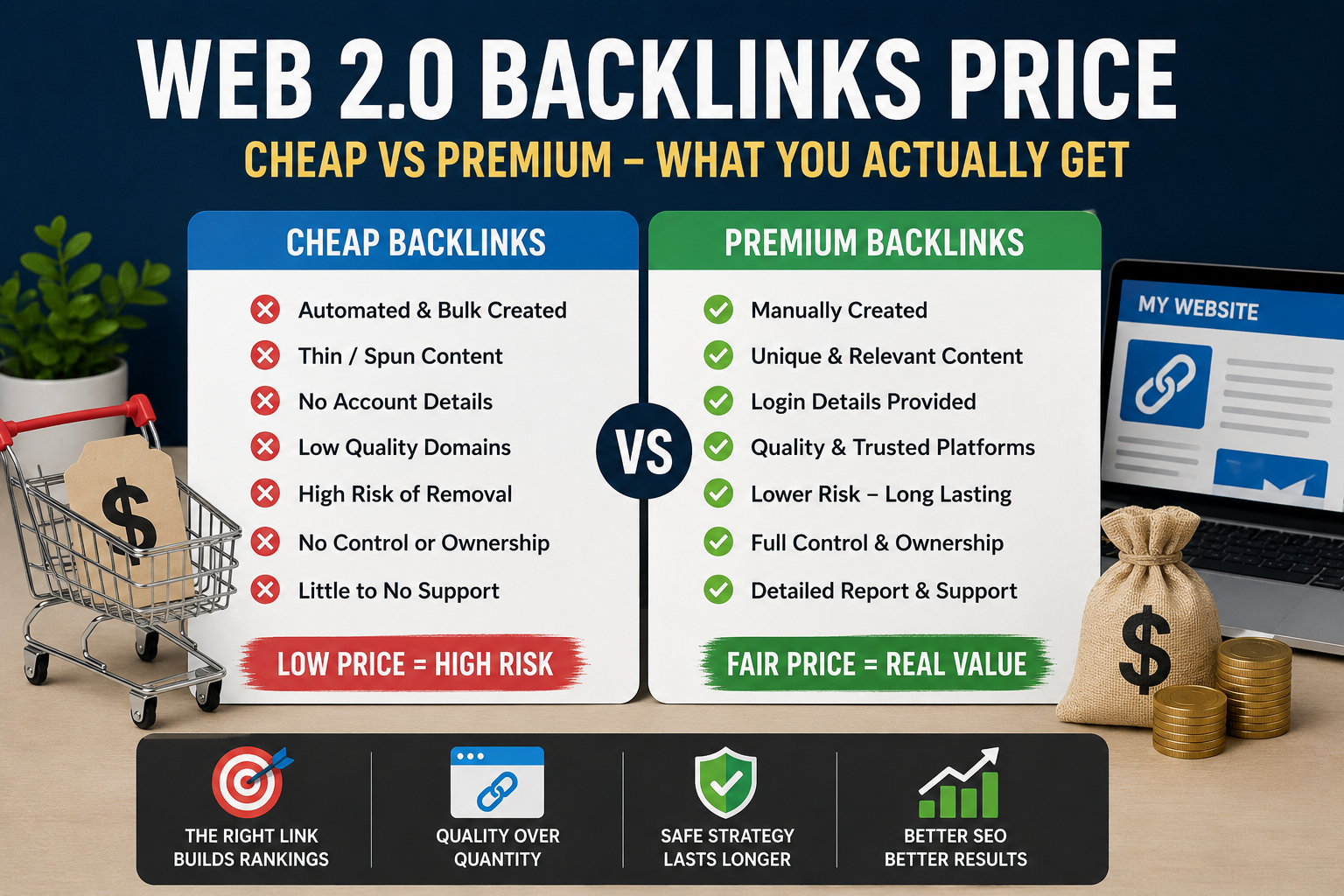
What Are You Actually Paying For?
When I price this sort of work I look at the work involved.
Account Creation
Someone has to create the account.
That may involve email verification, profile completion, choosing a site name and setting up the property.
Some platforms take a couple of minutes.
Others are a pain.
If you’re getting account login details afterwards, there is additional value because you have control of the property and can potentially use it again.
Content
This is a big one.
There is a huge difference between dumping 150 words of rubbish onto a page and creating a useful post that actually looks like it belongs there.
I don’t need every Web 2.0 article to win a Pulitzer Prize.
It isn’t what the page is there for.
But I don’t want complete garbage either.
If you’re paying for a manually built property, there should be enough relevant content around the link for the page to make sense.
Property Setup
A blank page with one article on it is cheap to create.
A property with a proper name, description, image, profile information and supporting pages takes longer.
Again, I wouldn’t go mad with this.
You can waste hours making a free blog look beautiful when nobody is ever going to visit it.
There needs to be some common sense.
I want the property to look legitimate enough for what I’m using it for.
Link Placement
I prefer contextual links.
If I have a choice between a random profile field and a backlink placed naturally inside relevant content, I know which one I want sitting closer to my money site.
You should also know which URL is being linked to and what anchors are being used.
If the seller won’t let you control any of this, I would want to know why.
Indexing and Crawling
This is where people get obsessed with the wrong thing.
They check whether every single backlink URL is indexed in Google.
I care whether the search engines have discovered the link.
There is a difference.
A backlink doesn’t need to sit permanently in Google’s search results for Google’s crawler to have discovered the page and followed its links.
When I build my own properties I also interlink them and use supporting links where appropriate.
I have covered the setup in my Web 2.0 link wheel guide.
That is considerably more work than hitting publish and forgetting about the URL.
What Does a $5 Web 2.0 Package Normally Look Like?
At this end of the market I expect automation or a very basic service.
There is nothing wrong with knowing that before you buy.
The problem starts when a seller advertises something as completely manual, carefully researched and individually created when the economics make that almost impossible.
Think about it.
Suppose someone offers:
100 manually created Web 2.0 properties for $5.
That is five cents per property before marketplace fees.
For five cents they are supposedly:
creating an account,
verifying it,
writing content,
optimizing the property,
adding your link,
publishing it,
checking the URL,
and producing a report.
I wouldn’t believe that.
Would you?
What About a $50 Package?
Now we are getting into a range where some actual manual work becomes more realistic, especially for a smaller number of properties.
I would rather have 10 or 20 Web 2.0 sites that have been set up properly than be sold an imaginary mountain of “high authority” links where nobody can explain what was done.
At Rankers Paradise we currently have a Web 2.0 backlink package built around 20 properties.
This includes manually created accounts, unique content, branded properties, natural anchor placement and a report.
More importantly, you receive the login details.
That matters to me.
If you own the login, you can go back.
You can edit the post.
You can change a URL.
You can add another article.
You can update the anchor.
You can continue using the property later.
You have an asset rather than just another line in a spreadsheet.
Would I Pay $200 for Web 2.0 Backlinks?
Possibly.
But I would want to see what I was getting.
Twenty standard new properties for $200 is $10 each.
That isn’t automatically expensive if somebody is genuinely spending time building each one.
On the other hand, $200 for 20 thin pages created in five minutes each would not excite me.
The price needs to match the labour and the quality.
I don’t buy SEO based purely on DA numbers either.
If someone tells me:
“These are DA 90 backlinks.”
My next question is:
What is the actual page I’m getting the backlink from?
The root domain might have enormous authority according to a third-party SEO tool.
Your newly created page doesn’t suddenly inherit every bit of that authority because you registered an account yesterday.
That doesn’t mean the link has no value.
It means I don’t buy the sales pitch without looking underneath it.
Price Per Link Is a Better Comparison
This is an easy calculation and it exposes some interesting packages.
Suppose Service A sells:
100 links for $20.
That is $0.20 per backlink.
Service B sells:
20 links for $60.
That is $3 per backlink.
At first glance Service A looks much cheaper.
But now ask what happens if only 10 of those 100 links are pages you’d actually want.
Your effective cost for the useful links just changed.
Now imagine Service B gives you 20 properly created accounts with unique content and login details.
The comparison isn’t really 100 links versus 20.
It is two completely different services using the same name.
This happens all over the backlink industry.
Cheap Web 2.0 Backlinks Are Not Automatically Bad
I want to make this clear because I see people go too far in the other direction.
Expensive doesn’t automatically mean good.
Cheap doesn’t automatically mean bad.
I have seen expensive links that I wouldn’t pay $10 for.
I have also used very cheap backlinks and watched rankings move.
The trick is knowing where the link fits into the campaign.
I wouldn’t judge a Tier 2 backlink by exactly the same standard as a link pointing straight at an important money page.
The purpose is different.
This is why blindly buying “the highest DA backlinks” isn’t how I work.
I want to know:
Where does the link point?
What is the target keyword?
How competitive is it?
What backlinks does the target page already have?
What anchors have already been used?
How quickly am I building links?
What is the next stage of the campaign?
SEO gets much easier when you stop treating every backlink like an identical unit.
Tier 1 and Tier 2 Pricing Should Be Different
This is another reason prices can be confusing.
If I’m creating Tier 1 Web 2.0 properties, I normally put more effort into them.
These are the properties linking directly to the target website.
I want decent content.
I want sensible anchors.
I want a relevant page.
I want control over where the backlink sits.
For Tier 2, I can loosen things up.
Those links aren’t pointing directly at the money site. They are supporting the URLs that do.
That means a cheap bulk Web 2.0 package might have a perfectly sensible use.
I just wouldn’t confuse the two.
If a seller offers thousands of links cheaply, ask where they expect you to use them.
Their answer will tell you quite a lot.
How Much Would It Cost to Build Them Yourself?
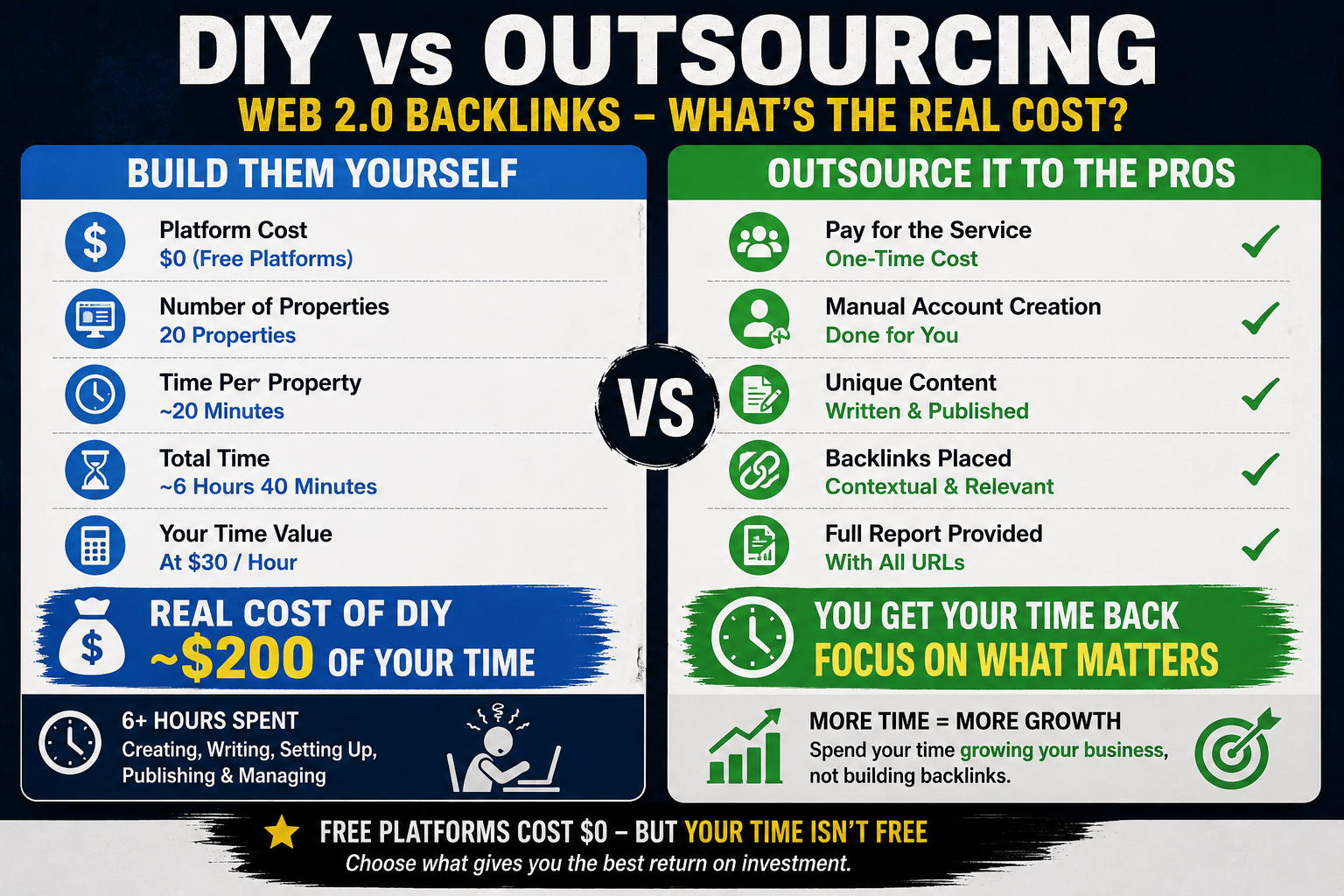
Technically, $0.
In reality, your time has a price.
Let’s say it takes you 20 minutes to set up one decent property including the account, basic branding, article and link.
Twenty properties means around 6 hours and 40 minutes.
And that assumes everything goes smoothly.
It never does.
One website decides your username isn’t acceptable.
Another wants email verification.
Another has changed its editor since the last time you logged in.
One post disappears.
Another account gets flagged.
You spend ten minutes wondering where the publish button has gone.
Welcome to link building.
If your time is worth $30 an hour, 6 hours and 40 minutes is already roughly $200 of your time.
Suddenly paying somebody $50 or $100 to do the work doesn’t look particularly expensive.
This is the calculation business owners often forget.
Free isn’t free if it eats half your day.
When I Would Build the Links Myself
There are situations where I would absolutely DIY it.
If I were testing a brand-new keyword and wanted five links, I might just create them.
If I wanted complete control over a small campaign, doing it myself makes sense.
If I wanted to understand how the strategy works before outsourcing it, I would definitely build a few.
You learn much more by doing this stuff than you do reading about it.
Create a WordPress site.
Create another property.
Publish something.
Link them together.
Watch what happens.
Track the keyword.
That is how I learned most of what I know about links.
Testing.
Not reading somebody’s theory on LinkedIn.
When I Would Pay Someone Else
Volume changes everything.
Building five sites is easy.
Building 50 gets boring.
Building hundreds across multiple campaigns becomes a job.
At that point I’m buying my time back.
This is the same reason businesses outsource content, citations, outreach and technical SEO.
You could do all of it yourself.
You probably don’t have enough hours in the day.
If you decide outsourcing is the better option, I have also written a much broader guide on how to buy backlinks without simply throwing money at whatever seller has the biggest numbers.
What I Check Before Paying for Any Web 2.0 Service
I don’t need a 50-point checklist.
I want answers to a few basic questions.
Which platforms are being used?
If the seller won’t tell me anything, that bothers me.
Are the properties new or aged?
Neither answer is automatically better. I simply want to know what I’m buying.
Is the work manual or automated?
Again, automation isn’t automatically useless. Just describe it accurately.
Do I get unique content?
If these are Tier 1 properties, I prefer it.
Can I choose my URLs and anchors?
I want some control.
Do I receive login details?
This adds value.
What happens if a property gets removed?
Ask before buying, not afterwards.
Do I receive a full report?
I want every completed URL.
Those questions eliminate a lot of rubbish quickly.
Don’t Pay Extra Just Because Somebody Says “High DA”
This deserves its own section.
DA is not a Google metric.
It is useful as one piece of information.
It is not the thing I’m buying.
If I create a brand-new page on a huge platform, that page is still brand new.
I therefore don’t decide that a package is worth $300 instead of $50 because somebody has put “DA 90+” in the title.
I look at the complete setup.
Platform.
Page.
Content.
Link.
Anchor.
Crawlability.
Ownership.
Purpose.
Price.
That’s a much better way to compare services.
Should You Buy Aged Web 2.0 Properties?
Aged properties can justify a higher price.
But I would want evidence that the age actually gives me something.
An old account that has been dead for eight years with no useful pages, no links and no activity isn’t automatically amazing because the registration date is old.
If the property has history, existing pages, backlinks or signs that it gets crawled regularly, then things become more interesting.
This is exactly the same mistake people make with expired domains.
Old and good are not synonyms.
Check what you’re buying.
Do Web 2.0 Links Still Work?
I still use them.
That is the easiest answer I can give you.
I wouldn’t keep building them if I never saw movement.
What has changed is how I use them.
I don’t expect one random Tumblr page to launch a competitive keyword from position 80 to number one.
I use these links as part of a larger strategy.
Sometimes they’re Tier 1.
Sometimes they’re Tier 2.
Sometimes I use them to diversify a backlink profile.
Sometimes I use them because I want properties I control.
Sometimes I use them to help support stronger links.
I’ve documented actual Web 2.0 ranking tests in my main guide rather than simply telling people that they work.
That distinction matters to me.
SEO has enough opinions already.
I prefer results.
Can You Rank Using Web 2.0 Links Alone?
For a low-competition keyword, yes, I have seen these links produce very strong movements.
For competitive commercial SERPs, I wouldn’t limit myself to one backlink type.
I want diversity.
That can mean Web 2.0 properties, guest posts, citations, branded links, profiles, niche links and other relevant sources.
The exact mix depends on the website.
Our iGaming SEO case study is a good example of why I prefer looking at a complete campaign rather than obsessing over one isolated SEO trick.
Harder niches normally require more work.
No surprise there.
Check What You Already Have Before Spending Money
Before buying another 20, 50 or 100 backlinks, look at your current profile.
You might already have enough links.
You might have an anchor text problem.
You might be sending everything to the homepage.
You might have good links that simply haven’t been leveraged properly.
Or you might discover that the page you’re trying to rank has virtually nothing pointing at it.
This is where doing a backlink audit becomes useful.
I would rather spend ten minutes checking what I already have than blindly purchase another package because an SEO tool told me my competitor has more links.
More isn’t always the answer.
Better placement can be.
What I Would Pay in 2026
If I were buying for one of my own sites, this is how I would think about it.
For bulk automated links, I want them cheap.
I’m buying volume.
For manually created new properties, I am happy to pay more because somebody has to do the work.
For proper Tier 1 properties with unique content and account ownership, I expect the price per link to rise again.
For aged properties with genuine history, I’ll consider paying a premium if I can see why they’re worth more.
For a fully managed campaign, I don’t compare it to the price of individual links at all.
I’m paying for the strategy and the labour.
That’s the key.
Stop comparing backlink packages by quantity alone.
The Cheapest Package Can Be the Most Expensive
This sounds backwards until you’ve bought enough links.
You spend $10.
The report arrives with 500 URLs.
Great.
Then you start checking them.
Some don’t load.
Some require a login.
Some pages don’t contain your link.
Some domains have disappeared.
Some links are redirects.
Some are completely irrelevant.
Now you have to spend an hour checking a spreadsheet containing links you didn’t really want in the first place.
Your $10 bargain wasn’t $10.
It cost $10 plus your time.
If you then have to buy another package to get the links you actually wanted, you’ve paid twice.
This is why I prefer knowing exactly what the service is before looking at the headline number.
Don’t Buy Links Based on Quantity
This applies outside Web 2.0 SEO too.
“10,000 backlinks” sounds impressive.
Until you ask why you need 10,000.
I would rather know what ranking problem I’m trying to solve.
If a page is sitting at position 12 for a low-competition keyword, it might not need hundreds of backlinks.
Maybe it needs better internal linking.
Maybe it needs five decent external links.
Maybe the content doesn’t match the search intent.
Maybe the title needs work.
Maybe Google hasn’t properly crawled some of the links you already built.
Buying another 5,000 backlinks isn’t automatically the solution.
Google’s Position on Paid Links
There is something else you should know before spending anything.
Google’s current spam policies include buying or selling links for ranking purposes under link spam when those links are intended to manipulate search results.
You can read Google’s official spam policies yourself.
I’m not going to pretend that policy doesn’t exist.
If you pay for backlinks, understand what you’re doing and make your own decision about the risk.
I have always preferred testing things myself.
That way I know what happens rather than relying entirely on what somebody else tells me should happen.
So, How Much Should You Spend?
There isn’t one correct number.
If somebody tells you every Web 2.0 backlink should cost exactly $3.42, they’re making it up.
Look at what you’re getting.
For a handful of links you may be better off spending nothing and creating them yourself.
For 20 manually built properties, paying somebody can make complete sense.
For bulk Tier 2 work, cheap automation can have its place.
For carefully prepared Tier 1 properties, expect to pay more.
The right price depends on the job.
My Rule Before Buying
I use a very simple rule:
Could I create what they’re selling myself for less than they’re charging when I include the value of my time?
If the answer is yes, I might build it myself.
If the answer is no, outsourcing starts to make sense.
Then I look at quality.
If the quality is rubbish, I don’t care how cheap it is.
If the work is good and the price saves me several hours, I don’t care that somebody else is selling “1,000 backlinks” for $7.
I’m not buying the same product.
Want Us to Build Them?
If you have plenty of time, build Web 2.0 properties yourself.
Seriously.
Use my tutorials and test the strategy.
You will learn a lot doing it.
If you don’t fancy spending hours creating accounts, publishing content and keeping track of everything, you can see our current Web 2.0 backlink service here.
We create the properties manually, publish unique content, place the backlinks and provide a full report.
You also receive the login details for the properties in that package.
That means you can continue using them after I’ve finished the work.
I like that because you’re not just buying a backlink.
You’re getting control of the property.
Frequently Asked Questions
How much do Web 2.0 backlinks cost?
They can cost almost nothing when created through automated bulk services, while manually built properties with unique content can cost several dollars per link or more. The price should reflect the amount of real work involved rather than simply the authority score of the root domain.
Can I get Web 2.0 backlinks for free?
Yes. Many publishing platforms allow you to create an account or website for free. Your main cost is the time required to set up the properties, create content, publish your links and manage the accounts.
Is it worth paying for Web 2.0 backlinks?
It can be if outsourcing saves you a meaningful amount of time. I would compare the quality of the finished properties, content, account ownership and link placement rather than choosing the service offering the largest number of links.
Why are some Web 2.0 backlink packages so cheap?
Extremely cheap packages usually rely heavily on automation, templates or very fast production. That doesn’t necessarily make every link useless, but you should understand what you’re purchasing and decide whether those links belong at Tier 1, Tier 2 or elsewhere in your campaign.
Are expensive Web 2.0 backlinks better?
Not automatically. Higher prices can reflect more manual work, better content, aged accounts or more complete property setup, but price itself isn’t a quality metric. Check the actual deliverables.
How many Web 2.0 backlinks should I buy?
I don’t use a fixed number for every website. Look at the keyword competition, existing backlink profile, target page, current rankings and the other links in your campaign. A low-competition keyword may require very little compared with a competitive commercial search term.
Should Web 2.0 backlinks point directly to my website?
They can. I also use them at different tiers depending on the campaign. Properties pointing directly at a money website normally get more attention from me than bulk links being used to support Tier 1 backlinks.
Should I buy 100 Web 2.0 backlinks or 10 better ones?
If these are important Tier 1 properties, I would normally choose the smaller group that gives me better content, more control and properties I actually want. If I need bulk supporting links at another tier, quantity may become more useful.
Do I need login details?
You don’t absolutely need them, but I value them. Having the login means you can edit the page, change a backlink, publish additional content and continue using the property in future campaigns.
Are Web 2.0 backlinks safe?
No backlink-building method should be described as completely risk-free when it is being used to influence rankings. Google publishes specific policies concerning link spam. Understand those policies, avoid blindly blasting important pages and decide what level of risk you’re comfortable with.
Final Thoughts
I don’t judge a Web 2.0 package by asking how many links are in the report.
I judge what I’m actually getting.
That’s the bit that matters.
A $10 package can be useful.
A $100 package can be rubbish.
A $50 package can save you an entire afternoon.
The number on the checkout page doesn’t tell you any of that.
Look at the platforms.
Look at the content.
Look at the placement.
Find out whether you control the accounts.
Understand where the links fit into your SEO campaign.
Then look at the price.
Do it in that order and it becomes much harder to waste your money.