
I have been building backlinks for a long time, and there is one mistake I see people make over and over again.
They get the backlinks built and then forget about them.
That’s it.
They order 10 links, 50 links or perhaps hundreds of links. The report arrives. They open it, check a few URLs and assume the job is finished.
It isn’t.
Building the links is one part of the job. What happens next is where things get interesting.
Are the pages containing your links being crawled?
Are they staying live?
Are your keyword rankings moving?
Which links were followed by ranking improvements?
Have any good links disappeared?
Are you hammering the same anchor text?
Are you sending everything to one URL?
And, most importantly, are you actually getting a return from the money and time you are putting into link building?
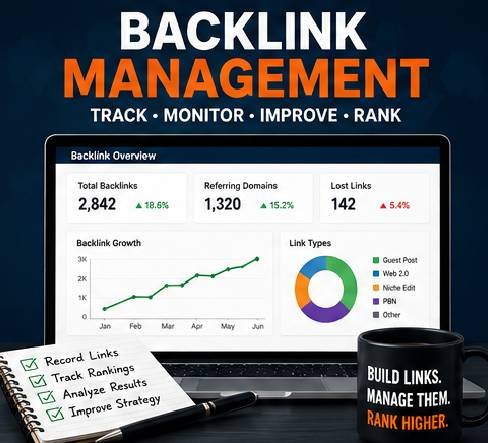
This is what I call backlink management.
I don’t want a spreadsheet full of URLs just so I can say a website has more links. I want to know what those links are doing.
I have tested links on my own sites for years. I have watched keywords sit still, move a few places, jump onto page one and eventually reach the number one position.
The biggest lesson I have learned is very simple:
Do not judge a backlink campaign from the number of links you have built. Judge it from what happens to the rankings afterwards.
Let me show you how I do it.
What Is Backlink Management?
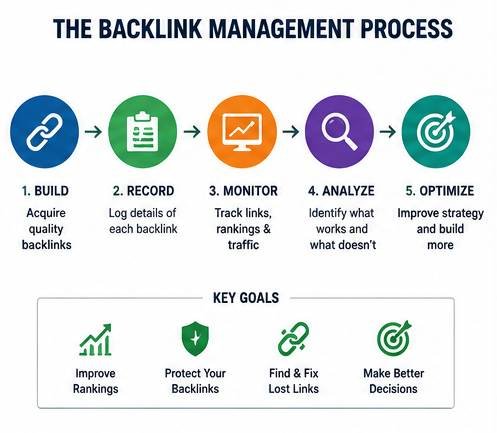
Backlink management is the process of keeping track of the links pointing to your website and making decisions based on what happens after those links are created.
That includes things like:
- Recording new links
- Checking whether links remain live
- Monitoring referring pages
- Watching your target keyword positions
- Tracking which URL each link points to
- Recording anchor text
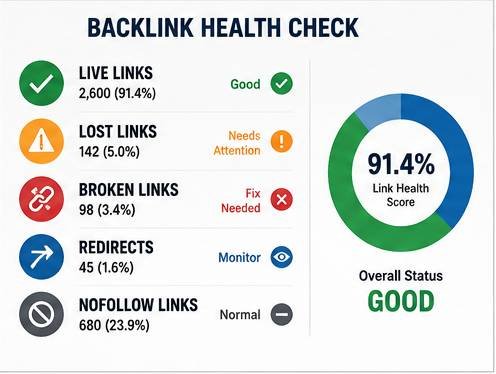
- Finding lost links
- Checking broken target pages
- Watching link velocity
- Comparing results over time
- Deciding where the next links should go
You don’t need to turn this into a complicated science.
In fact, making SEO too complicated can become a problem in itself.
I like to know three basic things.
What did I do?
When did I do it?
What happened afterwards?
If I build links to a page on Monday and the keyword starts climbing over the following weeks, I have something useful to analyse.
If I build another set of links and nothing changes after giving them enough time, I need to investigate why.
That is far more useful than staring at a DR or DA number all day.
Buying the Backlink Is Only the Start
If you regularly buy backlinks, start thinking about every purchase as the beginning of a test rather than the end of a transaction.
You have paid for a link.
Fine.
Now what?
Record the date it went live.
Record the linking URL.
Record the target URL.
Write down the anchor text.
Record your keyword ranking.
Then wait and watch.
This gives you something you can actually work with.
If you buy links from five different sources and throw all the reports into a folder, you will struggle to determine which strategy produced the best return.
You might keep buying the weakest links simply because they look impressive on paper.
That is not something I want to do.
I want more of what works and less of what doesn’t.
Simple.
The Biggest Backlink Management Mistake I See
People are impatient.
I have done it myself.
You build some backlinks and check the rankings the next morning.
Nothing.
Check again the following day.
Nothing.
A week later the keyword has moved two places and you start wondering whether the links are rubbish.
Give them time.
One of the most useful things about testing links on your own websites is that you begin to understand how long things can take.
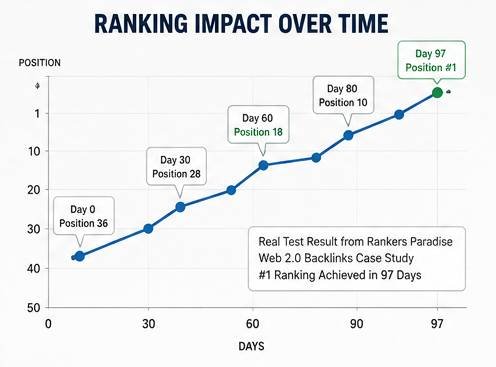
I have a very good example of this sitting on Rankers Paradise.
I published my web 2.0 backlinks test on 28th June 2024 and created five Web 2.0 links on the same date.
I didn’t hide what happened.
I published the ranking updates as the test progressed.
After nearly one month the page was sitting at position 28.
After around two months it reached position 18.
Going into the third month it hit position 10.
Then it reached number 3.
On 3rd October 2024, exactly 97 days into the experiment, the page hit number 1 on Google for the target search.
That is why tracking dates matters.
Imagine looking at those five links after a week and deciding they didn’t work.
You would have completely misread the result.
My Number One Rule: Keep Records
You don’t need expensive software to get started.
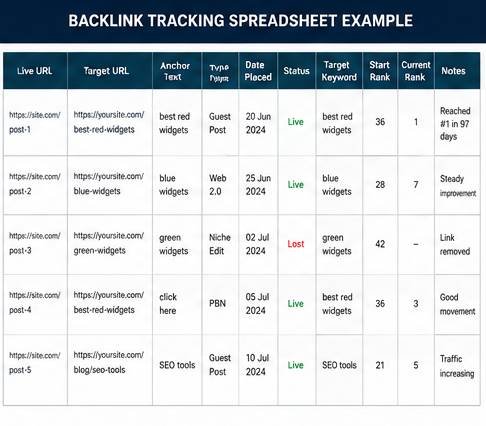
A spreadsheet will do.
For each backlink I recommend recording:
| Data | What To Record |
|---|---|
| Live URL | Exact page containing your backlink |
| Target URL | Page on your site receiving the link |
| Anchor | Text used for the backlink |
| Link type | Guest post, PBN, Web 2.0, directory, etc. |
| Date | When the backlink went live |
| Status | Live, removed, redirected or changed |
| Target keyword | Keyword you are trying to move |
| Starting rank | Ranking before the link campaign |
| Current rank | Latest position |
| Notes | Anything unusual |
That last column is more useful than it looks.
I might note that a page took longer than expected to get crawled. Another link may disappear. A target keyword might suddenly jump ten positions. A particular type of link might repeatedly produce good results.
After months of doing this, patterns start appearing.
That is where your own data becomes more useful than somebody else’s SEO theory.
Don’t Obsess Over DA and DR
I use SEO metrics.
They are useful.
But they aren’t Google.
This distinction matters.
A DR 70 website does not automatically give you a fantastic backlink, and a lower-metric website doesn’t automatically give you a useless one.
Look at the actual website.
Does it have real pages?
Does Google index them?
Does it have relevant content?
Does it receive organic traffic?
Is the linking article related to your subject?
Is the site stuffed with obvious paid posts covering casinos, CBD, roofing, crypto, lawyers and pet food all on the same afternoon?
You can normally spot rubbish fairly quickly when you stop looking at one metric.
Metrics help me investigate.
They don’t make the final decision for me.
Track Rankings From Day One
This is one of the most important parts of managing backlinks.
Take a ranking measurement before you start.
If your keyword is position 36 before the campaign, write down 36.
Otherwise, how are you going to know what happened?
Suppose you build links for three months and finish at position 4.
Great result.
But without the starting position, you have lost part of the story.
The same applies when things don’t work.
If a keyword remains around position 40 after months of work, something needs investigating.
Maybe the links aren’t strong enough.
Maybe the page doesn’t satisfy the search intent.
Perhaps your competitors have much stronger backlink profiles.
The problem could be your internal links.
Your content might simply need improving.
Do not automatically assume every ranking problem requires another 100 backlinks.
Look at the whole page.
Measure the Target Page, Not Just the Domain
This catches people out.
They buy backlinks and then watch their domain authority.
I would rather watch the URL I am trying to rank.
Let’s say I want a page to rank for:
best red widgets
I build links directly to that page.
My first questions are:
Has the ranking for “best red widgets” improved?
Is the page picking up additional long-tail searches?
Has organic traffic to that URL increased?
Has the page moved into the top 20, top 10 or top 3?
Those are useful outcomes.
Watching the domain DR move from 31 to 32 doesn’t tell me nearly as much about that campaign.
Watch the Long-Tail Rankings Too
Something else happened during my Web 2.0 test that I think is important.
I originally targeted one longer search term.
As the page aged and backlinks continued pointing towards it, it started ranking for other related searches too.
Eventually it was ranking number one for a shorter variation.
This is something people miss when they only track a single exact-match keyword.
A successful page can start pulling traffic from dozens or hundreds of variations.
So when managing a campaign, don’t only ask:
“Did my main keyword move?”
Check whether the URL is gaining overall organic visibility.
Sometimes the biggest gain isn’t the keyword you originally had written on your spreadsheet.
New Backlinks Need Time to Be Discovered
Another mistake is assuming a backlink doesn’t exist because your favourite SEO tool hasn’t found it yet.
Third-party crawlers are not Google.
Even Ahrefs explains that discovery of a new backlink can take anywhere from a few days to several weeks depending on crawl priority and other factors.
Google Search Console has another limitation worth knowing about. Its Links report is not intended to be a complete list of every backlink Google knows about.
So don’t panic because a newly created backlink isn’t immediately displayed in every tool you use.
Open the linking page.
Check that the backlink is physically there.
Make sure the target is correct.
Then monitor it over time.
How I Handle Backlinks That Don’t Appear to Be Doing Anything
First, I wait.
That sounds ridiculously simple, but waiting is part of SEO.
If nothing changes after a sensible period, I start checking.
Is the referring page accessible?
Can search engines crawl it?
Is it indexed?
Is my link still there?
Is the target page indexed?
Is the anchor correct?
Is the target keyword simply too competitive for the amount of authority I have built?
Is the content good enough?
Are stronger competitors continuing to build links?
Don’t diagnose a ranking problem from one metric.
Work through it.
Keep the Links Flowing
This is probably the advice I repeat more than anything else.
Keep the links flowing.
I prefer consistency to huge random blasts.
This doesn’t mean every website needs exactly three backlinks every day or precisely 50 links every month.
There isn’t a magic universal number.
What I don’t like is this:
Month 1: 200 backlinks.
Month 2: nothing.
Month 3: nothing.
Month 4: 150 backlinks.
Month 5: nothing.
That is not how I normally approach a serious campaign.
I would rather build consistently, monitor what happens and adjust as the results come in.
Our published Rankers Paradise case studies show why I keep coming back to this approach. One e-commerce campaign recorded organic traffic growth of more than 42% over three months, alongside several target terms moving from pages two and three to the number one position.
The lesson I take from results like these isn’t “buy X links and Google owes you a ranking.”
It doesn’t.
The lesson is that consistent link building combined with measurement gives you something you can improve.
Manage Anchor Text Before It Becomes a Mess
Your backlink spreadsheet should have an anchor column.
Always.
If you don’t record anchors, it becomes surprisingly easy to lose track.
Imagine you have 150 referring domains pointing at a commercial page.
How many use your brand?
How many use the naked URL?
How many contain your target keyword?
How many use partial variations?
You should know.
I don’t believe in treating anchor ratios as some magic mathematical formula where Google rewards you for hitting 7.43%.
That isn’t how I approach it.
I want variation.
If something starts looking forced when I review the profile, I change direction with the next links.
The spreadsheet makes that decision easy.
Know Which Pages Are Getting Too Many Links
Another useful thing happens when you manage your links properly.
You spot neglected pages.
Your homepage might have hundreds of links.
Your main money page might have 80.
Then you discover a useful article sitting in position 12 with three referring domains.
That catches my attention.
I would rather investigate the page sitting just outside page one than blindly send another 50 links to something already dominating its SERP.
Backlink management should help decide where the next backlink goes.
That’s the whole point.
Use a Backlink Audit to Clean Up the Picture
If you already have years of links pointing at the domain, don’t start another campaign completely blind.
Run a backlink audit first.
Find out what you already have.
Look at your strongest referring pages.
Look at lost links.
Check anchors.
Find broken targets.
Identify pages that already attract authority.
Then make your next decision.
This is especially important with older domains because you may inherit years of link-building history.
You don’t want to keep pushing in one direction without knowing what happened before.
Lost Backlinks Are Worth Watching
Links disappear.
That is normal.
A webmaster deletes an article.
A site shuts down.
A URL redirects.
A page gets rebuilt.
The owner edits the article and removes your link.
The referring page becomes noindex.
Things change.
Ahrefs, for example, separates several reasons for lost backlinks, including removed links, missing pages, redirects, crawl errors and pages becoming non-canonical.
Don’t treat every “lost” alert as proof that somebody deleted your backlink, either.
Check the page yourself.
If it was a genuinely valuable placement and the link has actually vanished, see whether it can be recovered.
If it was rubbish, I am not losing sleep over it.
Check for Broken Backlinks
This is an easy win that gets ignored.
You might have perfectly good websites linking to URLs on your domain that now return a 404.
That authority is pointing into a dead end.
Find them.
If there is a suitable replacement page, redirect the old URL properly.
If the old page should still exist, restore it.
This isn’t glamorous SEO.
It is maintenance.
But I would rather recover value I already earned than immediately pay for another backlink.
Use Google Search Console, But Understand Its Limits
I use multiple sources because no backlink database shows you everything.
Google’s own Search Console Links report can show:
- Top externally linked pages
- Top linking websites
- Common linking text
- Internal link information
That makes it useful.
However, Google explicitly states that this report is a sample rather than a comprehensive list of every link to your site.
Remember that when comparing tools.
One platform may show a link another doesn’t.
That doesn’t automatically mean anything is wrong.
Should You Remove Every Bad-Looking Backlink?
No.
Be careful here.
Every established website attracts junk.
Scraper sites appear.
Strange domains link to you.
Automated pages copy things.
If I spent my entire day trying to clean every ugly URL from a backlink report, I would never get any real work done.
Google itself says it generally ignores known spammy links.
That doesn’t mean you should deliberately go out and build garbage.
It means you shouldn’t have a heart attack every time an odd domain appears in Search Console.
There is a big difference.
Paid Links and Google’s Guidelines
There is something else link buyers should understand.
Google’s published guidance says links created as advertisements or paid placements should be qualified using rel="sponsored", with nofollow also remaining acceptable.
Google also maintains spam policies covering attempts to manipulate search rankings.
Know the rules and make your own decisions.
I test SEO strategies and report what happens. I don’t pretend there is zero risk involved in trying to influence organic rankings.
Anyone guaranteeing that every possible backlink strategy is completely risk-free isn’t giving you the full picture.
What About Tiered Link Building?
I like tiered strategies when they have a purpose.
If you have a strong tier-one placement, supporting that referring page can help it get discovered and potentially strengthen the overall structure.
But again, manage it.
Know which tier-two links point to which tier-one assets.
Don’t create thousands of URLs and lose track of the structure.
I want to be able to open my report and understand what I built.
If I can’t understand my own backlink campaign, I can’t improve it.
Backlink Management for Competitive Niches
This becomes even more important in difficult markets.
I have worked with competitive industries where sitting still isn’t really an option.
Our iGaming SEO work is a good example of why you need to think beyond simply acquiring another backlink.
In competitive SERPs, your competitors aren’t waiting for you.
They are publishing content.
They are acquiring links.
They are changing pages.
They are targeting new keywords.
So your backlink profile isn’t competing against a frozen snapshot.
The SERP keeps moving.
That is why I monitor trends rather than obsessing over a single day’s ranking.
How Often Should You Check Your Backlinks?
I don’t think you need to sit watching them every hour.
You’ll drive yourself mad.
For active campaigns I want regular checks, but I care much more about trends over weeks and months.
A sensible routine might look like this:
When a link goes live: record it.
Weekly: check important new links and keyword movement.
Monthly: review the overall campaign, anchors, lost links, target URLs and organic growth.
Every few months: perform a deeper review and decide what needs more links, what has worked and what needs changing.
For very large sites or aggressive campaigns, you may need to check more frequently.
For a small site with ten backlinks, you don’t need enterprise-level monitoring.
Keep it proportional.
My Backlink Management Process
If you want the short version, this is it.
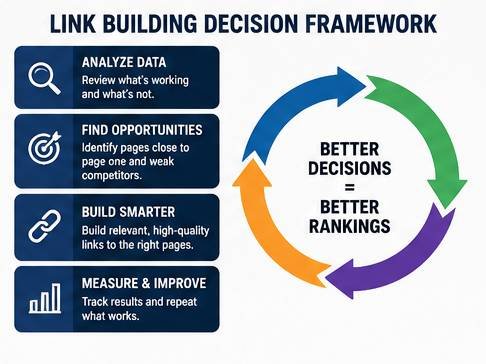
Step 1: Record the starting rankings
Do this before building anything.
Step 2: Record every important backlink
URL, target, anchor, date and type.
Step 3: Check the backlink is live
Don’t blindly trust a report.
Step 4: Give the campaign time
Don’t make decisions after 48 hours.
Step 5: Monitor target keywords
Look for direction rather than daily noise.
Step 6: Watch the whole target URL
Check whether it starts picking up additional searches and traffic.
Step 7: Check lost links
Recover valuable placements where it makes sense.
Step 8: Review anchor text
Keep things varied and stop before a pattern becomes ridiculous.
Step 9: Find pages close to page one
These can provide excellent opportunities for the next round of links.
Step 10: Repeat what works
This is the important one.
Your own results should shape your next campaign.
Stop Buying Links Blind
This is what I want you to take away from this article.
Backlinks are an investment.
Whether you spend £50, £500 or £5,000, you should have some idea what happens afterwards.
Don’t buy links because a seller gives you a massive DA number.
Don’t build another 500 because your rankings didn’t change by Friday.
Don’t abandon a strategy that needs three months after testing it for ten days.
And don’t assume something works forever just because it worked once.
Test.
Record.
Wait.
Measure.
Adjust.
Then do more of what moves the rankings.
That is backlink management in a nutshell.
It isn’t about collecting the biggest backlink report.
It is about making better link-building decisions.
Backlink Management FAQ
What is backlink management?
It is the ongoing process of recording, monitoring and evaluating backlinks pointing to your website. The goal is to understand what you have, what has been lost, where links point and whether your link-building activity is producing useful SEO results.
Why is backlink management important?
Because simply creating backlinks doesn’t tell you whether the campaign worked. Monitoring links alongside rankings and organic traffic helps you make better decisions about what to build next.
What is the best backlink management tool?
There isn’t one tool that shows absolutely everything. I like combining backlink data from SEO tools with Google Search Console, ranking data and my own link reports.
How do I keep track of purchased backlinks?
Use a spreadsheet containing the referring URL, target page, anchor text, date placed, type of backlink and current status. Add ranking information so you can compare link activity with SEO movement.
How often should backlinks be monitored?
For an active campaign, I recommend keeping an eye on important links and rankings weekly and carrying out a broader review monthly. Don’t overreact to daily changes.
What should I do if a backlink disappears?
First check the referring URL manually. If a valuable link really has been removed, contact the website owner or provider where appropriate. If the page moved, investigate the new URL and redirects before assuming the link is permanently gone.
How long should I wait before judging a backlink?
There is no fixed time because crawl rates, competition and website authority vary. From my own testing, I have seen links take weeks or months to produce their full effect. My published Web 2.0 experiment took 97 days to reach the number one position.
Should I track Domain Authority and Domain Rating?
You can use third-party metrics as supporting information, but don’t mistake them for Google rankings. I care more about whether target URLs gain visibility, rankings and organic traffic.
Can backlinks lose value?
Yes. Referring pages and domains change. Links can disappear, pages can become unavailable, URLs can redirect and link attributes can change. This is another reason I don’t treat backlink building as a one-time job.
Can I manage backlinks myself?
Yes. You can start with Google Search Console, a ranking checker and a spreadsheet. More advanced tools make larger campaigns easier to analyse, but you don’t need an expensive setup to begin tracking results.
What is the most important backlink metric?
For me, it is the result. If I am building links to improve a target keyword, I want to see whether that keyword and the target URL gain organic visibility. Metrics are useful clues, but rankings and traffic are ultimately what I am trying to improve.
Final Thoughts
I have tested enough backlinks over the years to know that there is no point building them and then walking away.
Some links surprise you.
Some disappoint you.
Some take much longer than expected.
Others help a page start climbing surprisingly quickly.
You only learn the difference if you track what happens.
My own published tests have repeatedly taught me the same lesson: give good links time, keep the work consistent and watch the results instead of guessing.
If you are already spending money on backlinks, start managing them properly before spending more.
You might discover that the information sitting inside your existing backlink profile tells you exactly what you should do next.