
I am going to show you exactly how Web 2.0 backlinks compare to Cloud Stacking so you know where to invest your time and link-building budget.
If you have been doing off-page SEO for any length of time, you already know that high-authority, contextual tier 1 backlinks are the engine that pushes your keyword rankings to the top of Google.
But when it comes to buffer sites and tiered link building, there is a massive debate in the SEO community:
Should you build custom Web 2.0 blogs, or should you stack HTML properties across Amazon AWS, Google Cloud, and Microsoft Azure?
I have built, tested, and tracked thousands of both properties over the years. In this guide, I will break down the exact performance, indexing speed, safety, footprint risks, and ranking power of both methods. Follow this breakdown step-by-step to see which strategy will deliver #1 organic SERP results for your website.
What Are Web 2.0 Backlinks?
Before we run a direct head-to-head comparison, let’s make sure we are clear on the definitions.
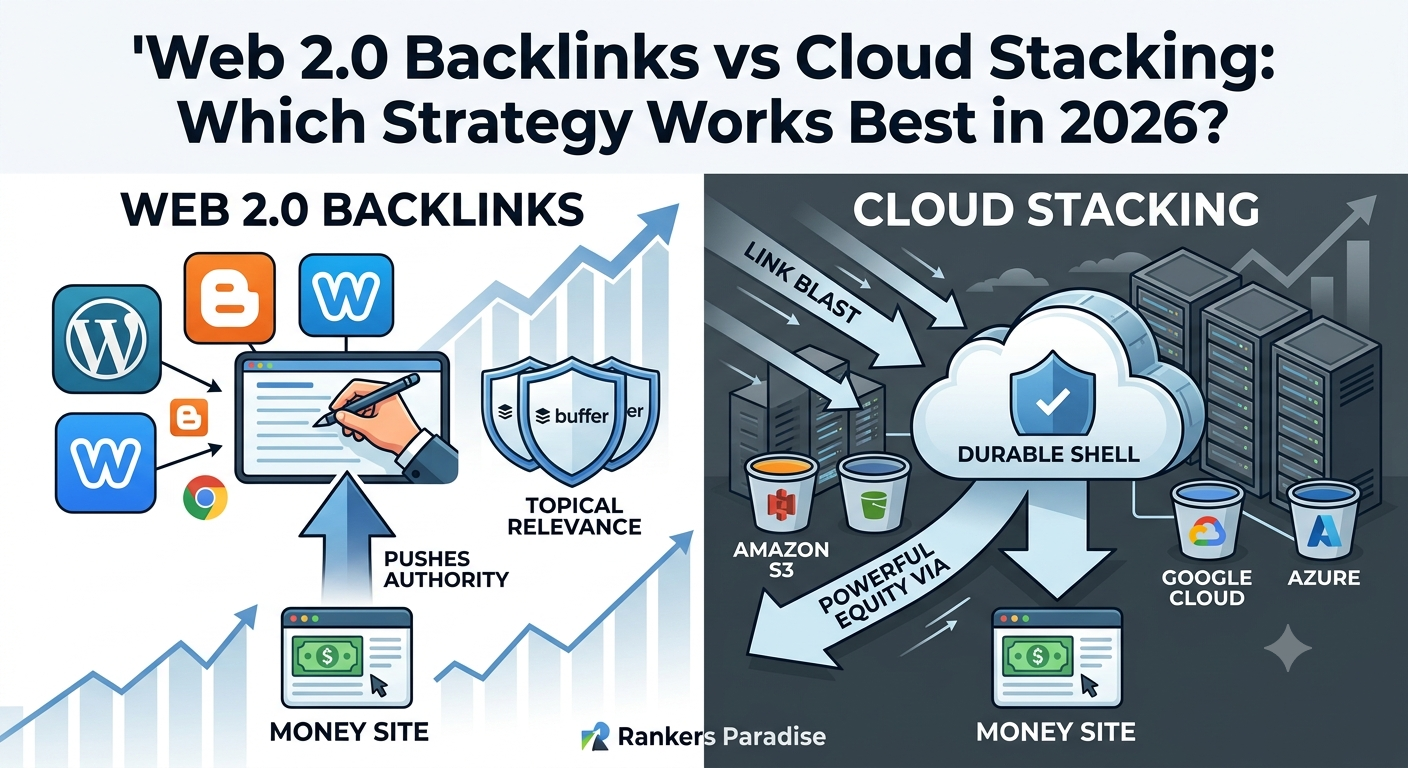
Web 2.0 backlinks are contextual links created on free user-generated platforms like WordPress.com, Blogger, Wix, Tumblr, Weebly, and Strikingly.
When you sign up for a free account on these platforms, you get a free subdomain (e.g., yourbrand.wordpress.com). Because the root domain already holds high Domain Authority (DA) and domain trust from Google bot, publishing structured, niche-relevant articles on these subdomains creates a powerful buffer site that passes equity directly to your money site.
Why SEOs Use Web 2.0 Properties:
-
Full Control: You can edit the content, swap out anchor text, or remove links whenever you want.
-
Safe Buffers: They act as a shield between raw automated Tier 2 blasting and your target money page.
-
Custom Branding: You can add media, custom logos, dynamic widgets, contact forms, and video embeds to mimic a genuine brand presence.
What Is Cloud Stacking?
Cloud Stacking (also called AWS Stacking or Cloud Authority Stacking) involves hosting simple static HTML pages, PDFs, and XML files on major cloud storage providers like Amazon S3, Google Cloud Storage, Microsoft Azure, and Backblaze.
These cloud storage buckets run on the core seed domain of tech giants (e.g., s3.amazonaws.com or storage.googleapis.com). Because Google considers these root infrastructure domains essential to the web, they carry virtually unassailable trust metrics.
Why SEOs Use Cloud Stacking:
-
High Seed Authority: The root domains are practically immune to traditional algorithmic penalty filters.
-
Fast Indexing: Google bot crawls major cloud infrastructure subdomains constantly.
-
Easy Automation: You can deploy dozens of static HTML landing pages in a few minutes using upload scripts.
Web 2.0 Backlinks vs Cloud Stacking: The Direct Head-to-Head Comparison
To help you decide which method fits your current SEO goals, let’s examine how both stack up across five critical ranking factors.
+------------------------+------------------------------------+------------------------------------+
| Ranking Factor         | Web 2.0 Backlinks                  | Cloud Stacking                     |
+------------------------+------------------------------------+------------------------------------+
| Indexing Speed         | Moderate (Requires indexing push)  | Fast (Crawled rapidly by Google)   |
| Footprint Risk         | Medium (If built lazily)           | Very Low (Hosted on enterprise IPs)|
| Tier 2 Pass-Through    | High (Absorbs heavy link blasts)   | High (Extremely durable)           |
| Cost & Setup Time      | 100% Free / Manual setup           | Low cost (Micro-pennies per storage)|
| Brand & Content Appeal | High (Looks like a real blog)      | Low (Basic static HTML pages)      |
+------------------------+------------------------------------+------------------------------------+
Detailed Factor Breakdown
1. Indexing Speed and Bot Crawl Frequency
Getting your backlink crawled and indexed into the Google SERPs is half the battle. If Google bot does not index your link, your target keyword rankings will not budge.
-
Cloud Stacking: Takes the lead here. Because Google bot constantly monitors enterprise cloud storage buckets (
s3.amazonaws.com,storage.googleapis.com), static HTML files uploaded to these buckets often get indexed in days—sometimes hours—without extra indexing software. -
Web 2.0 Properties: Freshly registered Web 2.0 subdomains start with zero internal PageRank. While platforms like WordPress.com and Tumblr get crawled frequently, a brand-new sub-domain page requires good internal linking, social signals, or pinging to ensure Google indexes it.
Winner: Cloud Stacking for raw indexing velocity.
2. Footprint Management and Safety
Google’s automated spam filters constantly look for unnatural link patterns and shared footprints.
-
Web 2.0 Backlinks: If you register 20 Web 2.0 blogs using the same Gmail account, same IP address, same themes, and identical anchor text distribution, Google can detect the network and drop your subdomains. But if you take the time to drop your footprints (using clean proxies, varying templates, and mixing anchor text types), Web 2.0s remain completely safe.
-
Cloud Stacking: Cloud files inherit the IP range and SSL certificates of Amazon, Google, or Microsoft. Google cannot penalize the core domain infrastructure without breaking half the internet. As a result, the base footprint risk of the hosting root itself is virtually non-existent.
Winner: Cloud Stacking for raw footprint resistance.
3. Content Depth and User Experience (UX)
This is where the tide turns back toward Web 2.0s.
-
Web 2.0 Backlinks: Look and behave like real websites. You can format long-form articles, integrate blog categories, embed Google Maps for local SEO, and add custom navigation. If a manual reviewer or human evaluator checks a clean Web 2.0 blog, it looks like a legitimate industry publication.
-
Cloud Stacking: Most cloud stacked pages are bare-bones HTML documents or uploaded PDFs. They rarely look like real websites. While Google bot reads the HTML text cleanly, these pages do not build long-term user trust or generate organic referral traffic.
Winner: Web 2.0 Backlinks for authentic branding and long-term asset value.
4. Passing PageRank and Absorbing Tier 2 Links
If you plan to throw thousands of automated Tier 2 GSA, Forum, or Web 2.0 links at your Tier 1 properties to push link juice down to your money site, you need a strong buffer.
Both strategies excel here:
-
A strong Web 2.0 network acts as a perfect sponge, soaking up Tier 2 contextual links and passing clean topical authority down to your main URL.
-
Cloud bucket HTML pages can absorb massive amounts of link volume without the cloud account getting banned or suspended for spam.
Winner: Tie. Both serve as durable Tier 1 buffers for multi-tier link building campaigns.
How to Safely Build and Structure Your Links
Whether you choose Web 2.0s or Cloud Stacking, follow this simple checklist to ensure your campaign yields top SERP rankings without triggering algorithmic filters:
-
Vary Your Anchor Text: Never blast 100% exact match keywords. Keep exact match anchors around 10-20%, and fill the rest with naked URLs, brand names, and generic phrases (e.g., “click here”, “source”).
-
Publish Unique, Contextual Content: Do not post duplicate 300-word articles. Write in-depth, relevant content that satisfies search intent.
-
Use Proper Multi-Tier Structure: Point your Cloud Stack properties into your Web 2.0 blogs, and point your Web 2.0 blogs directly to your main target page. This creates a powerful multi-tier link wheel that concentrates authority while shielding your main domain.
-
Acquire High-Quality Foundation Links: Buffer networks work best when supported by diverse off-page signals. If you want to accelerate your overall domain trust, you can also buy backlinks from established providers to supplement your manually built properties.
Frequently Asked Questions
Can Cloud Stacking replace Web 2.0 backlinks completely?
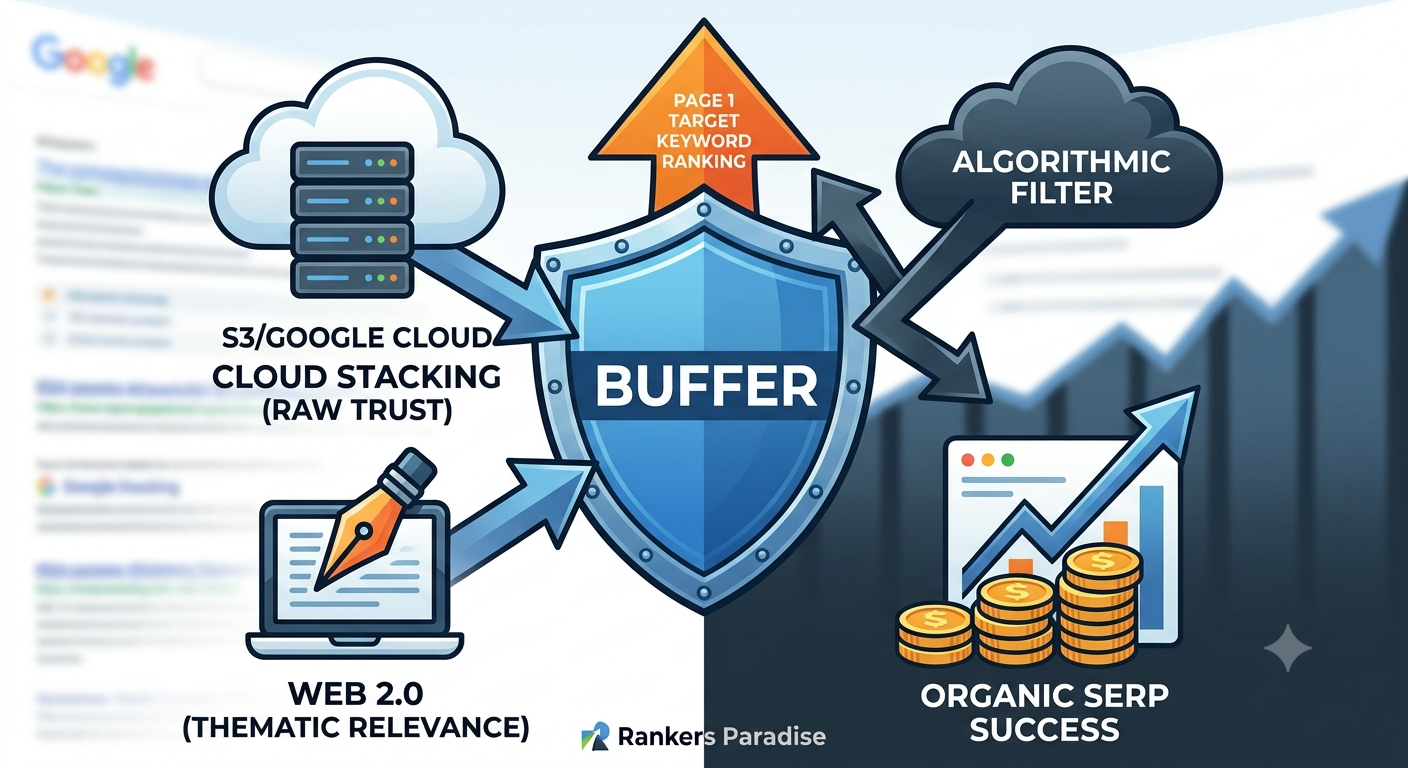
No. Cloud Stacking is an excellent supplementary strategy for rapid indexing and raw trust, but Web 2.0 properties offer superior thematic relevance, flexible layouts, and long-term brand building. Using both in tandem produces the strongest ranking results.
Do I need to buy paid subscriptions for Cloud Stacking?
Most major cloud storage providers (Amazon AWS, Google Cloud, Microsoft Azure) offer free-tier usage caps that are more than enough to host dozens of static HTML pages for SEO purposes without incurring costs.
How many Web 2.0 backlinks do I need to rank on Google?
The exact number depends entirely on your keyword competition. For low-competition long-tail keywords, 5 to 10 well-optimized Web 2.0 properties supported by clean Tier 2 links are often enough to reach page #1.
The Verdict: Which Strategy Should You Use?
You do not have to choose strictly between one or the other. The best ranking results come from combining both strategies into a structured multi-tiered network.
-
Use Cloud Stacking as an indexing accelerant and raw authority buffer.
-
Use Web 2.0 Backlinks as your primary, highly contextual Tier 1 layer to pass clean topical relevance to your money site.
By leveraging Cloud Stacking to power up your Web 2.0 buffer sites, you get the rapid indexing benefits of enterprise cloud domains alongside the safe, contextual link flow of clean Web 2.0 properties.