
I am going to show you exactly how to choose anchor text when buying backlinks so you can rank your website #1 in the Google SERPs without catching an algorithmic penalty or manual action.
If you are about to pull the trigger on a new link package, you already know the most stressful part of the process. You are staring at the vendor order form, and it’s asking you for two things: your target URLs and your target anchor text.
Get this wrong, and you can nuke your organic traffic overnight. Get it right, and your keyword rankings will shoot to the top of the search engine results pages (SERPs).
Before we go any further, you must understand a fundamental truth about modern SEO. Google bot doesn’t just look at the quality of the websites linking to you; it analyzes the exact words used in those links to determine if your backlink profile looks natural or completely manipulated.
You can follow this guide step-by-step to plan the perfect anchor text strategy before you spend a single dollar on link building.
What is Anchor Text and Why Does It Matter When Buying Links?
Anchor text is the visible, clickable text in a hyperlink.
When you decide to buy backlinks, the anchor text you submit tells Google exactly what your page is about. If your page is about “dog training tips” and every single backlink you buy uses the exact phrase “dog training tips,” Google’s spam brain flags your site instantly. Real humans do not link to websites that way.
To remain completely undetected by the Google spam algorithms, your anchor text profile needs to look diverse, disorganized, and completely natural.
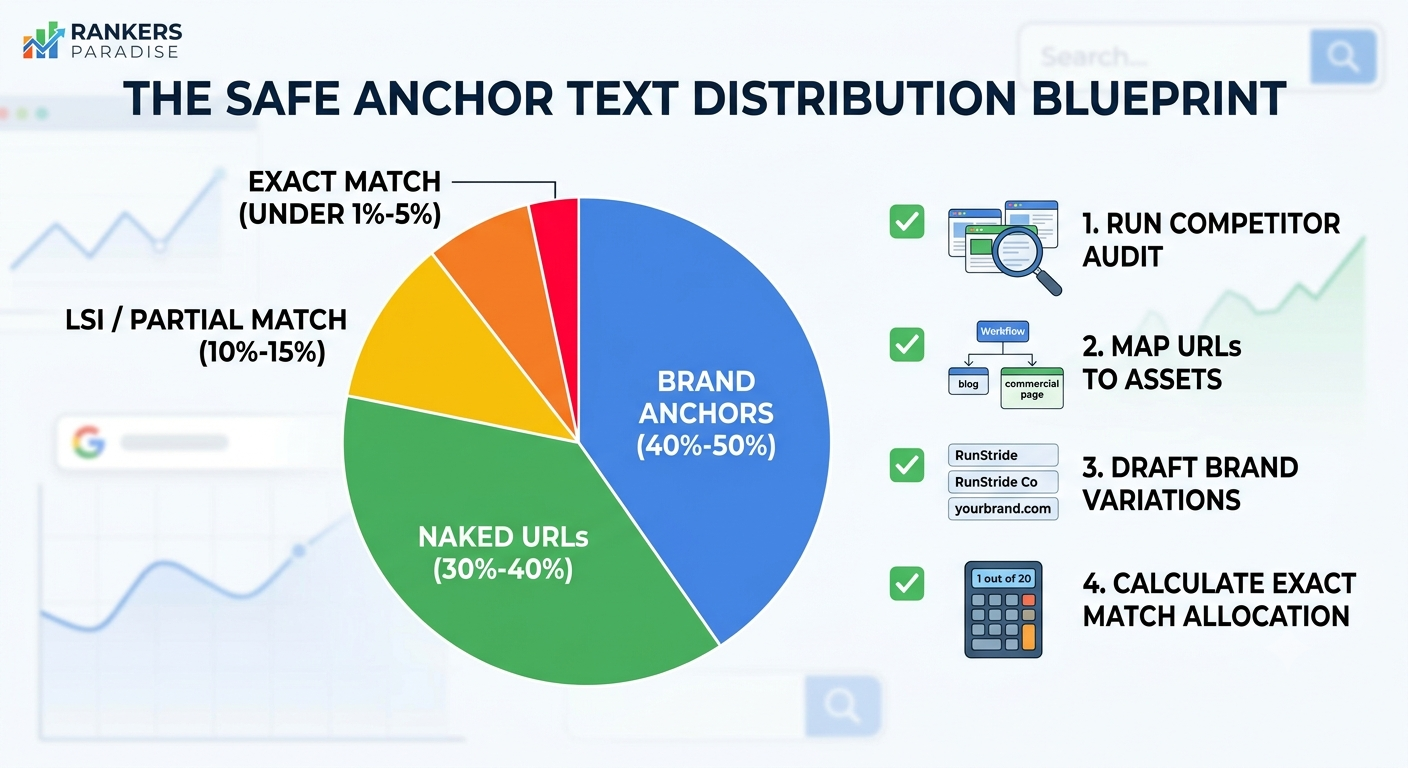
The Safe Anchor Text Ratio Blueprint
When you are buying links, you need to distribute your anchors across five distinct categories. We have tried and tested these ratios over and over again on our own sites and our clients’ sites to ensure maximum ranking power with zero footprint risk.
| Anchor Type | What It Looks Like | Safe Distribution Ratio |
| Brand Anchors | Rankers Paradise |
40% – 50% |
| Naked URLs | [https://rankersparadise.com/](https://rankersparadise.com/) |
30% – 40% |
| Generic / Miscellaneous | click here, website, go here |
10% – 15% |
| LSI / Partial Match | safe link building guide, top SEO tips |
5% – 10% |
| Exact Match | buy backlinks |
Under 1% – 5% |
Nick’s Golden Rule: Less is always more when it comes to exact match anchors. If your on-page optimization is done perfectly, a heavy cushion of Brand and Naked URL links will push your site to page one anyway. You only need a tiny splash of exact match text to lock in that #1 spot.
How to Choose Your Anchors Step-by-Step
Follow this exact workflow before filling out any link building order form.
Critical Mistakes to Avoid on Vendor Forms
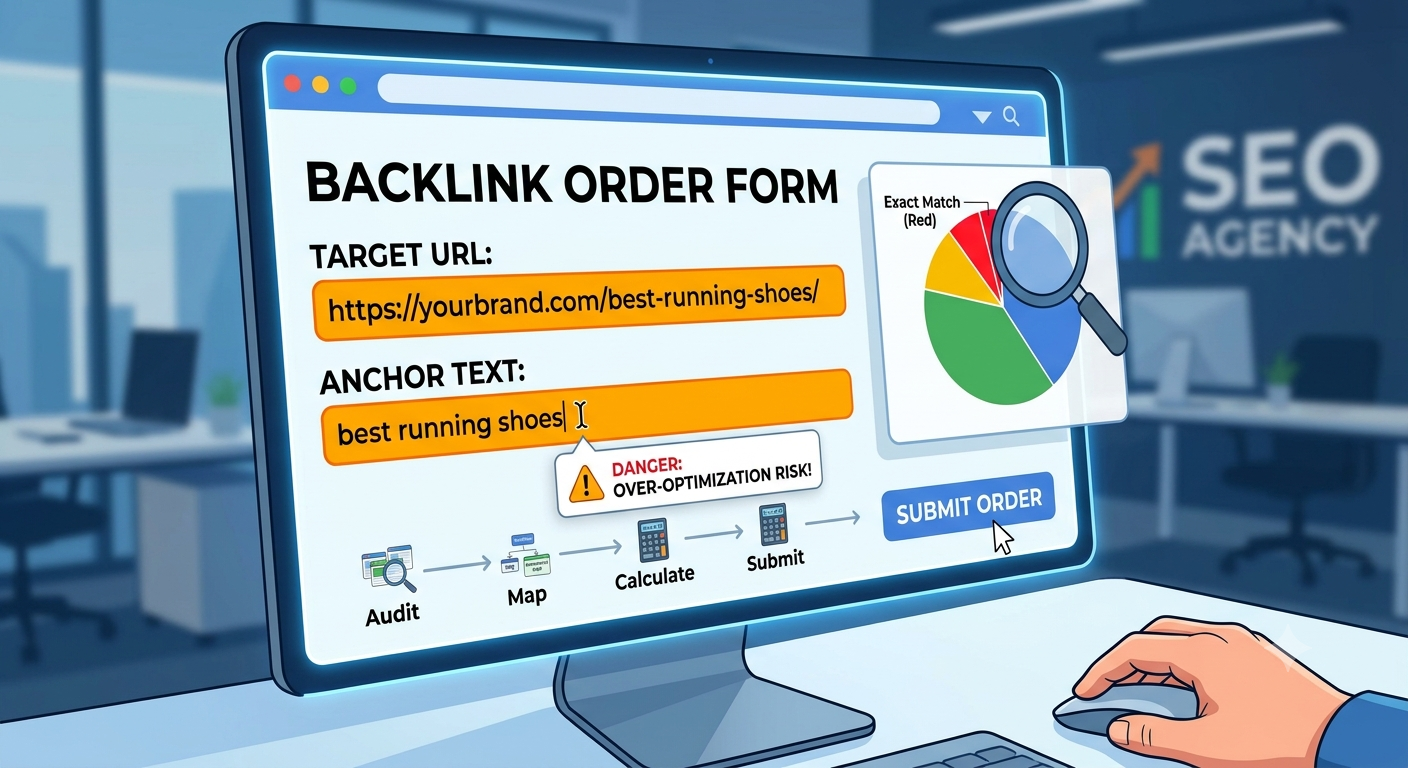
Many people fail to get good keyword ranking results because they make these lazy mistakes when buying links:
-
Using the Same Anchor Across a Whole Package: If you buy a monthly SEO package and paste a single keyword into the form, the agency might run that exact word across every placement. Always ask for a custom anchor distribution or supply the variations yourself.
-
Ignoring the On-Page Optimization: If your target keyword has an overall density of over 1% or 2% on your actual website, adding exact match backlinks will push you straight into an over-optimization penalty filter. Check your on-page setups using tools like Yoast SEO before you start your off-page link building.
-
Forcing Anchors Into Content Unnaturally: When guest post writers have to force a keyword like “best cheap buy backlinks online” into a sentence, it reads poorly to both human visitors and the Google search spider. Use natural language variations that fit smoothly within a paragraph.
If you keep your anchors clean, varied, and heavily branded, you give Google bot exactly what it wants to see: a highly trusted, organic-looking brand that deserves to sit at the absolute top of the organic SERPs.
Here is the exact 10-link anchor text distribution template based on the Rankers Paradise blueprint. You can copy and paste this structure directly into your spreadsheet or hand it over to your link-building provider to keep your link profile completely safe and natural.
For this example, let’s use a standard e-commerce configuration:
-
Target URL:
[https://yourbrand.com/best-running-shoes/](https://yourbrand.com/best-running-shoes/) -
Target Keyword:
best running shoes -
Brand Name:
RunStride
The 10-Link Anchor Distribution Template
| Link # | Anchor Category | Exact Anchor Text String | Notes & Execution Goal |
| 1 | Brand | RunStride |
Pure brand name. Establishes core entity authority. |
| 2 | Naked URL | [https://yourbrand.com/best-running-shoes/](https://yourbrand.com/best-running-shoes/) |
Full raw URL. The safest link type you can build. |
| 3 | Brand + Keyword | RunStride running shoes |
Blends your brand name with a partial keyword string. |
| 4 | Naked URL (Clean) | [yourbrand.com/best-running-shoes/](https://yourbrand.com/best-running-shoes/) |
Raw URL without the secure protocol (https://). |
| 5 | Generic | click here |
Standard editorial placeholder text. Looks totally random to Google bot. |
| 6 | LSI / Variation | top rated sneakers for running |
Uses synonyms so you don’t over-optimize the exact term. |
| 7 | Brand | RunStride Co |
Corporate entity variation of your primary brand name. |
| 8 | Page Title | Best Running Shoes Guide |
Natural anchor text when someone references your article title. |
| 9 | Generic / Action | website |
Another conversational generic anchor to cushion the profile. |
| 10 | Exact Match | best running shoes |
Your one exact match link. Only deploy this after the other 9 are built. |
Checklist Before You Submit This to a Vendor
'.](https://rankersparadise.com/wp-content/uploads/2026/07/10-link-safe-anchor-text-distribution-template.png)
-
The 10% Exact Match Guard: Out of 10 total links, exactly one uses your exact target keyword. Never increase this ratio in a single batch, especially for fresh domains or deep commercial pages.
-
Case Sensitivity Matters: Notice how Link #1 and Link #7 mix up casing and suffixes. Google’s algorithm tracks natural text variance; humans don’t always type brand names perfectly.
-
On-Page Prerequisite: Ensure your target page has an on-page keyword density of under 1% for the phrase “best running shoes” before these links index. If your on-page is over-optimized, even a single exact match link can trigger a ranking filter.