
Search rankings can feel mysterious from the outside. One page climbs quickly, another struggles for months, and a competitor with thinner content somehow keeps holding the top spot. But rankings are not random. Behind every search result is a layered system built to sort, test, compare, and reward pages based on hundreds of signals.
To rank well, it is not enough to publish content and hope. You need to understand the systems that decide which pages deserve visibility, which pages should be trusted, and which pages are likely to satisfy a searcher.
Search Engines Are Sorting Systems First
At the most basic level, a search engine is a giant sorting machine. It discovers pages, stores information about them, and then decides which pages are the best match when someone types a query.
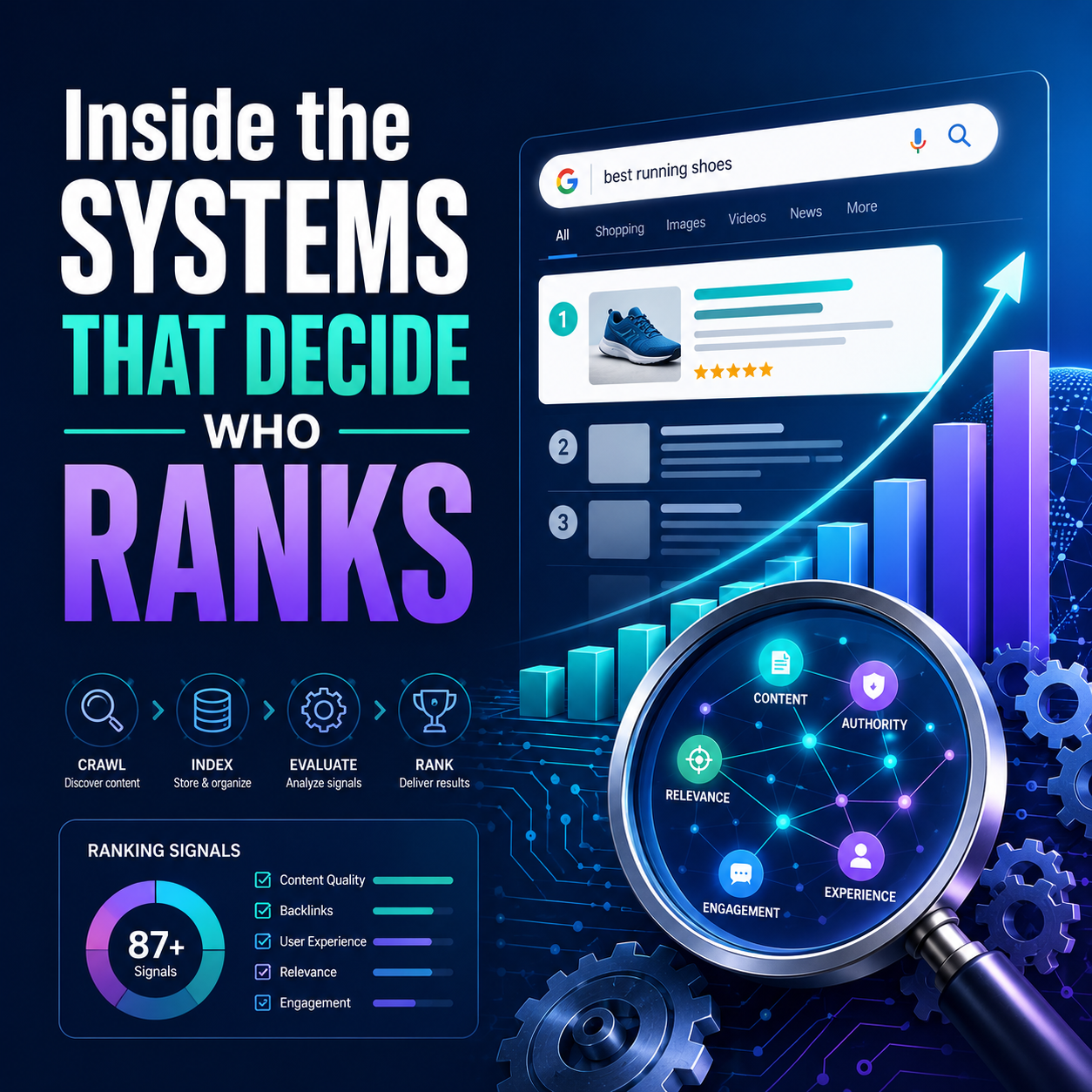
This process usually happens in three major stages:
- Crawling – search engines discover pages through links, sitemaps, and previous crawl paths.
- Indexing – the page is processed, understood, and stored in the search engine’s database.
- Ranking – the search engine compares relevant pages and orders them based on quality, relevance, trust, and usefulness.
Many websites fail before the ranking stage even begins. If a page is blocked, poorly structured, thin, duplicated, or difficult to crawl, it may never receive a fair chance to compete.
Relevance Still Comes First
Before authority, backlinks, or engagement matter, a page must be relevant to the query.
Search systems try to understand the intent behind a search. For example, someone searching “best link building strategy” may want guidance, while someone searching “buy backlinks” may be closer to making a decision. These are different intents, even though the topics overlap.
A strong ranking page usually matches intent clearly. It answers the main question, covers related subtopics, and uses language that fits what the searcher expects to find.
This is why keyword stuffing no longer works. Search engines are not just matching exact phrases. They are looking at meaning, context, entities, structure, and topic depth.
Authority Helps Search Engines Choose Between Similar Pages
In competitive niches, many pages cover the same subject. When relevance is similar, authority often becomes the deciding factor.
Authority is built through signals such as:
- High-quality backlinks from trusted websites
- Brand mentions across the web
- Strong internal linking
- Consistent topical coverage
- Positive user interaction over time
Backlinks remain one of the strongest external trust signals because they act like references from other websites. However, quality matters far more than volume. A small number of relevant, trusted links can outperform hundreds of weak or spammy ones.
For site owners who are building authority, it is important to understand how to safely buy backlinks without damaging long-term SEO performance.
Internal Links Tell Search Engines What Matters
Internal links are one of the most controllable ranking signals on your own website. They help search engines understand which pages are important, how topics connect, and where authority should flow.
A website with no internal linking strategy often leaves strong pages isolated. Even if the content is good, search engines may not fully understand its relationship to the rest of the site.
A good internal linking system points supporting articles toward pillar pages. This creates a clear topical structure. The pillar page becomes the main authority hub, while supporting content strengthens it by covering related angles.
This is why articles like this one are useful. They help build context around a main topic while sending relevance and authority toward the page that matters most.
Content Quality Is Measured in Layers
Search engines do not judge quality from one signal alone. They evaluate content through multiple layers.
A strong page usually has:
- Clear search intent alignment
- Helpful information that goes beyond surface-level answers
- Original wording and structure
- Strong headings and logical flow
- Updated and accurate information
- A satisfying answer to the user’s query
- Supporting media, examples, or explanations where useful
Thin content struggles because it does not give search engines enough reason to rank it above stronger competitors. Rewritten content also struggles when it offers nothing new.
Unique content does not mean saying something nobody has ever said before. It means presenting the topic in a useful, clear, and original way that serves the reader better than competing pages.
User Signals Can Reinforce Rankings
Search engines want to rank pages that satisfy users. While exact ranking systems are complex, user behavior can help reinforce whether a result is useful.
If people click a result, stay on the page, explore more content, and do not immediately return to search for another answer, that can support the idea that the page is doing its job.
This is why readability matters. A page may contain good information, but if it is hard to read, slow to load, cluttered with ads, or poorly formatted, users may leave quickly.
Good SEO is not only about pleasing algorithms. It is about creating pages that real people can use easily.
Technical SEO Creates the Foundation
Even great content can underperform if the technical foundation is weak.
Search engines need to access, crawl, render, and understand your site. Technical issues can limit visibility before content quality is even considered.
Common technical problems include:
- Slow loading pages
- Broken internal links
- Poor mobile usability
- Duplicate content
- Incorrect canonical tags
- Missing schema markup
- Indexing errors
- Weak site architecture
Technical SEO is not always visible to users, but it strongly affects how search engines process a website. A clean technical setup gives every page a better chance to rank.
Topical Authority Builds Long-Term Trust
One article can rank, but a full topic cluster can dominate.
Topical authority is built when a website covers a subject deeply and consistently. Instead of publishing random articles across unrelated topics, strong sites create connected content around a clear niche.
For example, a website focused on SEO might create pillar content around backlinks, keyword research, technical SEO, local SEO, and content strategy. Supporting articles then link back to those main pages.
This helps search engines see the site as a reliable source within that subject area. Over time, this can make it easier for new pages to rank because the domain already has topical strength.
Rankings Are Decided by Comparison
A page does not rank in isolation. It ranks by being compared against other pages competing for the same query.
That means your page does not need to be perfect. It needs to be better suited to the search result than the alternatives.
Search engines compare:
- Which page best matches intent
- Which page has stronger authority
- Which page provides the clearest answer
- Which page is technically sound
- Which page has better trust signals
- Which page fits the searcher’s needs fastest
This is why SEO is competitive. You are not only optimizing against an algorithm. You are optimizing against every other page trying to win the same position.
The Ranking System Rewards Consistency
Many websites fail because they treat SEO as a one-time task. They publish a page, build a few links, and then stop.
But rankings are dynamic. Competitors update their content. Search engines refine their systems. User expectations change. New pages enter the index every day.
Websites that win consistently usually keep improving. They refresh old content, strengthen internal links, fix technical issues, earn better backlinks, and expand topical coverage.
SEO momentum is built through repeated improvements, not one-off actions.
Final Thoughts
The systems that decide who ranks are complex, but the core idea is simple: search engines want to show the most relevant, trustworthy, useful result for each query.
To earn stronger rankings, a website needs more than keywords. It needs a crawlable structure, helpful content, smart internal links, quality backlinks, technical stability, and clear topical authority.
Ranking is not decided by one signal. It is decided by how all the signals work together. When your content, links, structure, and authority align, your pages become easier for search engines to trust and easier for users to choose.
Keep reading…
The ‘White Hat’ Lie: Why Everyone is Actually Buying Links